You trained hard. You worked in demanding clinical environments. You have managed cardiac arrests, run resuscitation teams, and made life-or-death decisions under pressure. Now you are building your career in the United States, and you have discovered something that surprises many internationally educated healthcare professionals: the skills and certifications you earned abroad may not automatically transfer.
Advanced Cardiovascular Life Support certification — ACLS — is one of the most universally required credentials in US hospitals and clinical settings. Whether you are an internationally educated nurse navigating the licensure process, a foreign medical graduate preparing for residency, or a physician or paramedic transitioning into US practice, ACLS certification is almost certainly on your checklist. This guide walks you through exactly what ACLS means in the US context, why it matters for your career mobility, and how to get certified quickly and affordably — even while managing the many other demands of relocating and relicensing.
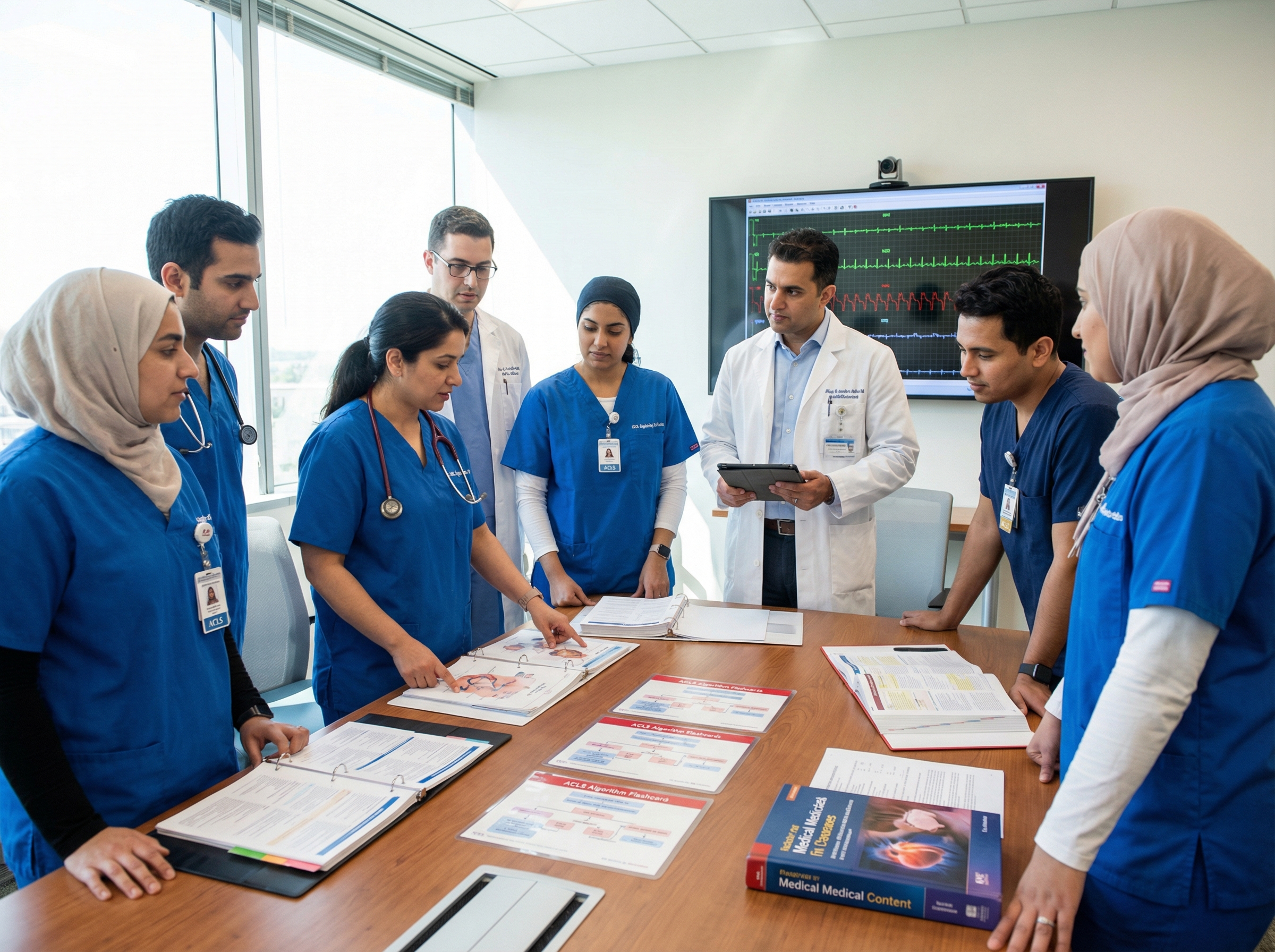
The US healthcare system operates on a credential-verification culture that is more formalized than in many other countries. Employers do not simply trust that you know advanced cardiac life support protocols — they require documented proof from a recognized provider, and they verify that your certification is current before your first shift.
According to data from the 2026 Main Residency Match, international medical graduates accounted for approximately 23.6% of all matched applicants, with nearly 9,700 IMG physicians matching to first-year residency positions. That represents tens of thousands of internationally trained clinicians entering or advancing within the US system each year — and virtually every one of them will need ACLS certification before they can practice in an acute care environment.
For internationally educated nurses, the numbers tell a similarly compelling story. With projections indicating a shortage of up to 3.2 million healthcare workers in the US by 2026, hospitals are actively recruiting internationally trained nurses and physicians. But that recruitment comes with a clear message: your credentials must meet US standards, and ACLS is near the top of that list.
Beyond compliance, ACLS certification demonstrates something deeper to US employers: that you are fluent in the specific algorithms, pharmacology, and team-based protocols that American emergency teams rely on. The signals that employers read from your ACLS certification go well beyond a checkbox — they communicate clinical readiness, professional investment, and familiarity with US standards of care.
If you trained as a physician, nurse, or paramedic outside the United States, you likely encountered cardiac resuscitation protocols during your education. The content of ACLS will feel clinically familiar — but the specific framework, the algorithmic structure, and the team dynamics emphasis are distinctly American in their presentation.
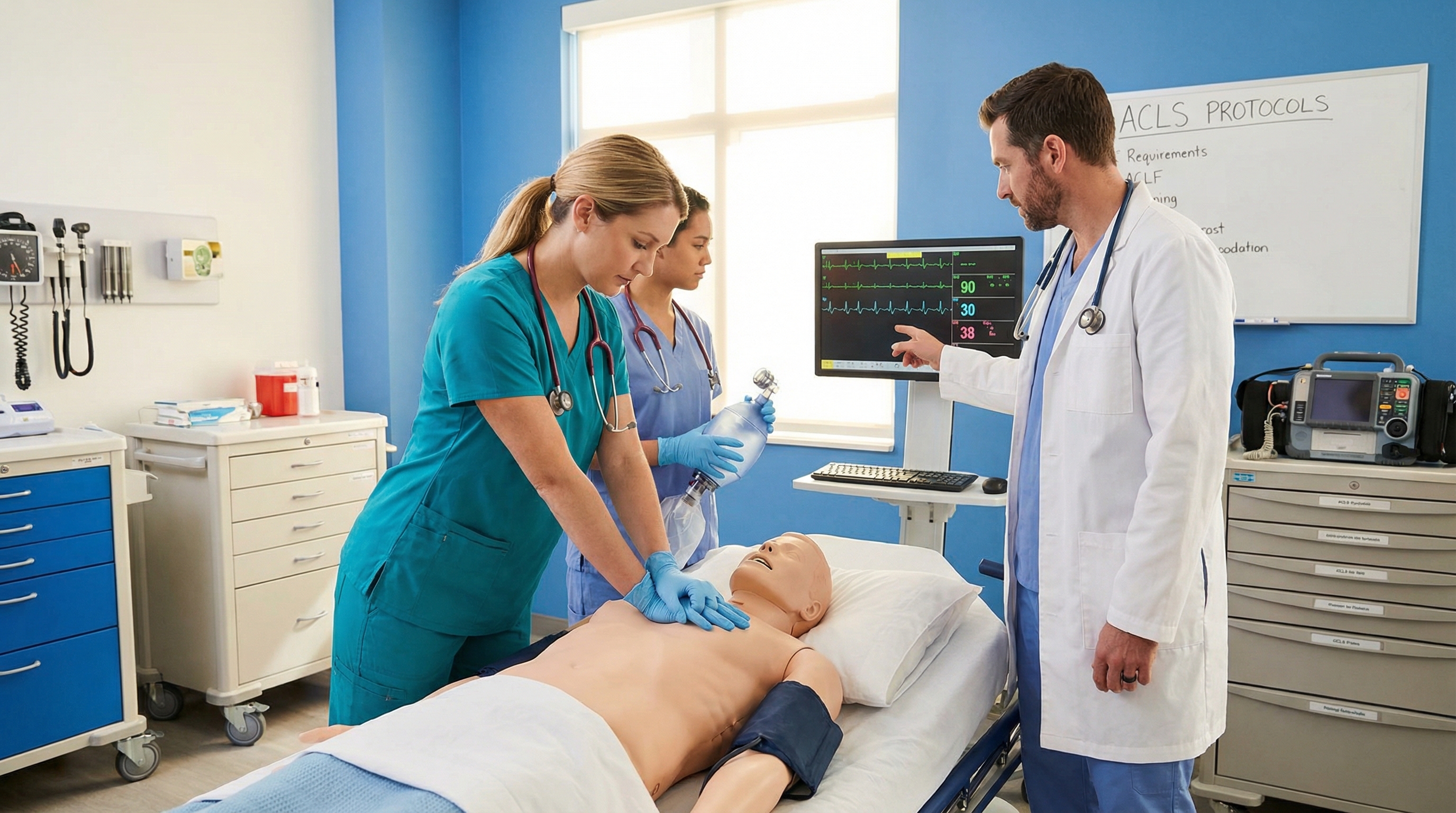
US ACLS certification, aligned with American Heart Association and ILCOR guidelines, covers the following core domains:
The US model places particular emphasis on high-performance team dynamics — clear roles, closed-loop communication, and real-time feedback. If you trained in a system where resuscitation leadership was more hierarchical or less structured around explicit role assignment, this aspect of ACLS may be the most culturally distinct element to absorb. It is also one of the elements US employers value most.
To understand how ACLS relates to other certifications you may also need, the guide on which certification you actually need — ACLS, PALS, or BLS is worth reading before you enroll, especially if you plan to work in settings that see both adult and pediatric patients.
ACLS certification requirements vary by role and clinical setting, but the list of professionals who are expected to hold it is broad. If you are transitioning from international practice into any of the following roles in a US clinical environment, plan on ACLS being required before — or immediately upon — starting:
BLS certification is a prerequisite for ACLS — it covers foundational CPR, AED use, and basic airway management. If you have not yet secured BLS, you will need that first. Many internationally trained professionals complete both in close succession. The good news: both can be done online, and understanding how BLS, ACLS, and PALS fit into a broader certification pathway can help you plan your sequence strategically.
When you are navigating visa applications, credential evaluations, licensure boards, English language testing, and relocation logistics simultaneously, the last thing you need is a certification process that requires you to show up at a specific location on a specific date and sit through a class that covers material you largely already know.
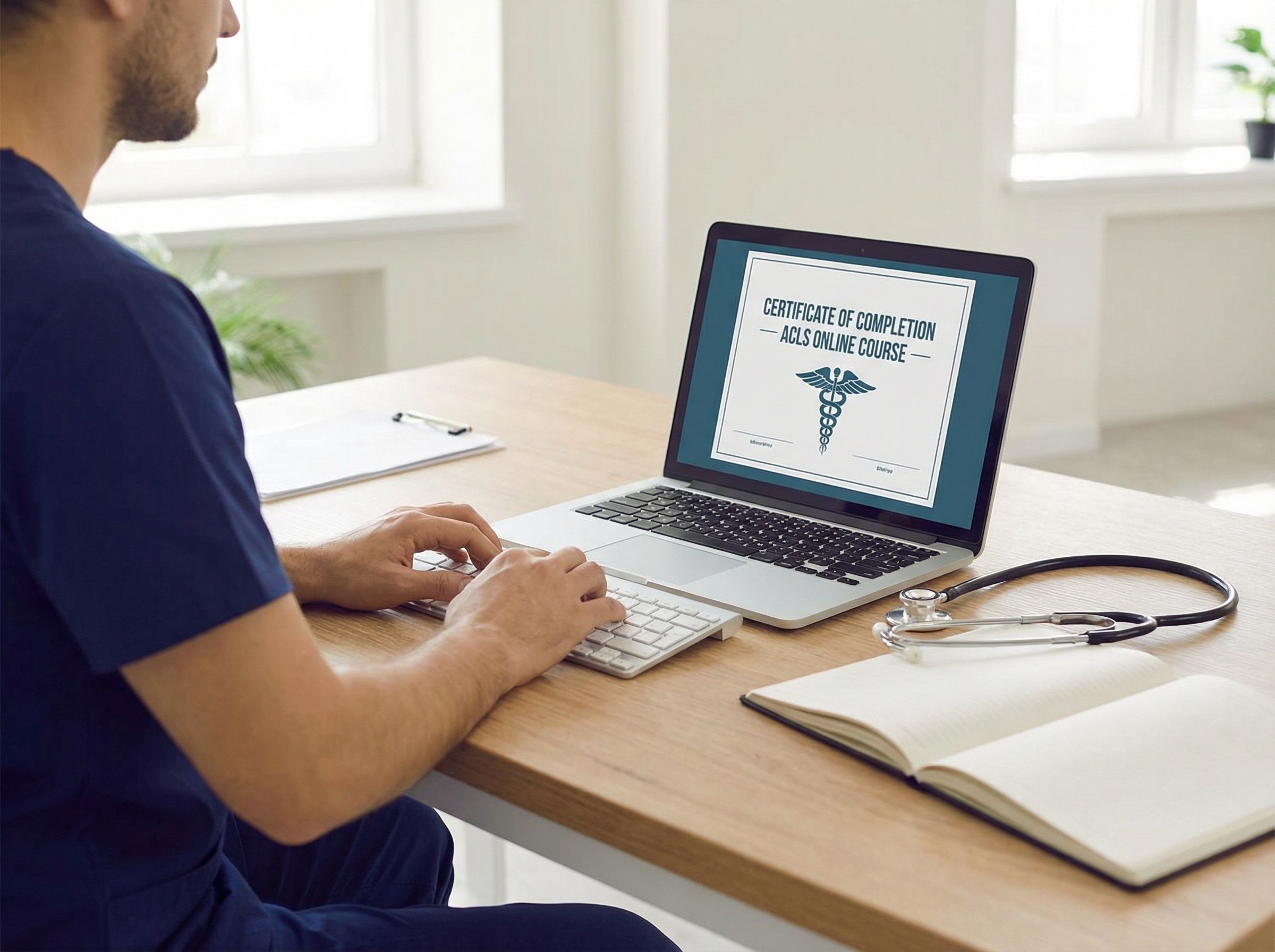
Online ACLS certification solves this problem directly. At Affordable ACLS, the entire course is self-paced and 100% online — developed by board-certified emergency medicine physicians with over 20 years of clinical experience. You can start the course from your home country before you arrive in the US, complete it in one to two hours, and have your digital certification card in hand immediately upon passing.
This matters enormously for internationally trained clinicians because it eliminates the scheduling friction that can delay your employment start date. Many US employers will not onboard clinical staff until all required credentials are in hand. Having your ACLS certification complete before you arrive — or within days of arrival — removes a common bottleneck from your onboarding timeline.
The comparison between online and in-person ACLS certification is worth reviewing in full, but for internationally educated professionals specifically, the advantages of online delivery are particularly pronounced: no travel to a training center, no waiting for a scheduled cohort, no time zone constraints, and immediate certification upon completion.
Many international healthcare professionals assume ACLS certification in the US will be expensive, time-consuming, or logistically complicated. In reality, the online pathway through Affordable ACLS is straightforward, fast, and priced to be accessible.
Here is what the process looks like from enrollment to certification:
The ACLS course is priced at $109 for initial certification and $99 for recertification. If you also need BLS and PALS — common for nurses entering critical care or pediatric settings — bundle pricing brings the combined cost down significantly. The ACLS plus BLS plus PALS bundle is available for $237, representing meaningful savings over purchasing each course separately.
For internationally trained professionals who are managing the financial pressures of relocation, the price point matters. ACLS certification should not require a significant financial outlay, and at Affordable ACLS, it does not.
This is one of the most common questions from internationally educated healthcare professionals, and it deserves a direct answer: yes. Online ACLS certification from an AHA- and ILCOR-compliant provider is accepted by hospitals, health systems, and clinical employers across the United States.
What employers verify is not the delivery format of your certification — online versus in-person — but rather whether the curriculum and standards behind it align with recognized guidelines. Affordable ACLS is fully compliant with American Heart Association and ILCOR standards, which is the benchmark US employers use when verifying credentials.
It is worth understanding that the US is already well into a period where online certification has become mainstream, not exceptional. Getting ACLS certified through an online, self-paced course is now the standard approach for busy clinicians across the country — including physicians in residency, travel nurses, and working ER staff. As an internationally trained professional, you are following a path that thousands of US-trained clinicians also use.
If you have any uncertainty about your specific employer's requirements, the safest approach is to confirm with HR before enrolling. In the vast majority of cases, online certification from a compliant provider is accepted without question. And if you need employer reimbursement for your certification costs, reviewing the guide on getting ACLS, BLS, and PALS costs covered by your employer may help you recover the investment entirely.
Internationally trained clinicians face a specific set of credential-stacking challenges that US-trained graduates do not encounter to the same degree. Understanding where ACLS fits within the broader landscape of your US credentialing journey helps you prioritize and sequence your efforts effectively.
Most US residency programs require ACLS certification either before the start of intern year or within the first few weeks of orientation. Given that you are simultaneously managing ECFMG certification, visa logistics, state licensure, and relocation, completing ACLS online before your orientation date eliminates one more variable from an already demanding checklist.
Many IMG physicians who trained in systems that use different resuscitation protocols — or more informal team-based approaches — find that ACLS serves a second purpose beyond credentialing: it familiarizes you with the specific algorithmic language your US colleagues will use during a code. When your team leader calls for a two-minute cycle or announces a rhythm check, you want to be operating within the same framework immediately. ACLS certification ensures that fluency.
According to research published in academic medicine literature, one of the most significant challenges IMGs face in US graduate medical education is adapting to the team-based communication norms of American clinical environments. ACLS training directly addresses this gap by teaching the structured, role-defined communication model that US resuscitation teams rely on.
Internationally educated nurses typically complete NCLEX licensure, VisaScreen requirements, and often English proficiency testing before they can practice in the US. ACLS is typically added to this stack as employers extend conditional or confirmed offers. For nurses targeting ICU, ER, cardiac care, or step-down positions, ACLS is rarely optional — it is a condition of employment.
The self-paced online format is particularly practical for internationally educated nurses because you may be completing your certification from outside the US, managing shift work in your home country while preparing for relocation. Online certification removes the geographic constraint entirely. You can complete ACLS from any country, receive your digital certification card, and present it to your US employer as part of your credentialing packet.
Travel nurses and those working with locum tenens agencies face additional complexity around multi-state certification requirements. The guide to managing multiple state certification requirements for travel nurses and locum tenens providers addresses this directly and is worth bookmarking as you plan your first US assignments.
The CGFNS Alliance has reported a doubling of applications from foreign-trained health workers seeking US eligibility in recent years — a clear signal that the demand for internationally educated nurses and allied health professionals in US healthcare is not a temporary trend but a structural shift.
One question internationally trained clinicians often ask is how different US ACLS standards are from the resuscitation guidelines they trained under. The honest answer is: the clinical science is largely the same, but the presentation, emphasis, and algorithmic structure differ enough to matter.
The International Liaison Committee on Resuscitation (ILCOR) provides the scientific foundation for resuscitation guidelines globally. Both the American Heart Association and the European Resuscitation Council draw from ILCOR's systematic evidence reviews. This means the underlying science — compression depth, rate, defibrillation energy levels, medication choices — is broadly consistent across major international systems.
Where differences emerge is in the specific algorithms, the team role terminology, and the documentation and communication practices expected during a resuscitation event. US hospitals use the AHA framework as the operational standard, which means team members, charge nurses, and supervising physicians all expect you to reference the same algorithm flowcharts, use the same medication terminology, and apply the same structured debrief model. ACLS certification through an AHA-aligned provider aligns you with that shared framework. The American Heart Association's international ACLS course page provides additional context on how the global and US versions of the course relate to each other.
Staying current with the most recent changes in ACLS guidelines is also worthwhile, particularly if your international training predates recent updates. Resuscitation science evolves, and US employers expect your certification to reflect current evidence-based practice.
Let us be specific about what getting ACLS certified through Affordable ACLS looks like in practical terms for an internationally trained clinician:
For internationally trained professionals who are accustomed to certification processes that involve significant cost, scheduling delays, and lengthy waiting periods for documentation, this timeline is likely to be a positive surprise. You can enroll today, complete the course today, and have your certification card today.
The Health Workforce Projections from HRSA confirm that demand for healthcare professionals across nearly every specialty is projected to intensify through the end of this decade. For internationally trained clinicians, this means the window of opportunity for US career entry is open and widening — but only for those who have their credentials in order. ACLS certification is one of the fastest, most affordable credential gaps you can close.
ACLS is typically the centerpiece credential, but most internationally educated healthcare professionals working in acute care environments will eventually need a portfolio of certifications. Understanding how these fit together helps you plan efficiently rather than acquiring them reactively.
BLS (Basic Life Support): The prerequisite for ACLS, covering CPR, AED use, and choking response for adults, children, and infants. Required for nearly every clinical role in the US. At $59, it is the most accessible entry point in the certification stack.
PALS (Pediatric Advanced Life Support): Required for professionals working in pediatric emergency, pediatric intensive care, neonatology-adjacent roles, and mixed-population settings. At $109 — the same price as ACLS — PALS rounds out the core emergency certification profile for clinicians who care for patients across the age spectrum.
Many internationally trained nurses and physicians enter the US workforce and discover that their first employer requires all three certifications. Pursuing them together through bundle pricing is the most cost-effective strategy, and completing all three through the same self-paced online platform minimizes the total time investment. The comparison between ACLS and PALS priorities can help you decide which to pursue first if budget or time requires you to stage your certifications.
The United States healthcare system needs what you bring. Your international training, your clinical experience, your multilingual capability, and your cross-cultural competence are genuine assets in a diverse patient population. What you need to unlock full participation in that system is credentials that speak the language US employers require — and ACLS is one of the most important of those credentials.
The barrier is lower than you might expect. Online ACLS certification through Affordable ACLS is fast, affordable, immediately verifiable, and built on the same clinical science you already know. At $109 for the full ACLS course — with unlimited retakes, immediate digital certification, and a money-back guarantee — the investment is minimal relative to the career doors it opens.
Whether you are an IMG preparing for intern year, an internationally educated nurse completing your credentialing packet for a US hospital system, or a skilled clinician transitioning from an international healthcare role into US practice, ACLS certification is not an obstacle. It is the credential that says, in clear and universally recognized terms: ready to work in any US acute care environment, from day one.
Trusted by over 500 healthcare professionals and backed by board-certified ER physicians with more than 20 years of emergency medicine experience, Affordable ACLS is the partner you need for this part of your journey. Questions? Reach the team at 866-655-2157 or support@affordableacls.com. Your certification — and your career in US healthcare — can begin today.
.jpg)