ACLS Blogs

ACLS Pretest: 20 Practice Questions with Answer Rationales

Why an ACLS Pretest Belongs in Your Study Routine

Walking into an ACLS exam without knowing where your knowledge gaps are is a little like running a code without checking the monitor first. You might get through it, but you are guessing more than you should be. A pretest gives you a low-stakes way to find out which rhythms, medications, algorithms, and team dynamics concepts you already have down cold, and which ones need another pass before test day.


This pretest includes 20 questions built to mirror the style and content areas of a real ACLS exam: rhythm recognition, drug dosing and indications, algorithm sequencing, and the team communication skills that examiners expect you to demonstrate during a megacode. Each question comes with the correct answer and a short rationale grounded in current American Heart Association (AHA) guidance, so you are not just memorizing an answer key, you are reinforcing the reasoning behind it.


How to Use This Pretest

Work through the questions in order, or jump to the section that worries you most. Answer each one before reading the rationale, even if you are tempted to peek. The value of a pretest comes from the honest attempt, not the final score, and pretending you knew an answer you actually guessed will only hurt you when the real exam is in front of you.


If you want a broader library of scenario-based questions after finishing this set, Affordable ACLS offers free practice tests you can use to keep drilling weak spots at your own pace. For a walkthrough of how the graded stations fit together on test day, our station-by-station megacode guide is a useful companion to this pretest.

Nurse reviewing ACLS practice questions on a tablet in a clinical training room


Rhythm Recognition Questions

Rhythm recognition is the foundation everything else in ACLS is built on. If you cannot correctly identify what is on the monitor, you cannot choose the right branch of the algorithm. If flutter waves and fibrillatory baselines still blur together for you, our beginner's guide to core ACLS heart rhythms is worth reviewing before these five questions.


Question 1. The monitor shows a sawtooth pattern of atrial activity at a rapid, regular rate with a variable ventricular response. What rhythm is this?

  • A. Atrial fibrillation
  • B. Atrial flutter
  • C. Sinus tachycardia
  • D. Ventricular tachycardia

Correct Answer: B, Atrial flutter

The sawtooth flutter waves come from an organized reentrant circuit in the atria, which is what separates atrial flutter from the chaotic, disorganized baseline of atrial fibrillation. The ventricular rate depends on how many flutter waves conduct through the AV node. Management follows the same stability-first approach as other supraventricular rhythms: assess the patient before you assess the rhythm strip.


Question 2. A patient with a known prolonged QT interval develops a polymorphic wide-complex rhythm where the QRS complexes appear to twist around the baseline. What is this rhythm, and what is the first-line treatment?

  • A. Monomorphic VT, treated with amiodarone
  • B. Torsades de pointes, treated with magnesium sulfate
  • C. Atrial fibrillation, treated with diltiazem
  • D. Supraventricular tachycardia, treated with adenosine

Correct Answer: B, Torsades de pointes, treated with magnesium sulfate

Torsades de pointes is a distinct form of polymorphic VT tied to QT prolongation, and it responds to IV magnesium sulfate even when the patient's serum magnesium level is normal. Standard antiarrhythmics used for other wide-complex rhythms are avoided here because several of them can prolong the QT interval further and worsen the problem. If the patient loses a pulse, the rhythm is managed exactly like any other pulseless VT within the cardiac arrest algorithm.


Question 3. A hemodynamically stable adult has a regular, wide-complex tachycardia at 160 bpm. The patient is alert with a strong pulse and normal blood pressure. What is the most appropriate immediate action?

  • A. Immediate defibrillation
  • B. High-quality chest compressions
  • C. IV access, 12-lead ECG, and expert consultation before antiarrhythmic therapy
  • D. Synchronized cardioversion without delay

Correct Answer: C, IV access, 12-lead ECG, and expert consultation before antiarrhythmic therapy

A stable patient with a wide-complex tachycardia does not need emergent cardioversion or compressions. The priority is establishing IV access, obtaining a 12-lead ECG, and getting expert input, since a wide-complex rhythm could be monomorphic VT or a supraventricular rhythm with aberrant conduction, and the treatment differs depending on which one it is. Cardioversion only becomes urgent if the patient's condition deteriorates.


Question 4. An unresponsive, pulseless patient's monitor shows a chaotic, disorganized waveform with no identifiable P waves, QRS complexes, or T waves. What is the immediate priority?

  • A. Synchronized cardioversion
  • B. Start CPR and defibrillate as soon as the rhythm is confirmed shockable
  • C. Administer atropine
  • D. Begin transcutaneous pacing

Correct Answer: B, Start CPR and defibrillate as soon as the rhythm is confirmed shockable

This waveform describes ventricular fibrillation, a shockable rhythm in the Adult Cardiac Arrest Algorithm. Chest compressions should start immediately while the defibrillator is applied, since early high-quality CPR paired with rapid defibrillation is what the current AHA Adult Cardiac Arrest Algorithm identifies as most closely tied to better outcomes. Atropine and pacing have no role once a shockable rhythm is confirmed.


Question 5. A patient is unresponsive and pulseless, but the monitor shows an organized rhythm with recognizable QRS complexes at a reasonable rate. What is this called, and what should the team do first?

  • A. Ventricular fibrillation, defibrillate immediately
  • B. Pulseless electrical activity, begin CPR and search for a reversible cause
  • C. Sinus rhythm, no intervention needed
  • D. Asystole, confirm in a second lead before starting CPR

Correct Answer: B, Pulseless electrical activity, begin CPR and search for a reversible cause

Organized electrical activity without a palpable pulse is pulseless electrical activity (PEA), a non-shockable rhythm managed with high-quality CPR, epinephrine, and a systematic search for an underlying cause rather than defibrillation. Our Hs and Ts guide walks through the reversible causes ACLS providers are expected to consider in this scenario, and the same framework is detailed in a StatPearls clinical review of PEA.


Medication and Dosing Questions

Medication questions trip up a lot of test takers because there are several similar-sounding drugs used at different points in the algorithm. The AHA's focused update on antiarrhythmic drug use during cardiac arrest is a good primary reference if you want the reasoning behind current dosing choices, and our ACLS medications cheat sheet is built to keep this section straight while you study.


Question 6. During cardiac arrest from VF or pulseless VT, which medication is given after the first shock and repeated roughly every 3 to 5 minutes?

  • A. Amiodarone
  • B. Atropine
  • C. Epinephrine
  • D. Adenosine

Correct Answer: C, Epinephrine

Epinephrine is the core vasopressor of the cardiac arrest algorithm, given as soon as feasible and then at regular intervals throughout the resuscitation regardless of the rhythm encountered. Atropine has no role in shockable or non-shockable cardiac arrest rhythms under current guidance, and adenosine is reserved for a completely different clinical picture, a stable narrow-complex tachycardia with a pulse.


Question 7. A patient remains in VF after three defibrillation attempts and ongoing high-quality CPR. Which antiarrhythmic is recommended as first-line therapy for shock-refractory VF or pulseless VT?

  • A. Lidocaine only, since amiodarone is no longer used
  • B. Amiodarone, with lidocaine as an accepted alternative
  • C. Verapamil
  • D. Digoxin

Correct Answer: B, Amiodarone, with lidocaine as an accepted alternative

Amiodarone is the guideline-preferred antiarrhythmic for shock-refractory VF or pulseless VT, with lidocaine considered an acceptable alternative rather than a discontinued option. The large randomized ALPS trial published in the New England Journal of Medicine found the two drugs performed similarly on survival to discharge, which is part of why both remain reasonable choices in practice. Neither drug should delay ongoing compressions or defibrillation.


Question 8. A patient has a heart rate of 38 bpm with hypotension and altered mental status directly related to the slow rate. What is the first-line pharmacologic treatment?

  • A. Epinephrine infusion
  • B. Atropine 1 mg IV
  • C. Adenosine 6 mg IV
  • D. Amiodarone 300 mg IV

Correct Answer: B, Atropine 1 mg IV

Atropine is the first-line drug for symptomatic bradycardia, given as an IV bolus and repeated if needed. If atropine does not resolve the symptoms, the bradycardia algorithm moves on to transcutaneous pacing or a chronotropic infusion such as epinephrine or dopamine rather than repeating atropine indefinitely. Adenosine and amiodarone are not indicated for a slow rhythm.


Question 9. A stable patient has a narrow-complex, regular tachycardia at 190 bpm that does not resolve with vagal maneuvers. What is the next step?

  • A. Synchronized cardioversion
  • B. Adenosine 6 mg rapid IV push
  • C. Amiodarone 300 mg IV
  • D. Magnesium sulfate

Correct Answer: B, Adenosine 6 mg rapid IV push

Adenosine is the next step for a stable, regular, narrow-complex tachycardia that has not responded to vagal maneuvers, given as a rapid IV push immediately followed by a saline flush because of its extremely short half-life. A second, larger dose can follow if the first does not convert the rhythm. Cardioversion is reserved for instability or when adenosine fails to work and the rhythm requires further management.


Question 10. A patient in cardiac arrest is found to have severe hyperkalemia as the suspected underlying cause. Which intervention is prioritized alongside standard resuscitation?

  • A. Naloxone
  • B. Calcium chloride or calcium gluconate
  • C. Additional epinephrine boluses only
  • D. Beta blocker administration

Correct Answer: B, Calcium chloride or calcium gluconate

Calcium stabilizes the cardiac cell membrane and is prioritized when hyperkalemia is the suspected cause of arrest, alongside measures that shift potassium intracellularly such as insulin with glucose. This is a good example of why the reversible-causes framework matters: standard resuscitation drugs will not fix an electrolyte problem on their own, no matter how correctly they are dosed.


Algorithm and Sequence Questions

Knowing individual facts is not the same as knowing when to apply them. Algorithm questions test whether you can sequence your actions correctly under pressure, which is exactly what the megacode station is designed to evaluate. If mnemonics help you lock in a sequence faster than reading a flowchart, our ACLS algorithm memory hacks article collects several that other test takers have found useful.


Question 11. An adult suddenly collapses in front of you and is unresponsive. After confirming scene safety, what is the correct next step?

  • A. Begin rescue breathing only
  • B. Activate the emergency response system and check for breathing and a pulse
  • C. Attach an AED without checking for a pulse first
  • D. Start chest compressions before checking responsiveness

Correct Answer: B, Activate the emergency response system and check for breathing and a pulse

After confirming the scene is safe and the patient is unresponsive, the next step is activating the emergency response system and simultaneously checking for breathing and a pulse, which determines everything that follows. Skipping this check and jumping straight to compressions or an AED risks missing information you need to manage the rest of the resuscitation correctly.


Question 12. After the first shock for VF and 2 minutes of CPR, the rhythm check shows persistent VF. What is the correct next sequence of actions?

  • A. Deliver a second shock, resume CPR immediately, then give epinephrine
  • B. Administer amiodarone before any further shocks
  • C. Stop compressions to recheck for a pulse first
  • D. Switch immediately to synchronized cardioversion

Correct Answer: A, Deliver a second shock, resume CPR immediately, then give epinephrine

Persistent VF after a shock calls for another shock, followed by an immediate resumption of chest compressions rather than a pulse check, since resuming compressions without delay preserves any perfusion pressure that was built up. Epinephrine is layered in during this cycle, and amiodarone is reserved for once the rhythm proves refractory to shocks alone.


Question 13. A patient with a tachyarrhythmia becomes acutely hypotensive, confused, and shows signs of shock directly caused by the fast heart rate. What is the immediate treatment?

  • A. Adenosine, regardless of rhythm width
  • B. Synchronized cardioversion
  • C. An oral beta blocker
  • D. Observation with a repeat ECG in 30 minutes

Correct Answer: B, Synchronized cardioversion

Once a tachyarrhythmia is causing instability, such as hypotension, altered mental status, or signs of shock, the treatment is immediate synchronized cardioversion rather than pharmacologic management or observation. This distinction between stable and unstable is one of the most heavily tested branch points in the entire tachycardia algorithm, so it is worth being able to state out loud, not just recognize on paper.
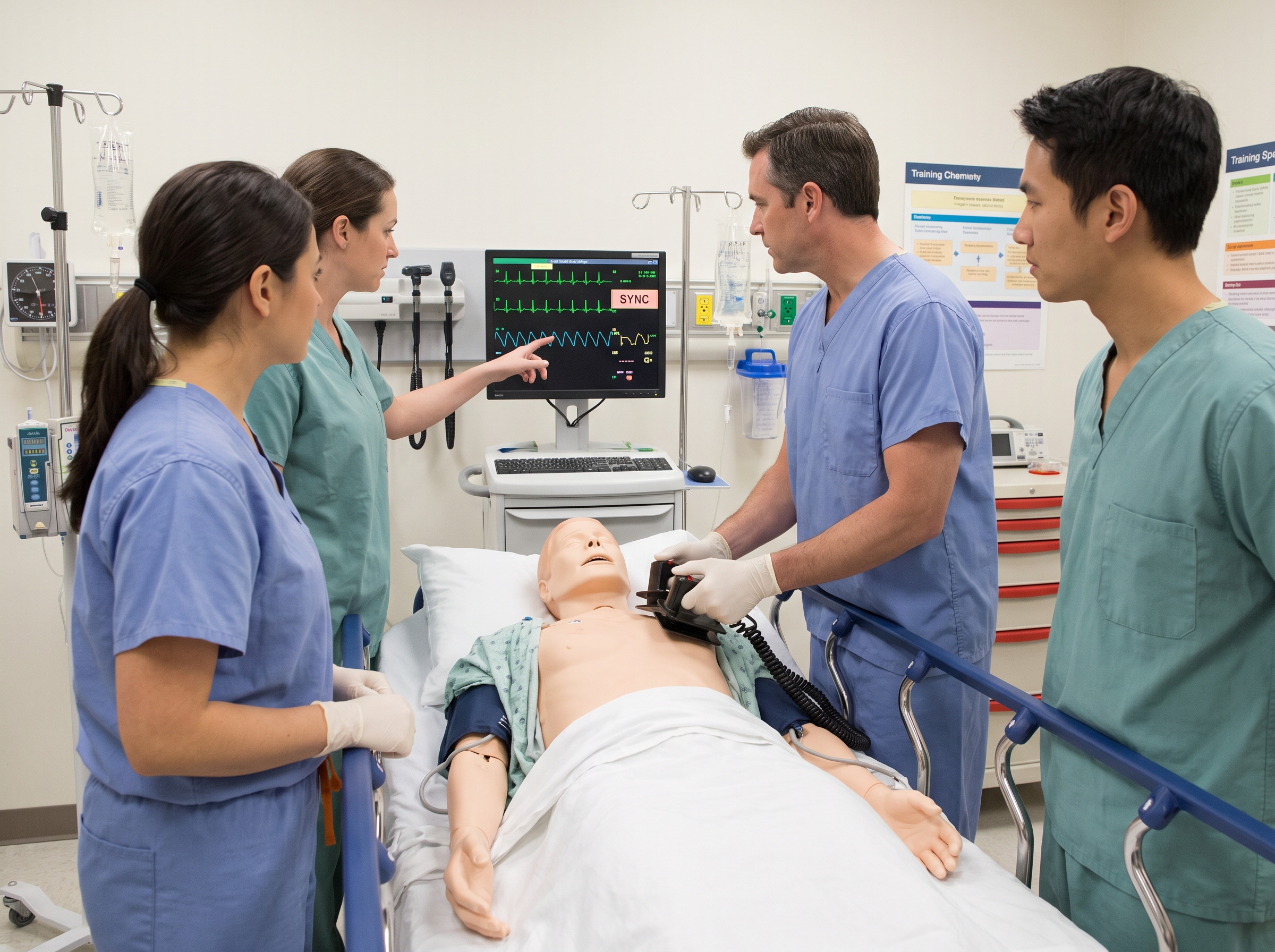
Emergency medicine team preparing to perform synchronized cardioversion during a training simulation


Question 14. A patient with symptomatic bradycardia does not improve after atropine. What is the next appropriate step?

  • A. Discontinue interventions and observe
  • B. Transcutaneous pacing or a chronotropic infusion
  • C. Repeated high-dose epinephrine boluses every minute
  • D. Immediate defibrillation

Correct Answer: B, Transcutaneous pacing or a chronotropic infusion

When atropine fails to resolve symptomatic bradycardia, the algorithm moves to transcutaneous pacing or a chronotropic infusion such as dopamine or epinephrine rather than repeating a drug that has already proven ineffective. Defibrillation has no role here since bradycardia is not a shockable rhythm.


Question 15. A patient achieves return of spontaneous circulation (ROSC) after cardiac arrest. Which of the following is part of appropriate post-cardiac arrest care?

  • A. Immediate discharge planning
  • B. Withholding all supplemental oxygen to avoid hyperoxia
  • C. Targeted temperature management, a 12-lead ECG, and treatment of reversible causes
  • D. Discontinuing further monitoring once the rhythm returns

Correct Answer: C, Targeted temperature management, a 12-lead ECG, and treatment of reversible causes

ROSC is the beginning of a distinct phase of care, not the end of the resuscitation. Post-cardiac arrest management includes targeted temperature management, a 12-lead ECG to evaluate for a coronary cause, ongoing hemodynamic support, and continued attention to any reversible cause identified earlier in the arrest, all while avoiding both hyperoxia and hypoxia rather than avoiding oxygen altogether.


Question 16. A patient presents with sudden facial droop, arm weakness, and slurred speech. What is the most time-critical priority in the initial evaluation?

  • A. Immediate intubation
  • B. Determining the time the patient was last known well
  • C. Administering aspirin before any imaging
  • D. A full cardiac workup before any neurologic assessment

Correct Answer: B, Determining the time the patient was last known well

In suspected acute stroke, establishing the last known well time is the single most time-critical data point, because it determines whether the patient falls inside the window for time-sensitive therapies. Rapid stroke assessment and imaging follow immediately afterward, and this is one of the few ACLS-adjacent algorithms where a clock, not a rhythm strip, drives the first decision.


Team Dynamics and Communication Questions

A surprising number of test takers lose points on team dynamics questions, not because the concepts are complicated, but because they focus so heavily on drugs and algorithms that they forget communication is graded too. If you are stepping into a code team role for the first time, our guide for new code team members covers this ground in more depth.


Question 17. The team leader assigns a task to a team member, who repeats the instruction back and then states out loud when it is complete. What communication principle does this demonstrate?

  • A. Clear roles and responsibilities
  • B. Closed-loop communication
  • C. Mutual respect
  • D. Knowledge sharing

Correct Answer: B, Closed-loop communication

Closed-loop communication is the call out, confirmation, and completion cycle that ensures an instruction was heard correctly and actually carried out, rather than assumed. A clinical review of closed-loop communication training notes that teams frequently intend to use this pattern but drop it under stress, which is exactly why examiners look for it explicitly during a megacode.


Question 18. Before a resuscitation begins, the team leader assigns compressions, airway, medications, and recorder duties to specific individuals by name. This illustrates which principle of effective team dynamics?

  • A. Constructive intervention
  • B. Clear roles and responsibilities
  • C. Closed-loop communication
  • D. Re-evaluation and summarizing

Correct Answer: B, Clear roles and responsibilities

Assigning specific tasks to specific people by name, rather than announcing a task to the room in general, prevents duplicated effort and gaps where everyone assumed someone else was handling something. This principle is separate from closed-loop communication, which is about confirming that an assigned task was heard and completed, not about who was assigned what in the first place.


Question 19. A team member notices that chest compressions have become too shallow and respectfully speaks up to correct the technique. This reflects which team dynamics principle?

  • A. Knowing one's limitations
  • B. Constructive intervention
  • C. Clear messages
  • D. Mutual respect only, with no action required

Correct Answer: B, Constructive intervention

Constructive intervention means speaking up when something needs to be corrected, done respectfully and without personal criticism, so that patient care improves in real time rather than being addressed only after the fact. A code team functions best when every member feels able to raise a concern immediately, regardless of role or seniority.


Question 20. After a resuscitation event ends, the team gathers to review what went well and what could be improved for next time. What is this process called, and why does it matter?

  • A. Handoff report, required only for legal documentation
  • B. Debriefing, which reinforces learning and improves future team performance
  • C. Root cause analysis, performed only after an adverse outcome
  • D. Shift change, unrelated to clinical performance

Correct Answer: B, Debriefing, which reinforces learning and improves future team performance

Debriefing is the re-evaluation and summarizing step of effective team dynamics, giving the team a structured chance to reinforce what worked and identify what to change before the next event. This habit is worth building well before your exam, since the teams that debrief consistently in practice tend to move through the actual algorithm more smoothly when it counts.


Scoring Your Pretest and Planning Next Steps

There is no official passing score for this pretest since it is a study tool, not a certification exam, but a useful rule of thumb is to treat any section where you missed more than one question as a section to revisit before you sit for the real thing. Go back through the rationales, not just the correct letter, since the reasoning is what will help you handle a differently worded question on exam day.


If rhythm recognition was your weak spot, spend time with strips until the patterns are automatic rather than something you have to reason through. If medications gave you trouble, drill dosing and indications until they are reflexive. If algorithm sequencing tripped you up, walk through the megacode stations again with the sequence out loud. And if you are still working toward your initial certification or your renewal is coming up, Affordable ACLS was built by practicing emergency physicians specifically to make that process affordable, self-paced, and straightforward, with the ACLS certification and recertification course covering every content area this pretest touched on.


Frequently Asked Questions About the ACLS Pretest

Is this pretest the same length or format as the real ACLS exam?

No. This is a 20-question study tool designed to sample the major content areas of ACLS, rhythms, medications, algorithms, and team dynamics, so you can gauge your readiness. The exact number of questions, format, and passing threshold on your certification exam depend on your course provider, so check your course's exam blueprint directly rather than assuming it matches this set.


What should I do if I miss several questions in one category?

Treat it as a roadmap rather than a discouraging result. Go back to the specific content area, review it with a dedicated resource such as a cheat sheet or algorithm guide, and retake a fresh set of practice questions on that topic before moving on, rather than rereading the same material passively.


Do I need to memorize exact drug doses, or just the order they are given?

Both matter. Knowing that epinephrine comes before amiodarone in a refractory VF arrest is important, but so is knowing the actual dose and route, since exam questions and real resuscitations both expect precision. Building both pieces together, sequence and dosing, is the fastest way to move information from short-term recall into something you can use under pressure.


ACLS Blogs

ACLS Pretest: 20 Practice Questions with Answer Rationales

Why an ACLS Pretest Belongs in Your Study Routine

Walking into an ACLS exam without knowing where your knowledge gaps are is a little like running a code without checking the monitor first. You might get through it, but you are guessing more than you should be. A pretest gives you a low-stakes way to find out which rhythms, medications, algorithms, and team dynamics concepts you already have down cold, and which ones need another pass before test day.


This pretest includes 20 questions built to mirror the style and content areas of a real ACLS exam: rhythm recognition, drug dosing and indications, algorithm sequencing, and the team communication skills that examiners expect you to demonstrate during a megacode. Each question comes with the correct answer and a short rationale grounded in current American Heart Association (AHA) guidance, so you are not just memorizing an answer key, you are reinforcing the reasoning behind it.


How to Use This Pretest

Work through the questions in order, or jump to the section that worries you most. Answer each one before reading the rationale, even if you are tempted to peek. The value of a pretest comes from the honest attempt, not the final score, and pretending you knew an answer you actually guessed will only hurt you when the real exam is in front of you.


If you want a broader library of scenario-based questions after finishing this set, Affordable ACLS offers free practice tests you can use to keep drilling weak spots at your own pace. For a walkthrough of how the graded stations fit together on test day, our station-by-station megacode guide is a useful companion to this pretest.

Nurse reviewing ACLS practice questions on a tablet in a clinical training room


Rhythm Recognition Questions

Rhythm recognition is the foundation everything else in ACLS is built on. If you cannot correctly identify what is on the monitor, you cannot choose the right branch of the algorithm. If flutter waves and fibrillatory baselines still blur together for you, our beginner's guide to core ACLS heart rhythms is worth reviewing before these five questions.


Question 1. The monitor shows a sawtooth pattern of atrial activity at a rapid, regular rate with a variable ventricular response. What rhythm is this?

  • A. Atrial fibrillation
  • B. Atrial flutter
  • C. Sinus tachycardia
  • D. Ventricular tachycardia

Correct Answer: B, Atrial flutter

The sawtooth flutter waves come from an organized reentrant circuit in the atria, which is what separates atrial flutter from the chaotic, disorganized baseline of atrial fibrillation. The ventricular rate depends on how many flutter waves conduct through the AV node. Management follows the same stability-first approach as other supraventricular rhythms: assess the patient before you assess the rhythm strip.


Question 2. A patient with a known prolonged QT interval develops a polymorphic wide-complex rhythm where the QRS complexes appear to twist around the baseline. What is this rhythm, and what is the first-line treatment?

  • A. Monomorphic VT, treated with amiodarone
  • B. Torsades de pointes, treated with magnesium sulfate
  • C. Atrial fibrillation, treated with diltiazem
  • D. Supraventricular tachycardia, treated with adenosine

Correct Answer: B, Torsades de pointes, treated with magnesium sulfate

Torsades de pointes is a distinct form of polymorphic VT tied to QT prolongation, and it responds to IV magnesium sulfate even when the patient's serum magnesium level is normal. Standard antiarrhythmics used for other wide-complex rhythms are avoided here because several of them can prolong the QT interval further and worsen the problem. If the patient loses a pulse, the rhythm is managed exactly like any other pulseless VT within the cardiac arrest algorithm.


Question 3. A hemodynamically stable adult has a regular, wide-complex tachycardia at 160 bpm. The patient is alert with a strong pulse and normal blood pressure. What is the most appropriate immediate action?

  • A. Immediate defibrillation
  • B. High-quality chest compressions
  • C. IV access, 12-lead ECG, and expert consultation before antiarrhythmic therapy
  • D. Synchronized cardioversion without delay

Correct Answer: C, IV access, 12-lead ECG, and expert consultation before antiarrhythmic therapy

A stable patient with a wide-complex tachycardia does not need emergent cardioversion or compressions. The priority is establishing IV access, obtaining a 12-lead ECG, and getting expert input, since a wide-complex rhythm could be monomorphic VT or a supraventricular rhythm with aberrant conduction, and the treatment differs depending on which one it is. Cardioversion only becomes urgent if the patient's condition deteriorates.


Question 4. An unresponsive, pulseless patient's monitor shows a chaotic, disorganized waveform with no identifiable P waves, QRS complexes, or T waves. What is the immediate priority?

  • A. Synchronized cardioversion
  • B. Start CPR and defibrillate as soon as the rhythm is confirmed shockable
  • C. Administer atropine
  • D. Begin transcutaneous pacing

Correct Answer: B, Start CPR and defibrillate as soon as the rhythm is confirmed shockable

This waveform describes ventricular fibrillation, a shockable rhythm in the Adult Cardiac Arrest Algorithm. Chest compressions should start immediately while the defibrillator is applied, since early high-quality CPR paired with rapid defibrillation is what the current AHA Adult Cardiac Arrest Algorithm identifies as most closely tied to better outcomes. Atropine and pacing have no role once a shockable rhythm is confirmed.


Question 5. A patient is unresponsive and pulseless, but the monitor shows an organized rhythm with recognizable QRS complexes at a reasonable rate. What is this called, and what should the team do first?

  • A. Ventricular fibrillation, defibrillate immediately
  • B. Pulseless electrical activity, begin CPR and search for a reversible cause
  • C. Sinus rhythm, no intervention needed
  • D. Asystole, confirm in a second lead before starting CPR

Correct Answer: B, Pulseless electrical activity, begin CPR and search for a reversible cause

Organized electrical activity without a palpable pulse is pulseless electrical activity (PEA), a non-shockable rhythm managed with high-quality CPR, epinephrine, and a systematic search for an underlying cause rather than defibrillation. Our Hs and Ts guide walks through the reversible causes ACLS providers are expected to consider in this scenario, and the same framework is detailed in a StatPearls clinical review of PEA.


Medication and Dosing Questions

Medication questions trip up a lot of test takers because there are several similar-sounding drugs used at different points in the algorithm. The AHA's focused update on antiarrhythmic drug use during cardiac arrest is a good primary reference if you want the reasoning behind current dosing choices, and our ACLS medications cheat sheet is built to keep this section straight while you study.


Question 6. During cardiac arrest from VF or pulseless VT, which medication is given after the first shock and repeated roughly every 3 to 5 minutes?

  • A. Amiodarone
  • B. Atropine
  • C. Epinephrine
  • D. Adenosine

Correct Answer: C, Epinephrine

Epinephrine is the core vasopressor of the cardiac arrest algorithm, given as soon as feasible and then at regular intervals throughout the resuscitation regardless of the rhythm encountered. Atropine has no role in shockable or non-shockable cardiac arrest rhythms under current guidance, and adenosine is reserved for a completely different clinical picture, a stable narrow-complex tachycardia with a pulse.


Question 7. A patient remains in VF after three defibrillation attempts and ongoing high-quality CPR. Which antiarrhythmic is recommended as first-line therapy for shock-refractory VF or pulseless VT?

  • A. Lidocaine only, since amiodarone is no longer used
  • B. Amiodarone, with lidocaine as an accepted alternative
  • C. Verapamil
  • D. Digoxin

Correct Answer: B, Amiodarone, with lidocaine as an accepted alternative

Amiodarone is the guideline-preferred antiarrhythmic for shock-refractory VF or pulseless VT, with lidocaine considered an acceptable alternative rather than a discontinued option. The large randomized ALPS trial published in the New England Journal of Medicine found the two drugs performed similarly on survival to discharge, which is part of why both remain reasonable choices in practice. Neither drug should delay ongoing compressions or defibrillation.


Question 8. A patient has a heart rate of 38 bpm with hypotension and altered mental status directly related to the slow rate. What is the first-line pharmacologic treatment?

  • A. Epinephrine infusion
  • B. Atropine 1 mg IV
  • C. Adenosine 6 mg IV
  • D. Amiodarone 300 mg IV

Correct Answer: B, Atropine 1 mg IV

Atropine is the first-line drug for symptomatic bradycardia, given as an IV bolus and repeated if needed. If atropine does not resolve the symptoms, the bradycardia algorithm moves on to transcutaneous pacing or a chronotropic infusion such as epinephrine or dopamine rather than repeating atropine indefinitely. Adenosine and amiodarone are not indicated for a slow rhythm.


Question 9. A stable patient has a narrow-complex, regular tachycardia at 190 bpm that does not resolve with vagal maneuvers. What is the next step?

  • A. Synchronized cardioversion
  • B. Adenosine 6 mg rapid IV push
  • C. Amiodarone 300 mg IV
  • D. Magnesium sulfate

Correct Answer: B, Adenosine 6 mg rapid IV push

Adenosine is the next step for a stable, regular, narrow-complex tachycardia that has not responded to vagal maneuvers, given as a rapid IV push immediately followed by a saline flush because of its extremely short half-life. A second, larger dose can follow if the first does not convert the rhythm. Cardioversion is reserved for instability or when adenosine fails to work and the rhythm requires further management.


Question 10. A patient in cardiac arrest is found to have severe hyperkalemia as the suspected underlying cause. Which intervention is prioritized alongside standard resuscitation?

  • A. Naloxone
  • B. Calcium chloride or calcium gluconate
  • C. Additional epinephrine boluses only
  • D. Beta blocker administration

Correct Answer: B, Calcium chloride or calcium gluconate

Calcium stabilizes the cardiac cell membrane and is prioritized when hyperkalemia is the suspected cause of arrest, alongside measures that shift potassium intracellularly such as insulin with glucose. This is a good example of why the reversible-causes framework matters: standard resuscitation drugs will not fix an electrolyte problem on their own, no matter how correctly they are dosed.


Algorithm and Sequence Questions

Knowing individual facts is not the same as knowing when to apply them. Algorithm questions test whether you can sequence your actions correctly under pressure, which is exactly what the megacode station is designed to evaluate. If mnemonics help you lock in a sequence faster than reading a flowchart, our ACLS algorithm memory hacks article collects several that other test takers have found useful.


Question 11. An adult suddenly collapses in front of you and is unresponsive. After confirming scene safety, what is the correct next step?

  • A. Begin rescue breathing only
  • B. Activate the emergency response system and check for breathing and a pulse
  • C. Attach an AED without checking for a pulse first
  • D. Start chest compressions before checking responsiveness

Correct Answer: B, Activate the emergency response system and check for breathing and a pulse

After confirming the scene is safe and the patient is unresponsive, the next step is activating the emergency response system and simultaneously checking for breathing and a pulse, which determines everything that follows. Skipping this check and jumping straight to compressions or an AED risks missing information you need to manage the rest of the resuscitation correctly.


Question 12. After the first shock for VF and 2 minutes of CPR, the rhythm check shows persistent VF. What is the correct next sequence of actions?

  • A. Deliver a second shock, resume CPR immediately, then give epinephrine
  • B. Administer amiodarone before any further shocks
  • C. Stop compressions to recheck for a pulse first
  • D. Switch immediately to synchronized cardioversion

Correct Answer: A, Deliver a second shock, resume CPR immediately, then give epinephrine

Persistent VF after a shock calls for another shock, followed by an immediate resumption of chest compressions rather than a pulse check, since resuming compressions without delay preserves any perfusion pressure that was built up. Epinephrine is layered in during this cycle, and amiodarone is reserved for once the rhythm proves refractory to shocks alone.


Question 13. A patient with a tachyarrhythmia becomes acutely hypotensive, confused, and shows signs of shock directly caused by the fast heart rate. What is the immediate treatment?

  • A. Adenosine, regardless of rhythm width
  • B. Synchronized cardioversion
  • C. An oral beta blocker
  • D. Observation with a repeat ECG in 30 minutes

Correct Answer: B, Synchronized cardioversion

Once a tachyarrhythmia is causing instability, such as hypotension, altered mental status, or signs of shock, the treatment is immediate synchronized cardioversion rather than pharmacologic management or observation. This distinction between stable and unstable is one of the most heavily tested branch points in the entire tachycardia algorithm, so it is worth being able to state out loud, not just recognize on paper.

Emergency medicine team preparing to perform synchronized cardioversion during a training simulation


Question 14. A patient with symptomatic bradycardia does not improve after atropine. What is the next appropriate step?

  • A. Discontinue interventions and observe
  • B. Transcutaneous pacing or a chronotropic infusion
  • C. Repeated high-dose epinephrine boluses every minute
  • D. Immediate defibrillation

Correct Answer: B, Transcutaneous pacing or a chronotropic infusion

When atropine fails to resolve symptomatic bradycardia, the algorithm moves to transcutaneous pacing or a chronotropic infusion such as dopamine or epinephrine rather than repeating a drug that has already proven ineffective. Defibrillation has no role here since bradycardia is not a shockable rhythm.


Question 15. A patient achieves return of spontaneous circulation (ROSC) after cardiac arrest. Which of the following is part of appropriate post-cardiac arrest care?

  • A. Immediate discharge planning
  • B. Withholding all supplemental oxygen to avoid hyperoxia
  • C. Targeted temperature management, a 12-lead ECG, and treatment of reversible causes
  • D. Discontinuing further monitoring once the rhythm returns

Correct Answer: C, Targeted temperature management, a 12-lead ECG, and treatment of reversible causes

ROSC is the beginning of a distinct phase of care, not the end of the resuscitation. Post-cardiac arrest management includes targeted temperature management, a 12-lead ECG to evaluate for a coronary cause, ongoing hemodynamic support, and continued attention to any reversible cause identified earlier in the arrest, all while avoiding both hyperoxia and hypoxia rather than avoiding oxygen altogether.


Question 16. A patient presents with sudden facial droop, arm weakness, and slurred speech. What is the most time-critical priority in the initial evaluation?

  • A. Immediate intubation
  • B. Determining the time the patient was last known well
  • C. Administering aspirin before any imaging
  • D. A full cardiac workup before any neurologic assessment

Correct Answer: B, Determining the time the patient was last known well

In suspected acute stroke, establishing the last known well time is the single most time-critical data point, because it determines whether the patient falls inside the window for time-sensitive therapies. Rapid stroke assessment and imaging follow immediately afterward, and this is one of the few ACLS-adjacent algorithms where a clock, not a rhythm strip, drives the first decision.


Team Dynamics and Communication Questions

A surprising number of test takers lose points on team dynamics questions, not because the concepts are complicated, but because they focus so heavily on drugs and algorithms that they forget communication is graded too. If you are stepping into a code team role for the first time, our guide for new code team members covers this ground in more depth.


Question 17. The team leader assigns a task to a team member, who repeats the instruction back and then states out loud when it is complete. What communication principle does this demonstrate?

  • A. Clear roles and responsibilities
  • B. Closed-loop communication
  • C. Mutual respect
  • D. Knowledge sharing

Correct Answer: B, Closed-loop communication

Closed-loop communication is the call out, confirmation, and completion cycle that ensures an instruction was heard correctly and actually carried out, rather than assumed. A clinical review of closed-loop communication training notes that teams frequently intend to use this pattern but drop it under stress, which is exactly why examiners look for it explicitly during a megacode.


Question 18. Before a resuscitation begins, the team leader assigns compressions, airway, medications, and recorder duties to specific individuals by name. This illustrates which principle of effective team dynamics?

  • A. Constructive intervention
  • B. Clear roles and responsibilities
  • C. Closed-loop communication
  • D. Re-evaluation and summarizing

Correct Answer: B, Clear roles and responsibilities

Assigning specific tasks to specific people by name, rather than announcing a task to the room in general, prevents duplicated effort and gaps where everyone assumed someone else was handling something. This principle is separate from closed-loop communication, which is about confirming that an assigned task was heard and completed, not about who was assigned what in the first place.


Question 19. A team member notices that chest compressions have become too shallow and respectfully speaks up to correct the technique. This reflects which team dynamics principle?

  • A. Knowing one's limitations
  • B. Constructive intervention
  • C. Clear messages
  • D. Mutual respect only, with no action required

Correct Answer: B, Constructive intervention

Constructive intervention means speaking up when something needs to be corrected, done respectfully and without personal criticism, so that patient care improves in real time rather than being addressed only after the fact. A code team functions best when every member feels able to raise a concern immediately, regardless of role or seniority.


Question 20. After a resuscitation event ends, the team gathers to review what went well and what could be improved for next time. What is this process called, and why does it matter?

  • A. Handoff report, required only for legal documentation
  • B. Debriefing, which reinforces learning and improves future team performance
  • C. Root cause analysis, performed only after an adverse outcome
  • D. Shift change, unrelated to clinical performance

Correct Answer: B, Debriefing, which reinforces learning and improves future team performance

Debriefing is the re-evaluation and summarizing step of effective team dynamics, giving the team a structured chance to reinforce what worked and identify what to change before the next event. This habit is worth building well before your exam, since the teams that debrief consistently in practice tend to move through the actual algorithm more smoothly when it counts.


Scoring Your Pretest and Planning Next Steps

There is no official passing score for this pretest since it is a study tool, not a certification exam, but a useful rule of thumb is to treat any section where you missed more than one question as a section to revisit before you sit for the real thing. Go back through the rationales, not just the correct letter, since the reasoning is what will help you handle a differently worded question on exam day.


If rhythm recognition was your weak spot, spend time with strips until the patterns are automatic rather than something you have to reason through. If medications gave you trouble, drill dosing and indications until they are reflexive. If algorithm sequencing tripped you up, walk through the megacode stations again with the sequence out loud. And if you are still working toward your initial certification or your renewal is coming up, Affordable ACLS was built by practicing emergency physicians specifically to make that process affordable, self-paced, and straightforward, with the ACLS certification and recertification course covering every content area this pretest touched on.


Frequently Asked Questions About the ACLS Pretest

Is this pretest the same length or format as the real ACLS exam?

No. This is a 20-question study tool designed to sample the major content areas of ACLS, rhythms, medications, algorithms, and team dynamics, so you can gauge your readiness. The exact number of questions, format, and passing threshold on your certification exam depend on your course provider, so check your course's exam blueprint directly rather than assuming it matches this set.


What should I do if I miss several questions in one category?

Treat it as a roadmap rather than a discouraging result. Go back to the specific content area, review it with a dedicated resource such as a cheat sheet or algorithm guide, and retake a fresh set of practice questions on that topic before moving on, rather than rereading the same material passively.


Do I need to memorize exact drug doses, or just the order they are given?

Both matter. Knowing that epinephrine comes before amiodarone in a refractory VF arrest is important, but so is knowing the actual dose and route, since exam questions and real resuscitations both expect precision. Building both pieces together, sequence and dosing, is the fastest way to move information from short-term recall into something you can use under pressure.


blogs

More articles for you

all articles

Start Today!

Get certified at your own pace, on your schedule, from the comfort of your home.