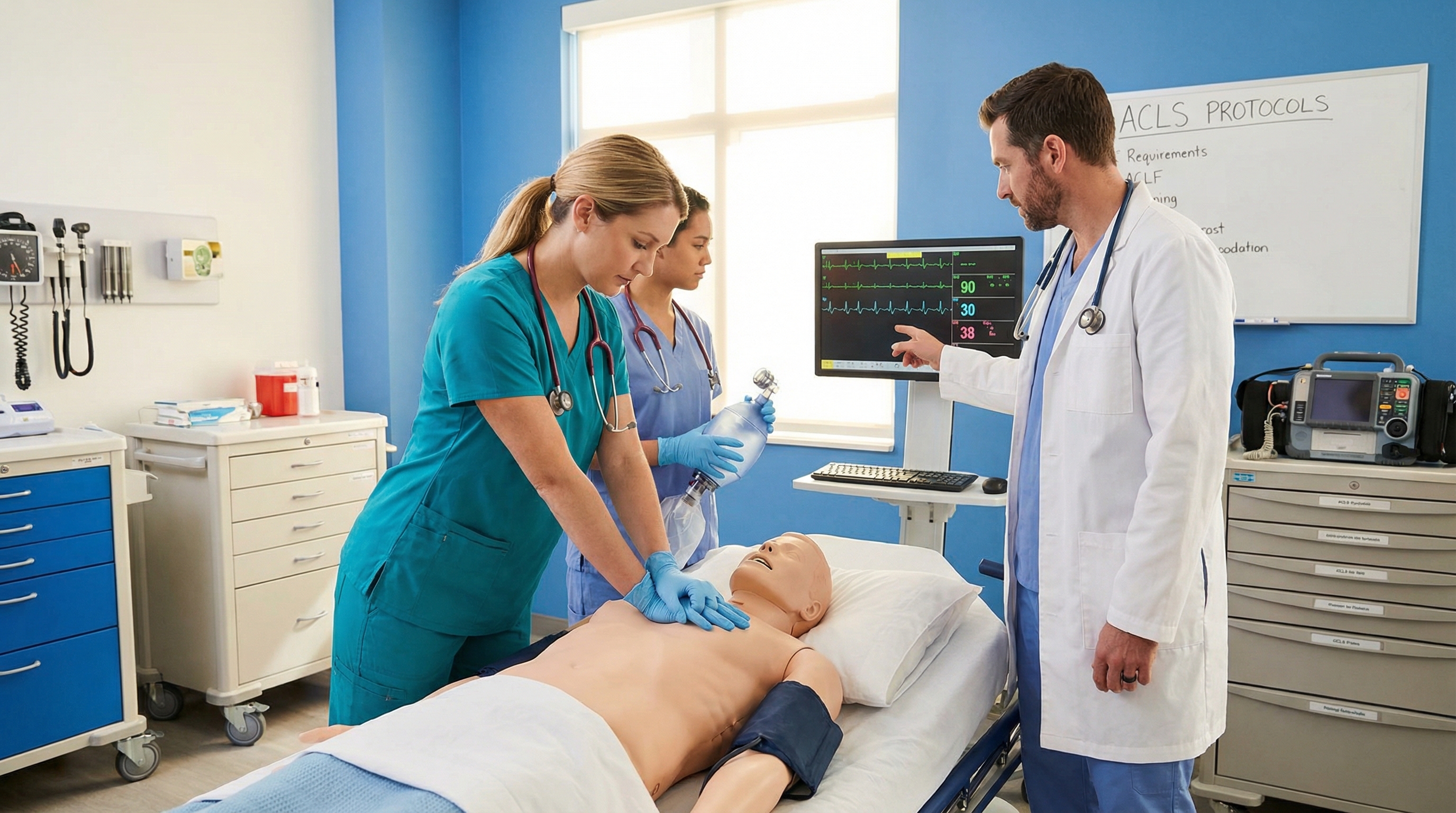
The ACLS megacode is the practical capstone of your Advanced Cardiovascular Life Support certification. It is the moment where everything you have studied — algorithms, drug doses, rhythm recognition, airway management — gets tested under simulated real-world pressure. For many healthcare providers, it is the most anxiety-inducing part of the entire certification process. That anxiety, however, is almost always worse than the actual experience. Walk in knowing exactly what to expect, station by station, and you will walk out with your certification and genuine confidence.
In a megacode scenario, you are placed in the role of team leader during a simulated cardiac arrest or arrhythmia emergency. An evaluator watches you direct your team, apply the correct ACLS algorithm, manage medications and timing, and make clinical decisions in real time. Scenarios typically run 10 to 20 minutes. Most providers encounter two to three scenario branches within a single megacode session, each requiring a different algorithm response. The evaluator is not looking for a flawless performance — they are looking for safe, organized leadership and correct algorithm use. Understanding that distinction changes everything about how you should prepare.

This guide walks you through every station you are likely to encounter, explains what evaluators are actually checking, and gives you the mental framework to stay organized under pressure. Whether you are sitting for your first ACLS certification or heading into a recertification, this walkthrough will sharpen your test-day performance.
Before diving into individual stations, it helps to understand the overall structure of a megacode exam. Megacode scenarios are designed around the core ACLS algorithms established by the American Heart Association. The two major branches of the cardiac arrest algorithm are the shockable rhythms branch — ventricular fibrillation (VF) and pulseless ventricular tachycardia (pVT) — and the non-shockable rhythms branch, which covers pulseless electrical activity (PEA) and asystole. According to the 2025 AHA Guidelines for CPR and Emergency Cardiovascular Care, these algorithm branches form the foundation for all ACLS provider competency assessment.
In addition to cardiac arrest scenarios, megacode sessions commonly include management of symptomatic tachycardia (stable and unstable), symptomatic bradycardia, and post-cardiac arrest care. The evaluator controls how the scenario evolves. A patient might begin in VF, respond to defibrillation, then develop a bradycardia that requires additional management. Your job is to stay oriented to each rhythm change and pivot your algorithm application accordingly.
As team leader, you are expected to verbalize your decisions, delegate clearly, confirm actions are completed, and maintain situational awareness throughout. You are also responsible for keeping track of two-minute CPR cycle intervals, medication timing, and when to reassess rhythm. The communication scripts your team uses during a code blue directly reflect your leadership — and that is what the evaluator is observing from start to finish.
The VF/pVT scenario is the most common megacode opening. The patient is unresponsive, pulseless, and the monitor shows a chaotic or wide-complex rhythm. Your first responsibility as team leader is to recognize the arrest and initiate the shockable algorithm without hesitation.
Here is the sequence evaluators want to see executed cleanly:
Evaluators specifically watch for your ability to minimize CPR interruptions. Every pause in chest compressions reduces coronary perfusion pressure. Your verbal commands should keep compressions running continuously except during rhythm checks and shock delivery. A common misstep is pausing CPR too early or too long when the defibrillator is charging — train yourself to keep compressions going until the moment of shock delivery.
The memory hacks for ACLS algorithms that work best in VF scenarios involve anchoring the two-minute cycle to a physical cue — some providers use the rhythm check as a mental reset point, running through the checklist of shock, epinephrine timing, and antiarrhythmic eligibility at each pause.
Pulseless electrical activity and asystole are the non-shockable rhythms, and they follow the right branch of the cardiac arrest algorithm. The approach here is fundamentally different from VF/pVT: there is no defibrillation, and the entire clinical focus shifts toward high-quality CPR, rapid epinephrine administration, and identifying and reversing reversible causes.
When the monitor shows organized electrical activity but the patient has no pulse — that is PEA. When the monitor shows a flat line — that is asystole. Both follow the same non-shockable algorithm branch, though asystole is generally considered a worse prognostic sign. Your evaluator will want to see you manage the H's and T's systematically. The official AHA 2025 Adult Cardiac Arrest Algorithm outlines both branches in full and is worth having memorized cold before your exam.
The reversible causes every provider must know cold:
In a megacode scenario, the evaluator will often give you clinical clues pointing to one of these causes. A patient found in a cold environment suggests hypothermia. A patient with recent trauma and distended neck veins suggests tension pneumothorax or tamponade. Verbalizing your differential while keeping CPR running demonstrates exactly the kind of leadership the evaluator is looking for. Understanding PEA causes and treatment in depth is one of the highest-yield areas to review before your exam.
Key medication timing: Epinephrine 1 mg IV/IO should be given as soon as IV/IO access is established and then repeated every 3 to 5 minutes. Unlike VF/pVT, there is no antiarrhythmic medication in the non-shockable branch — your pharmacological tool is epinephrine alone, combined with cause-specific interventions.
The tachycardia station tests your ability to differentiate stable from unstable presentations and to apply the correct management pathway. Many providers find this station more cognitively demanding than the cardiac arrest stations because the algorithm branches based on subtle clinical distinctions.
The first question is always: is the patient stable or unstable? Unstable signs include altered mental status, acute chest pain, hypotension, or signs of shock. If the patient is unstable with a sustained tachycardia causing those symptoms — the answer is synchronized cardioversion, and it does not matter whether the rhythm is narrow or wide complex.
For stable patients, the algorithm branches by QRS width:
A frequent evaluator observation is that candidates rush to cardioversion for stable tachycardia out of anxiety. Slow down and demonstrate the stable-versus-unstable assessment explicitly. Verbalize it out loud: the patient has a heart rate of 180, blood pressure is 110/70, she is alert and oriented, no chest pain — this appears to be a stable narrow complex tachycardia, so you are going to attempt vagal maneuvers first. That narration is what earns you full credit on this station.
Symptomatic bradycardia is defined as a heart rate below 60 beats per minute that is producing symptoms — the symptoms being what makes it actionable. A heart rate of 48 with no symptoms in a trained athlete is not the same clinical problem as a heart rate of 48 with dizziness, chest pain, or hypotension in a 70-year-old. The evaluator will present you with a symptomatic scenario — your first task is to confirm that the bradycardia is causing the patient's symptoms, not simply co-occurring with them.
The management sequence is:
The evaluator watches closely for your understanding of the transcutaneous pacing confirmation step. Many candidates set the pacemaker and stop there. You must explicitly confirm both electrical capture — a pacing spike followed by a wide QRS on the monitor — and mechanical capture, which is a palpable pulse that matches the set pacing rate. Verbalize both steps clearly.
Return of spontaneous circulation is not the finish line — it is the start of a new and equally demanding phase of management. Post-ROSC care is increasingly emphasized in ACLS megacode scenarios because the quality of care in the minutes and hours after resuscitation directly determines neurological outcomes.
When the scenario transitions to ROSC — often signaled by a change in the monitor rhythm to an organized waveform with a detectable pulse — your priorities shift immediately:
The details of post-ROSC care and what happens after the heart restarts are worth reviewing thoroughly before your exam. Evaluators increasingly include ROSC management in megacode scenarios, and providers who pivot cleanly from resuscitation mode to post-arrest optimization stand out significantly from those who freeze when the pulse returns.
Technical knowledge of the algorithms is necessary — but it is not sufficient. The megacode evaluates your performance as a team leader, and leadership is a non-technical skill set. Providers who know every algorithm cold but cannot communicate clearly, delegate effectively, or maintain situational awareness under pressure will struggle more than they expect.
Research published in the Journal of Graduate Medical Education on simulation-based resuscitation team leader training confirms that team leader performance — specifically the quality of communication and role clarity — is the single strongest predictor of resuscitation team effectiveness. Here are the specific non-technical behaviors evaluators look for:

The transition from student to code team leader is a skill that can be practiced and systematically developed, regardless of your experience level. Providers who invest in deliberate communication practice — even running scenarios out loud solo — arrive at their megacode with a visible command presence that evaluators recognize immediately.
Knowing where other providers stumble is one of the most efficient preparation strategies available. These are the recurring failure points that evaluators see across megacode sessions:
Drug dosage errors are one of the most common reasons candidates fail individual scenarios. These are the doses you must have memorized before test day — no looking up, no hesitation. The timing and delivery windows for ACLS medications matter as much as the doses themselves:
Practicing medication administration in sequence during mock scenarios builds the procedural memory that holds up under test pressure. Consider making flashcards with drug, dose, indication, and timing — then test yourself until every card is automatic.
The week before your megacode exam is not the time for cramming new material. It is the time to consolidate and rehearse what you already know. Here is a practical preparation schedule:
Providers who are mentally preparing for their first real code and those sitting for ACLS certification share a common challenge: the transition from knowing the content to performing under pressure. That transition is entirely a function of practice volume. Every time you run through a scenario out loud — even alone — you are building the neural pathways that activate automatically when the evaluator starts the clock.
A common misconception is that online ACLS certification leaves providers less prepared for the practical megacode component. The opposite is often true. Well-designed online courses built around current AHA and ILCOR guidelines provide more algorithm exposure, more self-paced review time, and more scenario repetition than many compressed in-person formats allow.
Affordable ACLS was developed by Board Certified Emergency Medicine physicians with more than 20 years of combined clinical and academic experience specifically to address the learning needs of working healthcare providers. The curriculum is structured around real-world algorithm application — the same scenarios you will encounter in your megacode evaluation. Because the platform is entirely self-paced, you can spend additional time on the algorithms or scenarios that feel less solid before moving forward. Unlimited retakes ensure that no provider is penalized for needing additional practice on any module.
For providers juggling demanding clinical schedules, the ability to complete ACLS certification at your own pace — without blocking out two full days for an in-person course — represents a genuine quality-of-life improvement. At $109 for initial ACLS certification and $99 for recertification, the financial barrier is also significantly reduced compared to traditional options. Immediate certificate availability upon completion means you are never waiting on paperwork when a job requires proof of current certification.
The advantages of choosing online ACLS certification for career advancement extend well beyond convenience. Providers who complete their didactic certification online consistently arrive at their skills sessions with stronger algorithm knowledge because they have been able to review at their own pace and repeat challenging sections as many times as needed.
In the minutes before your megacode begins, run through this mental checklist to set yourself up for a clean performance:
The evaluator has seen hundreds of megacode sessions. They know the difference between a provider who has genuinely prepared and one who is winging it. More importantly, they know the difference between a provider who has prepared and a provider who has prepared thoroughly. Systematic preparation, algorithm fluency, and practiced verbal communication are the three pillars that separate providers who pass comfortably from those who struggle through it.
According to ACLS training experts who have evaluated hundreds of megacode sessions, the candidates who pass most confidently are not necessarily those with the most clinical experience — they are the ones who have practiced their verbal delivery and algorithm recall until both are automatic. Experience helps, but deliberate preparation is the variable you can control.
The ACLS megacode is a demanding evaluation — by design. The healthcare system depends on providers who can manage cardiac emergencies effectively, communicate clearly under pressure, and make correct algorithm-based decisions in real time. The megacode exists to confirm that you can do exactly that.
The good news is that the megacode is entirely passable with systematic preparation. Every station follows a defined algorithm. Every evaluator is checking the same core behaviors. Every medication has a known dose and timing. Nothing about the megacode requires improvisation — it requires preparation, practice, and the discipline to execute what you have learned when the scenario begins.
Walk in having reviewed each algorithm branch until it is automatic. Walk in having practiced your team leader communication out loud. Walk in knowing your drug doses without looking them up. Do those three things, and the megacode becomes confirmation of your competence rather than a test of survival. That is the confidence you are preparing for — and it is entirely within reach.
If you are preparing for your ACLS certification or recertification, Affordable ACLS provides physician-developed, fully online ACLS certification based on current AHA and ILCOR guidelines. With self-paced learning, unlimited retakes, immediate digital certificate delivery, and a money-back guarantee if your employer does not accept the certification, it is the most efficient path from preparation to credential for busy healthcare professionals.
.jpg)