ACLS Blogs

ACLS Team Dynamics: Communication Scripts That Save Lives During Code Blues

Why Communication Is the Difference Between Life and Death

When a code blue alarm sounds, every second counts. Healthcare professionals rush to the patient's bedside, equipment is mobilized, and a complex choreography of lifesaving interventions begins. Yet despite having skilled clinicians and advanced medical technology, cardiac arrest survival rates remain stubbornly low in many hospitals. The reason often isn't a lack of clinical knowledge or equipment—it's a breakdown in team communication.


Research has shown that effective team communication, coordination, and situational awareness are critical components to deliver optimal cardiopulmonary resuscitation. When code teams use standardized communication scripts and closed-loop communication techniques, they reduce medical errors, minimize treatment delays, and ultimately improve patient outcomes. This article explores the essential communication scripts, team dynamics principles, and evidence-based strategies that transform chaotic resuscitations into coordinated, efficient lifesaving efforts.

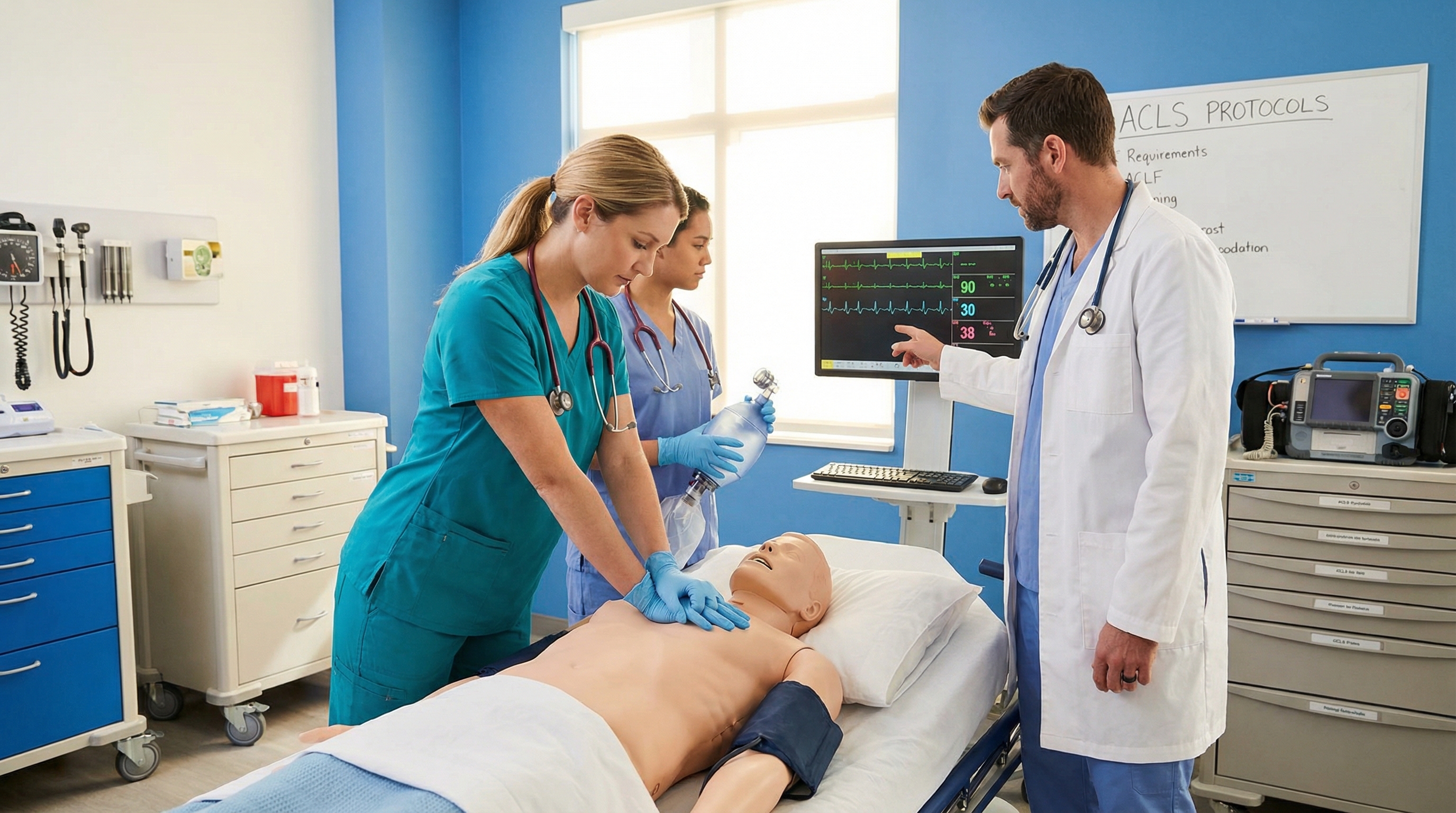
Healthcare team practicing code blue communication and coordination


The Foundation of Effective ACLS Team Dynamics

ACLS team dynamics refers to the collaborative behaviors, communication patterns, and organizational structures that enable resuscitation teams to function effectively during cardiac arrest and other medical emergencies. Unlike individual clinical skills, team dynamics focuses on how healthcare professionals work together, share information, and coordinate their actions under extreme time pressure and stress.


The American Heart Association emphasizes that high-quality CPR and effective team dynamics are equally important for successful resuscitation. You can have the most clinically skilled providers in the room, but without clear communication, defined roles, and mutual respect, even simple interventions can be delayed or performed incorrectly. Understanding and practicing effective team dynamics is not optional—it's a core competency for anyone who might respond to a code blue.


Five Core Elements of ACLS Team Dynamics

The AHA identifies five essential elements that characterize effective resuscitation teams. Mastering these elements transforms a group of individual clinicians into a coordinated team capable of delivering high-quality emergency care.


1. Clear Roles and Responsibilities: Every team member must know their specific role from the moment they enter the code. The team leader should assign roles explicitly, and team members should acknowledge their assignments. Common roles include team leader, compressor, airway manager, medication nurse, monitor/defibrillator operator, and recorder. When everyone knows their job, there's no confusion about who should be performing which task.


2. Clear Messages: During a code blue, there's no room for ambiguity. Team members must speak clearly, concisely, and loud enough to be heard over the chaos. Orders should be directed to specific individuals by name, and medical terminology should be precise. Instead of saying "give some epi," an effective team leader says "Sarah, give 1 milligram of epinephrine IV push now."


3. Closed-Loop Communication: This is perhaps the most important communication technique in ACLS. Closed-loop communication involves three steps: the team leader gives a clear order, the team member repeats back the order to confirm understanding, and the team member reports when the task is complete. This simple practice prevents miscommunication and ensures that critical interventions are actually performed.


4. Knowing Your Limitations: Effective team members recognize when they lack the skill or experience to perform a task safely. Speaking up about limitations isn't a sign of weakness—it's a critical safety behavior. If you're asked to place a difficult IV and you're not confident in your ability, saying "I'm not comfortable with that—we need someone with more experience" protects the patient and maintains team efficiency.


5. Knowledge Sharing and Constructive Intervention: Team members should share relevant patient information and clinical observations without waiting to be asked. If you notice something important—like a change in the cardiac rhythm or an expired medication—you have a responsibility to speak up. Similarly, if you observe an error or have a suggestion for improving care, you should offer it respectfully and constructively.


Closed-Loop Communication: The Cornerstone of Code Blue Success

Of all the communication techniques used during resuscitation, closed-loop communication has the strongest evidence base and the greatest impact on patient safety. Studies examining real-world resuscitations reveal a concerning gap between training and practice. Research analyzing out-of-hospital cardiac arrests found that standard form closed-loop communication was not consistently present in any of the resuscitations examined, despite multiple opportunities to use it.


The Three Components of Closed-Loop Communication

Component 1: Call-Out - The team leader or requesting team member makes a clear, specific request directed to an individual team member by name. For example: "Mike, please charge the defibrillator to 200 joules."


Component 2: Check-Back - The receiving team member repeats the order back to confirm understanding. Mike responds: "Charging defibrillator to 200 joules." This confirmation step catches misunderstandings before they become errors.


Component 3: Closing the Loop - After completing the task, the team member reports back to the leader. Mike announces: "Defibrillator charged to 200 joules, ready to shock." The leader now knows with certainty that the task is complete and the team can proceed to the next intervention.


This simple three-step process dramatically reduces the risk of miscommunication. In high-stress environments like cardiac arrest, our brains are under tremendous cognitive load. We hear things incorrectly, we forget instructions, and we assume tasks have been completed when they haven't. Closed-loop communication creates verbal confirmation at each step, ensuring that critical interventions happen correctly and on time. Research has demonstrated that standardized communication protocols during CPR can reduce chest compression interruption duration during rhythm checks from 9.4 seconds to just 5.3 seconds—a significant improvement that can impact patient outcomes.

Medical team demonstrating closed-loop communication during ACLS training


Essential Team Leader Communication Scripts

The team leader's communication style sets the tone for the entire resuscitation. Effective team leaders use specific scripts and phrases that have been refined through years of research and clinical experience. These aren't rigid scripts that must be followed word-for-word, but rather proven frameworks that ensure nothing gets missed during the chaos of a code blue.


Arrival and Initial Assessment Script

When you arrive as the designated team leader, your first words establish leadership and begin organizing the team:


"I am [name], and I will be leading this code. Let's do a quick pulse and rhythm check. Stop compressions for five seconds."


After the brief pulse check, immediately direct resumption of CPR if no pulse is found:


"No pulse detected. Resume high-quality CPR immediately. I need someone on compressions, someone managing the airway, someone on medications and IV access, someone on the monitor and defibrillator, and someone recording."


Role Assignment Script

Assign roles to specific individuals by name or by clearly pointing to them. Make eye contact when possible, as research shows that directed communication with eye contact increases the likelihood of closed-loop communication being used.


"Jennifer, you're on compressions. Mark, you're managing the airway—get me an oxygen saturation and prepare to bag-valve-mask. Lisa, you're on medications—establish IV or IO access. Tom, you're on the monitor—let me know the rhythm as soon as you have it. Rachel, you're recording—note the time we started CPR and document all interventions."


Wait for verbal acknowledgment from each team member before proceeding. If someone doesn't acknowledge, repeat the assignment: "Lisa, did you hear me? You're on medications and IV access."


Two-Minute Rhythm Check Script

Every two minutes during CPR, you'll need to check the rhythm and pulse. Minimizing interruptions to chest compressions is critical for survival, so your communication must be crisp and efficient. For more information on managing cardiac arrest rhythms, review the Adult Cardiac Arrest Vertical Algorithm.


"Approaching two minutes. Compressor, prepare to switch. All hands off the patient in 5... 4... 3... 2... 1... stop compressions. Pulse and rhythm check."


Quickly assess the rhythm on the monitor:


If VF/VT: "We have ventricular fibrillation. This is a shockable rhythm. Charging defibrillator to [X] joules. Everyone clear of the patient. I'm clear, you're clear, we're all clear. Shock delivered. Resume CPR immediately."


If PEA/Asystole: "We have [PEA or asystole]. This is a non-shockable rhythm. Resume high-quality CPR. Give 1 milligram of epinephrine IV push. Let's run through the H's and T's—does anyone have information about possible reversible causes?"


Medication Order Scripts

Medication errors during resuscitation can be fatal. Use precise communication that includes the medication name, dose, route, and timing. For a comprehensive reference, consult the ACLS Medications Cheat Sheet.


Epinephrine Order: "Lisa, give 1 milligram of epinephrine IV push now." Wait for check-back: "1 milligram epinephrine IV push." After administration: "1 milligram epinephrine given at [time]." Leader responds: "Thank you, epinephrine confirmed."


Amiodarone Order (after second shock in VF/pVT): "Lisa, give 300 milligrams of amiodarone IV push or IO." Check-back: "300 milligrams amiodarone IV push." Completion: "300 milligrams amiodarone given." Leader: "Amiodarone confirmed, thank you."


Remember to announce when medications are due: "We're approaching three minutes since the last epinephrine. Prepare the next dose." This proactive communication prevents delays.


Defibrillation Safety Script

Patient and provider safety during defibrillation requires a standardized script every single time:


"Charging defibrillator to [X] joules. All hands off the patient. Oxygen away from the patient. I'm going to look—I'm clear. You look—you're clear. We all look—we're all clear. Shocking on three: one, two, three, shock delivered. Resume CPR immediately."


This script has been refined to ensure that everyone—including the person delivering the shock—visually confirms that no one is touching the patient. The oxygen warning prevents fire hazards. The immediate resumption of CPR after shock delivery minimizes hands-off time.


Return of Spontaneous Circulation (ROSC) Script

When you achieve ROSC, your communication shifts from resuscitation to post-cardiac arrest care:


"Stop compressions. I have a strong pulse. We have return of spontaneous circulation. Time of ROSC is [current time]. Monitor blood pressure and oxygen saturation. Maintain oxygen saturation between 92 and 98 percent. Establish a systolic blood pressure greater than 90. Prepare for targeted temperature management. Let's get a 12-lead ECG. Does anyone know the suspected cause of the arrest?"


Effective Communication Scripts for Team Members

While the team leader's communication is critical, team members also have important communication responsibilities. Speaking up, sharing information, and using closed-loop communication are team member skills that directly impact patient outcomes. If you're building confidence as a new code team member, practicing these scripts will help you contribute effectively.


Acknowledging Orders

When you receive an order, always repeat it back before performing it:


Leader: "Sarah, give 1 milligram epinephrine IV push." You: "1 milligram epinephrine IV push." [Perform intervention] You: "1 milligram epinephrine given at 10:47."


Reporting Task Completion

Don't assume the leader knows you've completed a task. Always close the loop:


"IV access established in the right antecubital." "Airway secured with size 7.5 ET tube, placement confirmed, tube secured at 22 cm." "Defibrillator charged to 200 joules, ready to deliver shock."


Sharing Critical Information

If you observe something important, speak up immediately using clear, direct language:


"Rhythm change—I'm seeing organized complexes on the monitor." "Oxygen saturation dropping to 82 percent." "I'm seeing ectopy on the monitor post-ROSC." "The patient's pupils are dilated and non-reactive."


Offering Constructive Interventions

If you notice an error or have a suggestion, use respectful language that focuses on patient safety:


"I want to make sure we've considered hyperkalemia as a possible cause—the ECG shows peaked T waves." "I'm concerned about the compression depth—could we switch compressors?" "Just to confirm, we've given two doses of epinephrine so far, correct?"


The Evidence Base: Why These Scripts Work

The communication scripts and team dynamics principles taught in ACLS aren't arbitrary—they're based on decades of resuscitation research. Studies analyzing elements of teamwork in resuscitation have consistently found that communication, leadership, situational awareness, and scene organization are the most frequently cited factors influencing resuscitation success.


Research examining real-world code blues reveals significant communication gaps. One study analyzing anesthesia teams found that closed-loop communication was only used in 45 percent of call-outs, with higher usage during cardiac arrests (67 percent) compared to other emergencies. When directed with eye contact and for medication orders, closed-loop communication was more likely to be used. These findings highlight that even trained professionals don't consistently apply best-practice communication techniques without deliberate effort and regular training.


The benefits of standardized communication extend beyond just reducing errors. Research has shown that standardized communication scripts during CPR reduce the duration of chest compression interruptions for rhythm checks—a critical factor in survival. Brief, direct exchanges between team members contribute to better team performance, while excessive communication under high cognitive load can actually impair performance. The scripts outlined in this article strike the balance between necessary communication and information overload.


Perhaps most concerning is the gap in training. Baseline assessments of medical residents found that 98.6 percent felt uncertain or lacked confidence in leading effective codes before receiving structured training in team dynamics and communication. Traditional ACLS courses focus heavily on clinical algorithms and technical skills, but comparatively less time is devoted to communication and leadership training—despite strong evidence that these non-technical skills are equally important for patient outcomes.


Practicing Team Dynamics and Communication Skills

Reading about communication scripts is valuable, but the real learning happens through deliberate practice. Simulation training enhances real-world resuscitation skills by providing a safe environment to practice both technical and non-technical competencies.


High-Fidelity Simulation Training

High-fidelity simulation using mannequins and realistic scenarios allows teams to practice communication scripts in an environment that mimics the stress and chaos of real code blues. During simulation, team members can make mistakes, receive feedback, and refine their communication without risk to actual patients. Studies demonstrate that training in team-working skills improves teamwork and, when undertaken immediately after training, shortens the duration of simulated resuscitations.


Effective simulation training should focus on both technical skills (CPR quality, defibrillation, medication administration) and non-technical skills (communication, leadership, situational awareness). Facilitators should create realistic scenarios that require closed-loop communication, role clarity, and information sharing. Post-simulation debriefing is where the deepest learning occurs.


Structured Debriefing After Codes

Every code blue—whether real or simulated—should be followed by a structured debriefing. Debriefing after ACLS events enhances patient outcomes by creating opportunities for team learning and process improvement.


Effective debriefings follow a structured format: First, review the objective facts (what happened, timeline of interventions, patient outcome). Second, explore what went well (positive team behaviors, effective communication moments, successful interventions). Third, identify opportunities for improvement (communication breakdowns, role confusion, technical errors). Finally, commit to specific action items for future codes.


Creating a culture where debriefing is routine and expected requires psychological safety. Team members must feel comfortable discussing errors and near-misses without fear of punishment. Frame debriefing as a learning opportunity, not a blame session. When healthcare professionals see that debriefing leads to improved performance and better patient outcomes, participation becomes enthusiastic rather than reluctant.


Individual Skill Development

Even outside formal simulation sessions, you can develop your communication skills:


Practice the scripts out loud: It might feel awkward, but verbalizing the team leader scripts and team member responses helps commit them to memory. When the real code happens, you'll be able to recall these phrases under stress.


Observe experienced code leaders: Pay attention to how senior clinicians communicate during codes. Notice their tone of voice, their use of names, their clarity of instruction. Model your communication after leaders who run effective codes.


Mental rehearsal: Visualize yourself leading or participating in a code blue. Walk through the communication scripts in your mind. Mental practice activates similar neural pathways as physical practice and improves performance under pressure.


Seek feedback: After codes, ask colleagues for specific feedback on your communication. Did you speak clearly? Did you close the loop? Were your orders specific enough? Concrete feedback accelerates skill development.


Common Communication Pitfalls and How to Avoid Them

Even experienced clinicians can fall into communication traps during the stress of a code blue. Recognizing these common pitfalls helps you avoid them.


Pitfall 1: Ambiguous Orders

The Problem: "Someone give epi." "Can we get an airway?" "We should probably shock."


The Solution: Direct orders to specific individuals with precise instructions: "Jennifer, give 1 milligram epinephrine IV push now." "Mark, intubate the patient with a 7.5 ET tube." "I'm going to deliver a shock at 200 joules."


Pitfall 2: Failing to Confirm Orders

The Problem: The leader gives an order, the team member doesn't repeat it back, and the leader assumes it was heard and understood. The medication is never given or is given incorrectly.


The Solution: Leaders should wait for verbal confirmation before moving on. If you don't hear a check-back, ask directly: "Sarah, did you hear me? I need 1 milligram epinephrine IV push." Team members should always repeat orders back, even if the leader doesn't explicitly wait for it.


Pitfall 3: Information Overload

The Problem: Too many people talking at once, excessive background conversation, or the leader giving multiple complex orders simultaneously creates cognitive overload and confusion.


The Solution: The team leader should speak loudly enough to be heard but should limit communication to essential orders and updates. Minimize background conversation. If the room is too chaotic, the leader can announce: "I need everyone quiet except for essential updates." Give orders one at a time and wait for completion before moving to the next intervention.


Pitfall 4: Hierarchy Barriers

The Problem: Junior team members notice an error or have important information but don't speak up because they're intimidated by senior clinicians or afraid of being wrong.


The Solution: Effective team leaders explicitly invite input: "Does anyone have information that might help us here?" "I want everyone to speak up if you notice anything concerning." Team members should use assertive language when necessary: "I'm concerned that..." "I want to make sure we haven't missed..." Patient safety always takes priority over hierarchy.


Pitfall 5: Not Closing the Loop

The Problem: Team members receive orders, repeat them back, but never report when tasks are complete. The leader doesn't know if the medication was given or if the airway is secured.


The Solution: Always announce task completion: "1 milligram epinephrine given at 14:22." "Patient intubated, tube secured at 23 cm, placement confirmed by capnography." Leaders should periodically ask for updates: "Lisa, has the second dose of epinephrine been given?"


Putting It All Together: A Real-World Code Blue Scenario

To see how these communication scripts work in practice, let's walk through a simulated code blue from start to finish, highlighting the key communication moments. For more examples of effective ACLS communication in action, explore real-life success stories of ACLS cases that made a difference.


The Beginning: Establishing Leadership and Roles

You arrive at the bedside of a 67-year-old patient who has just collapsed. A nurse is performing chest compressions.


You: "I'm Dr. Martinez, and I will be leading this code. Let's do a quick pulse check. Stop compressions for five seconds." [No pulse felt] "No pulse detected. Resume CPR immediately. You on compressions—what's your name?"


Nurse: "I'm David."


You: "David, continue high-quality compressions. Jennifer, you're on airway—get me a saturation and bag-valve-mask. Lisa, you're on meds and access—establish an IV. Tom, you're on the monitor—tell me the rhythm. Sarah, you're recording—document the time and all interventions."


First Rhythm Check and Defibrillation

Tom: "I have the monitor on. Rhythm shows ventricular fibrillation."


You: "We have VF. This is a shockable rhythm. Tom, charge the defibrillator to 200 joules."


Tom: "Charging to 200 joules." [Brief pause] "Defibrillator charged to 200 joules, ready to shock."


You: "All hands off the patient. Oxygen away. I'm clear, you're clear, we're all clear. Shocking now." [Delivers shock] "Shock delivered. David, resume CPR immediately."


Medication Administration

Lisa: "IV access established in the left AC."


You: "Thank you, Lisa. Give 1 milligram of epinephrine IV push now."


Lisa: "1 milligram epinephrine IV push." [Administers medication] "1 milligram epinephrine given at 10:43."


You: "Epinephrine confirmed, thank you."


Second Rhythm Check and Continued Resuscitation

You: "Approaching two minutes. David, prepare to switch compressions. All hands off in 5... 4... 3... 2... 1... stop CPR. Pulse and rhythm check."


Tom: "Still ventricular fibrillation."


You: "Continuing shockable rhythm. Charging to 300 joules. Everyone clear. Shocking now." [Delivers shock] "Resume CPR. Lisa, give 300 milligrams of amiodarone IV push."


Lisa: "300 milligrams amiodarone IV push." [Administers] "300 milligrams amiodarone given."


Achievement of ROSC

After another two-minute cycle and a third shock:


You: "Stop compressions. Pulse check." [Strong pulse palpated] "I have a pulse. We have ROSC. Time is 10:51. Monitor the blood pressure and oxygen saturation. Jennifer, maintain oxygen saturation 92 to 98 percent. Tom, let's get a 12-lead ECG. Great work, team."


Getting Certified in ACLS: Mastering Team Dynamics

Understanding team dynamics and communication scripts is a core component of ACLS certification. Whether you're seeking initial certification or need to recertify, choosing the right training program ensures you're prepared to function effectively in real code situations.


Affordable ACLS offers comprehensive online ACLS certification developed by Board Certified Emergency Medicine physicians who actively practice in hospitals. The course covers all aspects of advanced cardiovascular life support, including detailed instruction on team dynamics, communication techniques, and leadership skills. You'll learn the same communication scripts and team principles discussed in this article, all based on current American Heart Association and ILCOR guidelines.


The self-paced online format allows you to study team dynamics concepts at your own speed, reviewing communication scripts and algorithms as many times as needed. You can complete the course from any device, and upon passing the exam, you'll receive immediate certification that's accepted by employers nationwide. With unlimited retakes and a money-back guarantee, there's no pressure—just thorough, clinically-focused training that prepares you for real-world resuscitations.


ACLS certification is available for just $99, with recertification at $89. Bundle options are available if you need multiple certifications. The course includes comprehensive coverage of cardiac arrest algorithms, medication administration, team dynamics, and post-cardiac arrest care—everything you need to be a confident, effective code team member.


Conclusion: Communication Skills Save Lives

When the code blue alarm sounds, technical skills alone aren't enough. The difference between a chaotic, ineffective resuscitation and a coordinated lifesaving effort often comes down to communication. By mastering closed-loop communication, using standardized scripts, establishing clear roles, and fostering a culture of knowledge sharing and constructive intervention, you transform a group of individual clinicians into an effective resuscitation team.


The communication scripts outlined in this article aren't theoretical concepts—they're evidence-based practices refined through decades of resuscitation research and real-world experience. When team leaders give clear, directed orders and team members repeat back instructions and report task completion, medication errors decrease, treatment delays are minimized, and patient outcomes improve.


Practice these communication skills deliberately. Use simulation training to refine your scripts. Participate in post-code debriefings to learn from each resuscitation. Whether you're a new nurse responding to your first code or an experienced physician leading your hundredth, there's always room to improve your communication and team dynamics.


In the high-stakes environment of cardiac arrest, every word matters. The next time you respond to a code blue, remember that your communication skills are just as important as your clinical knowledge. Speak clearly, close the loop, share information, and work together as a coordinated team. Those simple practices might just save a life.


ACLS Blogs

ACLS Team Dynamics: Communication Scripts That Save Lives During Code Blues

When a code blue alarm sounds, technical skills alone aren't enough. Research shows that effective team communication and standardized scripts during cardiac arrest can reduce treatment delays, minimize medical errors, and improve patient outcomes.

Why Communication Is the Difference Between Life and Death

When a code blue alarm sounds, every second counts. Healthcare professionals rush to the patient's bedside, equipment is mobilized, and a complex choreography of lifesaving interventions begins. Yet despite having skilled clinicians and advanced medical technology, cardiac arrest survival rates remain stubbornly low in many hospitals. The reason often isn't a lack of clinical knowledge or equipment—it's a breakdown in team communication.


Research has shown that effective team communication, coordination, and situational awareness are critical components to deliver optimal cardiopulmonary resuscitation. When code teams use standardized communication scripts and closed-loop communication techniques, they reduce medical errors, minimize treatment delays, and ultimately improve patient outcomes. This article explores the essential communication scripts, team dynamics principles, and evidence-based strategies that transform chaotic resuscitations into coordinated, efficient lifesaving efforts.

Healthcare team practicing code blue communication and coordination


The Foundation of Effective ACLS Team Dynamics

ACLS team dynamics refers to the collaborative behaviors, communication patterns, and organizational structures that enable resuscitation teams to function effectively during cardiac arrest and other medical emergencies. Unlike individual clinical skills, team dynamics focuses on how healthcare professionals work together, share information, and coordinate their actions under extreme time pressure and stress.


The American Heart Association emphasizes that high-quality CPR and effective team dynamics are equally important for successful resuscitation. You can have the most clinically skilled providers in the room, but without clear communication, defined roles, and mutual respect, even simple interventions can be delayed or performed incorrectly. Understanding and practicing effective team dynamics is not optional—it's a core competency for anyone who might respond to a code blue.


Five Core Elements of ACLS Team Dynamics

The AHA identifies five essential elements that characterize effective resuscitation teams. Mastering these elements transforms a group of individual clinicians into a coordinated team capable of delivering high-quality emergency care.


1. Clear Roles and Responsibilities: Every team member must know their specific role from the moment they enter the code. The team leader should assign roles explicitly, and team members should acknowledge their assignments. Common roles include team leader, compressor, airway manager, medication nurse, monitor/defibrillator operator, and recorder. When everyone knows their job, there's no confusion about who should be performing which task.


2. Clear Messages: During a code blue, there's no room for ambiguity. Team members must speak clearly, concisely, and loud enough to be heard over the chaos. Orders should be directed to specific individuals by name, and medical terminology should be precise. Instead of saying "give some epi," an effective team leader says "Sarah, give 1 milligram of epinephrine IV push now."


3. Closed-Loop Communication: This is perhaps the most important communication technique in ACLS. Closed-loop communication involves three steps: the team leader gives a clear order, the team member repeats back the order to confirm understanding, and the team member reports when the task is complete. This simple practice prevents miscommunication and ensures that critical interventions are actually performed.


4. Knowing Your Limitations: Effective team members recognize when they lack the skill or experience to perform a task safely. Speaking up about limitations isn't a sign of weakness—it's a critical safety behavior. If you're asked to place a difficult IV and you're not confident in your ability, saying "I'm not comfortable with that—we need someone with more experience" protects the patient and maintains team efficiency.


5. Knowledge Sharing and Constructive Intervention: Team members should share relevant patient information and clinical observations without waiting to be asked. If you notice something important—like a change in the cardiac rhythm or an expired medication—you have a responsibility to speak up. Similarly, if you observe an error or have a suggestion for improving care, you should offer it respectfully and constructively.


Closed-Loop Communication: The Cornerstone of Code Blue Success

Of all the communication techniques used during resuscitation, closed-loop communication has the strongest evidence base and the greatest impact on patient safety. Studies examining real-world resuscitations reveal a concerning gap between training and practice. Research analyzing out-of-hospital cardiac arrests found that standard form closed-loop communication was not consistently present in any of the resuscitations examined, despite multiple opportunities to use it.


The Three Components of Closed-Loop Communication

Component 1: Call-Out - The team leader or requesting team member makes a clear, specific request directed to an individual team member by name. For example: "Mike, please charge the defibrillator to 200 joules."


Component 2: Check-Back - The receiving team member repeats the order back to confirm understanding. Mike responds: "Charging defibrillator to 200 joules." This confirmation step catches misunderstandings before they become errors.


Component 3: Closing the Loop - After completing the task, the team member reports back to the leader. Mike announces: "Defibrillator charged to 200 joules, ready to shock." The leader now knows with certainty that the task is complete and the team can proceed to the next intervention.


This simple three-step process dramatically reduces the risk of miscommunication. In high-stress environments like cardiac arrest, our brains are under tremendous cognitive load. We hear things incorrectly, we forget instructions, and we assume tasks have been completed when they haven't. Closed-loop communication creates verbal confirmation at each step, ensuring that critical interventions happen correctly and on time. Research has demonstrated that standardized communication protocols during CPR can reduce chest compression interruption duration during rhythm checks from 9.4 seconds to just 5.3 seconds—a significant improvement that can impact patient outcomes.

Medical team demonstrating closed-loop communication during ACLS training


Essential Team Leader Communication Scripts

The team leader's communication style sets the tone for the entire resuscitation. Effective team leaders use specific scripts and phrases that have been refined through years of research and clinical experience. These aren't rigid scripts that must be followed word-for-word, but rather proven frameworks that ensure nothing gets missed during the chaos of a code blue.


Arrival and Initial Assessment Script

When you arrive as the designated team leader, your first words establish leadership and begin organizing the team:


"I am [name], and I will be leading this code. Let's do a quick pulse and rhythm check. Stop compressions for five seconds."


After the brief pulse check, immediately direct resumption of CPR if no pulse is found:


"No pulse detected. Resume high-quality CPR immediately. I need someone on compressions, someone managing the airway, someone on medications and IV access, someone on the monitor and defibrillator, and someone recording."


Role Assignment Script

Assign roles to specific individuals by name or by clearly pointing to them. Make eye contact when possible, as research shows that directed communication with eye contact increases the likelihood of closed-loop communication being used.


"Jennifer, you're on compressions. Mark, you're managing the airway—get me an oxygen saturation and prepare to bag-valve-mask. Lisa, you're on medications—establish IV or IO access. Tom, you're on the monitor—let me know the rhythm as soon as you have it. Rachel, you're recording—note the time we started CPR and document all interventions."


Wait for verbal acknowledgment from each team member before proceeding. If someone doesn't acknowledge, repeat the assignment: "Lisa, did you hear me? You're on medications and IV access."


Two-Minute Rhythm Check Script

Every two minutes during CPR, you'll need to check the rhythm and pulse. Minimizing interruptions to chest compressions is critical for survival, so your communication must be crisp and efficient. For more information on managing cardiac arrest rhythms, review the Adult Cardiac Arrest Vertical Algorithm.


"Approaching two minutes. Compressor, prepare to switch. All hands off the patient in 5... 4... 3... 2... 1... stop compressions. Pulse and rhythm check."


Quickly assess the rhythm on the monitor:


If VF/VT: "We have ventricular fibrillation. This is a shockable rhythm. Charging defibrillator to [X] joules. Everyone clear of the patient. I'm clear, you're clear, we're all clear. Shock delivered. Resume CPR immediately."


If PEA/Asystole: "We have [PEA or asystole]. This is a non-shockable rhythm. Resume high-quality CPR. Give 1 milligram of epinephrine IV push. Let's run through the H's and T's—does anyone have information about possible reversible causes?"


Medication Order Scripts

Medication errors during resuscitation can be fatal. Use precise communication that includes the medication name, dose, route, and timing. For a comprehensive reference, consult the ACLS Medications Cheat Sheet.


Epinephrine Order: "Lisa, give 1 milligram of epinephrine IV push now." Wait for check-back: "1 milligram epinephrine IV push." After administration: "1 milligram epinephrine given at [time]." Leader responds: "Thank you, epinephrine confirmed."


Amiodarone Order (after second shock in VF/pVT): "Lisa, give 300 milligrams of amiodarone IV push or IO." Check-back: "300 milligrams amiodarone IV push." Completion: "300 milligrams amiodarone given." Leader: "Amiodarone confirmed, thank you."


Remember to announce when medications are due: "We're approaching three minutes since the last epinephrine. Prepare the next dose." This proactive communication prevents delays.


Defibrillation Safety Script

Patient and provider safety during defibrillation requires a standardized script every single time:


"Charging defibrillator to [X] joules. All hands off the patient. Oxygen away from the patient. I'm going to look—I'm clear. You look—you're clear. We all look—we're all clear. Shocking on three: one, two, three, shock delivered. Resume CPR immediately."


This script has been refined to ensure that everyone—including the person delivering the shock—visually confirms that no one is touching the patient. The oxygen warning prevents fire hazards. The immediate resumption of CPR after shock delivery minimizes hands-off time.


Return of Spontaneous Circulation (ROSC) Script

When you achieve ROSC, your communication shifts from resuscitation to post-cardiac arrest care:


"Stop compressions. I have a strong pulse. We have return of spontaneous circulation. Time of ROSC is [current time]. Monitor blood pressure and oxygen saturation. Maintain oxygen saturation between 92 and 98 percent. Establish a systolic blood pressure greater than 90. Prepare for targeted temperature management. Let's get a 12-lead ECG. Does anyone know the suspected cause of the arrest?"


Effective Communication Scripts for Team Members

While the team leader's communication is critical, team members also have important communication responsibilities. Speaking up, sharing information, and using closed-loop communication are team member skills that directly impact patient outcomes. If you're building confidence as a new code team member, practicing these scripts will help you contribute effectively.


Acknowledging Orders

When you receive an order, always repeat it back before performing it:


Leader: "Sarah, give 1 milligram epinephrine IV push." You: "1 milligram epinephrine IV push." [Perform intervention] You: "1 milligram epinephrine given at 10:47."


Reporting Task Completion

Don't assume the leader knows you've completed a task. Always close the loop:


"IV access established in the right antecubital." "Airway secured with size 7.5 ET tube, placement confirmed, tube secured at 22 cm." "Defibrillator charged to 200 joules, ready to deliver shock."


Sharing Critical Information

If you observe something important, speak up immediately using clear, direct language:


"Rhythm change—I'm seeing organized complexes on the monitor." "Oxygen saturation dropping to 82 percent." "I'm seeing ectopy on the monitor post-ROSC." "The patient's pupils are dilated and non-reactive."


Offering Constructive Interventions

If you notice an error or have a suggestion, use respectful language that focuses on patient safety:


"I want to make sure we've considered hyperkalemia as a possible cause—the ECG shows peaked T waves." "I'm concerned about the compression depth—could we switch compressors?" "Just to confirm, we've given two doses of epinephrine so far, correct?"


The Evidence Base: Why These Scripts Work

The communication scripts and team dynamics principles taught in ACLS aren't arbitrary—they're based on decades of resuscitation research. Studies analyzing elements of teamwork in resuscitation have consistently found that communication, leadership, situational awareness, and scene organization are the most frequently cited factors influencing resuscitation success.


Research examining real-world code blues reveals significant communication gaps. One study analyzing anesthesia teams found that closed-loop communication was only used in 45 percent of call-outs, with higher usage during cardiac arrests (67 percent) compared to other emergencies. When directed with eye contact and for medication orders, closed-loop communication was more likely to be used. These findings highlight that even trained professionals don't consistently apply best-practice communication techniques without deliberate effort and regular training.


The benefits of standardized communication extend beyond just reducing errors. Research has shown that standardized communication scripts during CPR reduce the duration of chest compression interruptions for rhythm checks—a critical factor in survival. Brief, direct exchanges between team members contribute to better team performance, while excessive communication under high cognitive load can actually impair performance. The scripts outlined in this article strike the balance between necessary communication and information overload.


Perhaps most concerning is the gap in training. Baseline assessments of medical residents found that 98.6 percent felt uncertain or lacked confidence in leading effective codes before receiving structured training in team dynamics and communication. Traditional ACLS courses focus heavily on clinical algorithms and technical skills, but comparatively less time is devoted to communication and leadership training—despite strong evidence that these non-technical skills are equally important for patient outcomes.


Practicing Team Dynamics and Communication Skills

Reading about communication scripts is valuable, but the real learning happens through deliberate practice. Simulation training enhances real-world resuscitation skills by providing a safe environment to practice both technical and non-technical competencies.


High-Fidelity Simulation Training

High-fidelity simulation using mannequins and realistic scenarios allows teams to practice communication scripts in an environment that mimics the stress and chaos of real code blues. During simulation, team members can make mistakes, receive feedback, and refine their communication without risk to actual patients. Studies demonstrate that training in team-working skills improves teamwork and, when undertaken immediately after training, shortens the duration of simulated resuscitations.


Effective simulation training should focus on both technical skills (CPR quality, defibrillation, medication administration) and non-technical skills (communication, leadership, situational awareness). Facilitators should create realistic scenarios that require closed-loop communication, role clarity, and information sharing. Post-simulation debriefing is where the deepest learning occurs.


Structured Debriefing After Codes

Every code blue—whether real or simulated—should be followed by a structured debriefing. Debriefing after ACLS events enhances patient outcomes by creating opportunities for team learning and process improvement.


Effective debriefings follow a structured format: First, review the objective facts (what happened, timeline of interventions, patient outcome). Second, explore what went well (positive team behaviors, effective communication moments, successful interventions). Third, identify opportunities for improvement (communication breakdowns, role confusion, technical errors). Finally, commit to specific action items for future codes.


Creating a culture where debriefing is routine and expected requires psychological safety. Team members must feel comfortable discussing errors and near-misses without fear of punishment. Frame debriefing as a learning opportunity, not a blame session. When healthcare professionals see that debriefing leads to improved performance and better patient outcomes, participation becomes enthusiastic rather than reluctant.


Individual Skill Development

Even outside formal simulation sessions, you can develop your communication skills:


Practice the scripts out loud: It might feel awkward, but verbalizing the team leader scripts and team member responses helps commit them to memory. When the real code happens, you'll be able to recall these phrases under stress.


Observe experienced code leaders: Pay attention to how senior clinicians communicate during codes. Notice their tone of voice, their use of names, their clarity of instruction. Model your communication after leaders who run effective codes.


Mental rehearsal: Visualize yourself leading or participating in a code blue. Walk through the communication scripts in your mind. Mental practice activates similar neural pathways as physical practice and improves performance under pressure.


Seek feedback: After codes, ask colleagues for specific feedback on your communication. Did you speak clearly? Did you close the loop? Were your orders specific enough? Concrete feedback accelerates skill development.


Common Communication Pitfalls and How to Avoid Them

Even experienced clinicians can fall into communication traps during the stress of a code blue. Recognizing these common pitfalls helps you avoid them.


Pitfall 1: Ambiguous Orders

The Problem: "Someone give epi." "Can we get an airway?" "We should probably shock."


The Solution: Direct orders to specific individuals with precise instructions: "Jennifer, give 1 milligram epinephrine IV push now." "Mark, intubate the patient with a 7.5 ET tube." "I'm going to deliver a shock at 200 joules."


Pitfall 2: Failing to Confirm Orders

The Problem: The leader gives an order, the team member doesn't repeat it back, and the leader assumes it was heard and understood. The medication is never given or is given incorrectly.


The Solution: Leaders should wait for verbal confirmation before moving on. If you don't hear a check-back, ask directly: "Sarah, did you hear me? I need 1 milligram epinephrine IV push." Team members should always repeat orders back, even if the leader doesn't explicitly wait for it.


Pitfall 3: Information Overload

The Problem: Too many people talking at once, excessive background conversation, or the leader giving multiple complex orders simultaneously creates cognitive overload and confusion.


The Solution: The team leader should speak loudly enough to be heard but should limit communication to essential orders and updates. Minimize background conversation. If the room is too chaotic, the leader can announce: "I need everyone quiet except for essential updates." Give orders one at a time and wait for completion before moving to the next intervention.


Pitfall 4: Hierarchy Barriers

The Problem: Junior team members notice an error or have important information but don't speak up because they're intimidated by senior clinicians or afraid of being wrong.


The Solution: Effective team leaders explicitly invite input: "Does anyone have information that might help us here?" "I want everyone to speak up if you notice anything concerning." Team members should use assertive language when necessary: "I'm concerned that..." "I want to make sure we haven't missed..." Patient safety always takes priority over hierarchy.


Pitfall 5: Not Closing the Loop

The Problem: Team members receive orders, repeat them back, but never report when tasks are complete. The leader doesn't know if the medication was given or if the airway is secured.


The Solution: Always announce task completion: "1 milligram epinephrine given at 14:22." "Patient intubated, tube secured at 23 cm, placement confirmed by capnography." Leaders should periodically ask for updates: "Lisa, has the second dose of epinephrine been given?"


Putting It All Together: A Real-World Code Blue Scenario

To see how these communication scripts work in practice, let's walk through a simulated code blue from start to finish, highlighting the key communication moments. For more examples of effective ACLS communication in action, explore real-life success stories of ACLS cases that made a difference.


The Beginning: Establishing Leadership and Roles

You arrive at the bedside of a 67-year-old patient who has just collapsed. A nurse is performing chest compressions.


You: "I'm Dr. Martinez, and I will be leading this code. Let's do a quick pulse check. Stop compressions for five seconds." [No pulse felt] "No pulse detected. Resume CPR immediately. You on compressions—what's your name?"


Nurse: "I'm David."


You: "David, continue high-quality compressions. Jennifer, you're on airway—get me a saturation and bag-valve-mask. Lisa, you're on meds and access—establish an IV. Tom, you're on the monitor—tell me the rhythm. Sarah, you're recording—document the time and all interventions."


First Rhythm Check and Defibrillation

Tom: "I have the monitor on. Rhythm shows ventricular fibrillation."


You: "We have VF. This is a shockable rhythm. Tom, charge the defibrillator to 200 joules."


Tom: "Charging to 200 joules." [Brief pause] "Defibrillator charged to 200 joules, ready to shock."


You: "All hands off the patient. Oxygen away. I'm clear, you're clear, we're all clear. Shocking now." [Delivers shock] "Shock delivered. David, resume CPR immediately."


Medication Administration

Lisa: "IV access established in the left AC."


You: "Thank you, Lisa. Give 1 milligram of epinephrine IV push now."


Lisa: "1 milligram epinephrine IV push." [Administers medication] "1 milligram epinephrine given at 10:43."


You: "Epinephrine confirmed, thank you."


Second Rhythm Check and Continued Resuscitation

You: "Approaching two minutes. David, prepare to switch compressions. All hands off in 5... 4... 3... 2... 1... stop CPR. Pulse and rhythm check."


Tom: "Still ventricular fibrillation."


You: "Continuing shockable rhythm. Charging to 300 joules. Everyone clear. Shocking now." [Delivers shock] "Resume CPR. Lisa, give 300 milligrams of amiodarone IV push."


Lisa: "300 milligrams amiodarone IV push." [Administers] "300 milligrams amiodarone given."


Achievement of ROSC

After another two-minute cycle and a third shock:


You: "Stop compressions. Pulse check." [Strong pulse palpated] "I have a pulse. We have ROSC. Time is 10:51. Monitor the blood pressure and oxygen saturation. Jennifer, maintain oxygen saturation 92 to 98 percent. Tom, let's get a 12-lead ECG. Great work, team."


Getting Certified in ACLS: Mastering Team Dynamics

Understanding team dynamics and communication scripts is a core component of ACLS certification. Whether you're seeking initial certification or need to recertify, choosing the right training program ensures you're prepared to function effectively in real code situations.


Affordable ACLS offers comprehensive online ACLS certification developed by Board Certified Emergency Medicine physicians who actively practice in hospitals. The course covers all aspects of advanced cardiovascular life support, including detailed instruction on team dynamics, communication techniques, and leadership skills. You'll learn the same communication scripts and team principles discussed in this article, all based on current American Heart Association and ILCOR guidelines.


The self-paced online format allows you to study team dynamics concepts at your own speed, reviewing communication scripts and algorithms as many times as needed. You can complete the course from any device, and upon passing the exam, you'll receive immediate certification that's accepted by employers nationwide. With unlimited retakes and a money-back guarantee, there's no pressure—just thorough, clinically-focused training that prepares you for real-world resuscitations.


ACLS certification is available for just $99, with recertification at $89. Bundle options are available if you need multiple certifications. The course includes comprehensive coverage of cardiac arrest algorithms, medication administration, team dynamics, and post-cardiac arrest care—everything you need to be a confident, effective code team member.


Conclusion: Communication Skills Save Lives

When the code blue alarm sounds, technical skills alone aren't enough. The difference between a chaotic, ineffective resuscitation and a coordinated lifesaving effort often comes down to communication. By mastering closed-loop communication, using standardized scripts, establishing clear roles, and fostering a culture of knowledge sharing and constructive intervention, you transform a group of individual clinicians into an effective resuscitation team.


The communication scripts outlined in this article aren't theoretical concepts—they're evidence-based practices refined through decades of resuscitation research and real-world experience. When team leaders give clear, directed orders and team members repeat back instructions and report task completion, medication errors decrease, treatment delays are minimized, and patient outcomes improve.


Practice these communication skills deliberately. Use simulation training to refine your scripts. Participate in post-code debriefings to learn from each resuscitation. Whether you're a new nurse responding to your first code or an experienced physician leading your hundredth, there's always room to improve your communication and team dynamics.


In the high-stakes environment of cardiac arrest, every word matters. The next time you respond to a code blue, remember that your communication skills are just as important as your clinical knowledge. Speak clearly, close the loop, share information, and work together as a coordinated team. Those simple practices might just save a life.


blogs

More articles for you

all articles

Start Today!

Get certified at your own pace, on your schedule, from the comfort of your home.