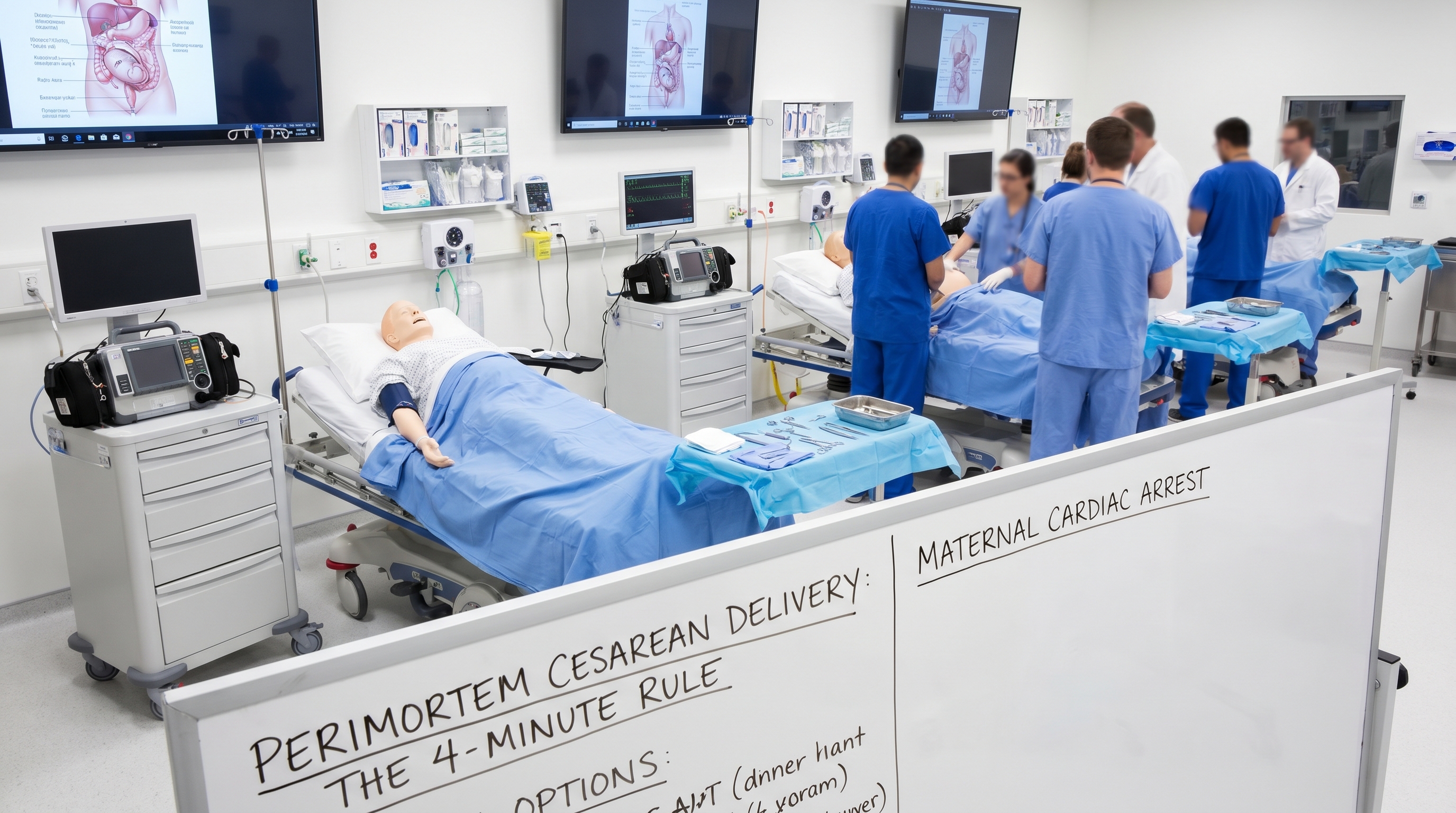
You are 90 seconds into a maternal cardiac arrest when you realize this patient is 34 weeks pregnant, unresponsive, pulseless, and not responding to high-quality CPR. The monitor shows ventricular fibrillation. You deliver the shock. No return of spontaneous circulation. The clock is ticking. Every member of your labor and delivery team is looking at you — or at each other — waiting for someone to say the words.
That moment is exactly what the perimortem cesarean delivery (PMCD) drill is designed for. The 4-minute rule — the principle that a provider should begin cesarean delivery within four minutes of maternal cardiac arrest and aim to have the fetus delivered by the fifth minute — is one of the most psychologically and technically demanding decision points in all of emergency medicine. And yet, it remains undertrained, underprepared, and consistently delayed in hospitals across the country. This article is a deep dive into what you and your labor and delivery ACLS team need to know, rehearse, and internalize before you are ever called upon to act.

The 4-minute rule originates from a landmark 1986 paper by Vern Katz, Deborah Dotters, and William Droegemueller, who reviewed reported cases of cardiac arrest in pregnancy and proposed that delivery within five minutes of maternal cardiac arrest was necessary for optimal neonatal neurological outcomes. Their review of case literature suggested that intact neonatal survival rates dropped sharply beyond that window, and the rule quickly became embedded in resuscitation curricula worldwide.
Decades later, the evidence base has matured considerably. Research published in eBioMedicine has challenged the strict biological threshold of four minutes, demonstrating that both maternal and neonatal survival rates diminish on a continuous slope rather than falling off a cliff at exactly 240 seconds. Intact neurological survival has been reported in infants delivered beyond the traditional window, and several case series document maternal ROSC following PMCD performed more than 15 to 20 minutes into cardiac arrest. The takeaway is not that time is irrelevant — it is absolutely critical — but that providers should not use elapsed time as an excuse to delay or withhold the procedure.
The current guidance from the American Heart Association's scientific statement on cardiac arrest in pregnancy, published in Circulation, frames the decision clearly: if there is no ROSC within four minutes of cardiac arrest in a patient with a gravid uterus at or above the umbilicus (generally 20 weeks or beyond), the team should proceed immediately to PMCD. The goal remains delivery by five minutes, but the more important message is to stop waiting and start cutting.
There is a persistent misconception that PMCD is performed solely to save the baby. In reality, delivering the fetus is also the single most powerful intervention to improve hemodynamics in the arresting mother. At 20 weeks gestation and beyond, the gravid uterus compresses the inferior vena cava and aorta when a patient is supine — a phenomenon known as aortocaval compression. This compression can reduce venous return to the heart by up to 30 percent, severely limiting cardiac output during CPR and making ROSC physiologically impossible in some patients regardless of how perfect your compressions are.
Once the uterus is emptied, venous return normalizes almost immediately. Multiple case reports in the literature document spontaneous return of maternal circulation within minutes of delivery — in patients who had shown no response to prolonged resuscitation efforts prior to PMCD. The procedure does not abandon the mother. In the right patient, it saves her. Understanding this physiology is what separates a hesitant provider from a decisive one when the moment arrives. For additional context on the physiologic modifications required during maternal resuscitation, see our overview of cardiac arrest in pregnant patients and modified resuscitation techniques.
The clinical decision to proceed with PMCD requires satisfying two criteria simultaneously: maternal cardiac arrest (pulseless, unresponsive, CPR in progress) and a gestational age or uterine size consistent with significant aortocaval compression. The practical threshold is a fundal height at or above the umbilicus, which corresponds roughly to 20 weeks of gestation. You do not need a confirmed gestational age in the heat of the moment — if the uterus is visibly or palpably large enough to compress the vena cava, it is large enough to warrant preparation for PMCD.
Beyond the threshold criteria, the decision is largely independent of the arrest rhythm and etiology. Ventricular fibrillation, pulseless ventricular tachycardia, PEA, and asystole all qualify. The underlying cause — whether hemorrhage, pulmonary embolism, eclampsia, amniotic fluid embolism, or sepsis — does not change the four-minute calculus. Similarly, fetal viability is considered, but provider uncertainty about viability should not prevent proceeding. A 24-week fetus has a meaningful chance of survival in a modern NICU; a 20-week fetus may not, but the primary indication at that gestational age is maternal hemodynamic improvement, not fetal survival.
According to StatPearls' comprehensive review of perimortem cesarean delivery, the procedure should also be considered up to 30 minutes after cardiac arrest onset in cases where resuscitation has been ongoing and the team has not yet performed PMCD. The window is wider than most providers assume.
Running a code on a pregnant patient requires the same core framework you use for any adult cardiac arrest — high-quality CPR, early defibrillation, IV or IO access, epinephrine — with several targeted modifications. These are not optional adjustments. They are physiologically mandated changes that directly affect the likelihood of ROSC and must be incorporated into your team's muscle memory before a real event occurs.
The first and most critical modification is left lateral uterine displacement (LUD). A dedicated team member manually displaces the uterus to the patient's left to relieve aortocaval compression while CPR continues in the supine position. This is not the same as tilting the patient — patient tilt significantly compromises compression quality and is no longer recommended. LUD is a hands-on, continuous task assigned to a single person and should be called out explicitly during team role assignment. The second modification is slightly superior hand placement for chest compressions to accommodate the elevated diaphragm of late pregnancy.
Early and definitive airway management is essential. Pregnant patients are at higher risk for difficult intubation (edematous airway, reduced functional residual capacity, faster desaturation) and aspiration. Preparation for a potentially difficult airway should begin simultaneously with compressions. Standard ACLS medications — epinephrine, amiodarone, defibrillation energy settings — are not modified for pregnancy. Concerns about fetal drug exposure do not apply during cardiac arrest; use what the algorithm calls for. For a thorough review of the H's and T's relevant to maternal arrest, including pulmonary embolism and magnesium toxicity, review our article on the reversible causes of sudden cardiac arrest. For the standard algorithm framework your team should be running in parallel, see our breakdown of the adult cardiac arrest vertical algorithm.
One of the most common causes of delayed PMCD is team paralysis — no one has been pre-designated to call the procedure, gather equipment, or perform the incision. Role clarity is the single most improvable variable in maternal code performance, and it must be established in advance through deliberate protocol design and regular simulation. Every labor and delivery unit should have a written maternal cardiac arrest response plan with named roles, and every team member should be able to recite their assigned function from memory.
A functional maternal cardiac arrest team needs a minimum of six to eight people with the following role assignments:
Role pre-assignment is not bureaucratic formality — it is the mechanism by which a chaotic, emotionally charged event becomes a synchronized clinical response. Teams that rehearse these assignments perform better under pressure. If you are working on your own role competency within a code structure, our resource on building confidence as a new code team member provides practical strategies for stepping into high-stakes clinical roles with greater certainty.

Perimortem cesarean delivery is not a standard operative delivery. It is a resuscitative procedure performed in extremis, and it must be executed with speed over precision. The technique is intentionally abbreviated compared to an elective or even emergent cesarean section. There is no time for a sterile drape, a careful incision plan, or extended anesthesia preparation. The goal is uterine evacuation within the shortest possible time window.
The recommended incision is a vertical midline or low transverse skin incision, followed by a low transverse uterine incision. Vertical skin incision is often preferred in the perimortem setting because it provides faster access and better exposure in an obese patient or in the absence of ideal positioning. The uterine incision should avoid the placenta if possible, though in an arrest situation the priority is speed of entry. The bladder flap development step used in standard cesarean delivery can be omitted entirely — there is no time for it.
The Emergency Medicine Cases review on resuscitative hysterotomy emphasizes a critical operational reality: the most common pitfall in maternal cardiac arrest is not performing PMCD badly — it is failing to perform it at all, or performing it too late. Provider hesitation, fear of doing it wrong, and waiting for ideal conditions are the primary causes of preventable maternal and neonatal death in this scenario. The team leader must be empowered to authorize the procedure and the surgeon must be empowered to act.
CPR should continue throughout the procedure without interruption. The operating surgeon works around ongoing chest compressions — this is a choreography that must be practiced. The neonatal team receives the infant immediately upon delivery and manages the newborn in a dedicated area of the same room, independently from the ongoing maternal resuscitation effort. Once the uterus is evacuated, the team continues maternal ACLS, watching for ROSC and managing hemorrhage as the next priority.
Effective PMCD decision-making begins with recognizing what caused the arrest in the first place — and working through the relevant reversible causes simultaneously. Maternal cardiac arrest has a distinct differential that differs meaningfully from the standard adult arrest. The most frequent etiologies include:
For each of these etiologies, the four-minute timeline applies equally. Identifying the cause informs the post-PMCD management plan but does not alter the timing decision. According to the American Journal of Obstetrics and Gynecology 2025 review of resuscitative cesarean delivery, the decision framework should be protocolized rather than improvised, with triggers and timelines established well before any clinical event occurs.
No amount of reading prepares a team for perimortem cesarean delivery the way deliberate simulation does. The psychological barriers to performing PMCD — cutting open a patient who may not survive, delivering a premature infant during ongoing CPR, working in a confined and chaotic space — are real and significant. They are best addressed through repeated, high-fidelity rehearsal that allows team members to encounter the discomfort of the scenario in a controlled environment before they face it with a real patient.
Effective PMCD simulation drills should include: a realistic maternal mannequin at or beyond 20 weeks simulated gestation, role pre-assignment before the drill begins, a live timekeeper calling out minute intervals, actual surgical supplies laid out in a PMCD kit, and a neonatal mannequin and resuscitation area set up in the same room. The drill should run from recognition of cardiac arrest through PMCD completion and neonatal handoff. Post-drill debriefing is where much of the learning happens — teams should discuss role gaps, communication failures, and timing delays without judgment. For evidence on why simulation is one of the highest-yield investments in resuscitation preparedness, see our article on how simulation training enhances real-world resuscitation skills.
The Society for Obstetric Anesthesia and Perinatology (SOAP) CPR consensus statement explicitly recommends that obstetric units conduct regular maternal cardiac arrest drills and that all obstetric caregivers receive targeted training in PMCD decision-making and technique. This is not a suggestion — in high-performing units, it is standard of care. The frequency recommended in most protocols is quarterly team drills supplemented by annual individual credentialing.
One of the most preventable sources of delay in PMCD is searching for equipment during the arrest. Every labor and delivery unit should maintain a dedicated, standardized maternal cardiac arrest supply kit that is stored in a known, accessible location and checked on a regular schedule. The kit should contain everything needed for both cesarean delivery and immediate neonatal resuscitation.
At minimum, the PMCD supply kit should include:
Many institutions now use a pre-packed, labeled PMCD kit modeled after crash-cart standardization principles. If your unit does not have one, advocating for its creation is one of the highest-impact patient safety initiatives you can pursue. A checklist posted inside the kit reinforces role assignments and procedure sequence during an actual event.
A maternal cardiac arrest — whether it ends in survival or death — is one of the most traumatic events a labor and delivery team can experience. The physiological and technical demands of the event are matched by its emotional weight. A thoughtful, structured post-event debrief is not optional; it is a professional and institutional responsibility.
From a quality improvement standpoint, every maternal cardiac arrest should be reviewed for: timing from recognition to LUD initiation, timing from arrest to PMCD decision and incision, role assignment completeness, communication clarity, and equipment availability. These metrics, tracked across events and drills, allow units to identify systemic gaps and drive protocol improvement over time. From a team wellbeing standpoint, the debrief creates space to process the experience, acknowledge emotional responses, and reinforce that the team did everything within their preparation and capability. Our article on enhancing patient outcomes through debriefing after ACLS events provides a framework for structuring these conversations effectively.
ACLS certification is the foundational credential that prepares every labor and delivery team member to participate meaningfully in a maternal cardiac arrest. It is not a box to be checked — it is the knowledge infrastructure that allows you to run the algorithm, administer medications correctly, manage rhythms, and integrate into your team's choreography rather than standing frozen in the middle of a code wondering what comes next.
For labor and delivery nurses, midwives, OB hospitalists, anesthesiologists, and residents rotating through obstetrics, maintaining current ACLS certification is both a professional requirement and a patient safety imperative. At Affordable ACLS, our 100% online, self-paced ACLS course is built and reviewed by board-certified emergency medicine physicians and is fully AHA/ILCOR-compliant. At just $109 for initial certification or $99 for renewal, it is the most accessible way for busy clinicians to stay current without sacrificing time or clinical hours. Unlimited retakes and immediate digital certification mean you are never left waiting to prove your credentials.
If you are newer to code team participation and want to build both your knowledge base and your confidence before your next clinical rotation on labor and delivery, take a few minutes to read through our guide to building confidence as a new code team member. The skills and mindset covered there translate directly to maternal arrest management. And if you need a structured review of the overall algorithm framework your team will be running during a maternal code, our adult cardiac arrest algorithm guide is an excellent reference to revisit before your next simulation drill.
The perimortem cesarean delivery four-minute rule has shaped obstetric emergency training for nearly four decades. Modern evidence has refined our understanding of its limitations as a strict biological threshold, but it has not diminished its utility as a decision anchor. Four minutes is not the moment at which all hope is lost — it is the moment at which a trained, prepared, role-assigned team executes the intervention that gives both patients their best possible chance.
What separates the teams that perform PMCD well from those that falter is preparation. Pre-assigned roles, quarterly simulation drills, standardized equipment kits, post-event debriefs, and ACLS-certified team members who understand the modified algorithm for maternal arrest — these are the structural elements that make four minutes feel like enough time rather than a countdown to failure.
If your unit is not yet running regular maternal cardiac arrest simulations or does not have a dedicated PMCD protocol and supply kit, today is the right time to start building those systems. The labor and delivery floor is one of the few clinical environments where a completely healthy patient can arrest without warning, where two lives are always at stake, and where the window for decisive action is measured in minutes. The teams that train for that reality are the ones who are ready when it arrives.
Questions about ACLS certification for your labor and delivery team? Contact Affordable ACLS at 866-655-2157 or email support@affordableacls.com. Our online ACLS course is available 24/7, includes unlimited retakes, and delivers your certification card immediately upon completion — so your team can stay current without missing a shift.
.jpg)