ACLS Blogs

Off-Duty Bystander CPR: Why Healthcare Workers Hesitate in Public and How to Overcome the Freeze Response

You Know What to Do — So Why Did You Freeze?

You have the training. You have the certification. You have responded to codes in the hospital more times than you can count. But last Tuesday at the grocery store, when an older gentleman collapsed in the cereal aisle, something unexpected happened: you froze.


If you are a nurse, physician, paramedic, or other healthcare professional, this scenario may be more familiar than you would like to admit. The hesitation that grips trained providers in off-duty emergencies is real, well-documented, and deeply human — and it has nothing to do with incompetence. Understanding why it happens, and how to wire your brain to override it, is one of the most important things you can do with your clinical skills outside the hospital.


According to the American Heart Association, approximately 350,000 out-of-hospital cardiac arrests (OHCAs) occur in the United States each year, and survival without bystander CPR drops sharply with every passing minute. As a healthcare provider off the clock, you are one of the most valuable assets that bystander could have — if you act.
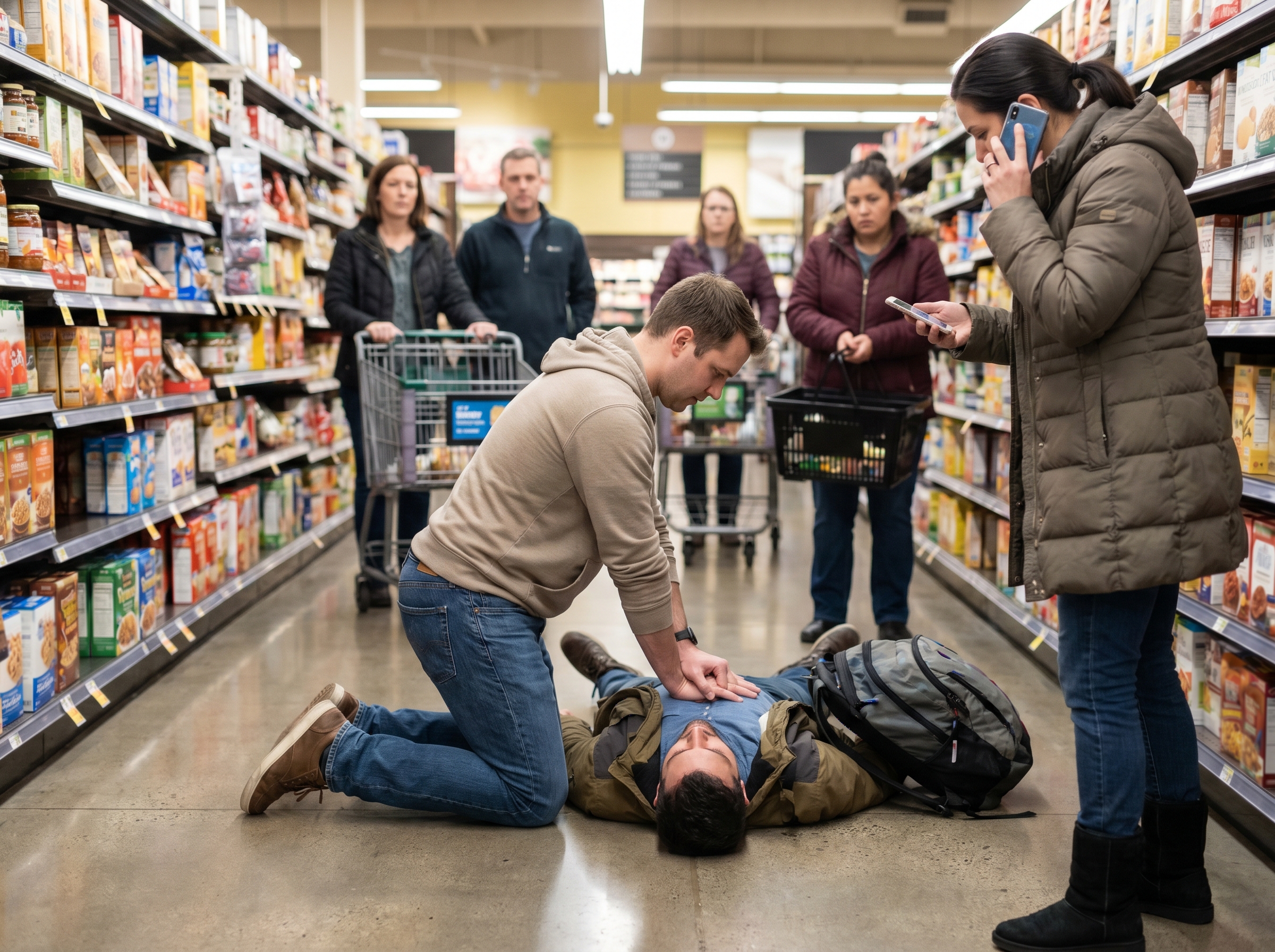
Off-duty healthcare professional performing bystander CPR on a collapsed person in a grocery store


The Science Behind the Freeze Response

The freeze response is not a character flaw. It is a deeply embedded neurological reaction to sudden, high-stakes, unexpected stress. In clinical environments, you operate within a structured system — a team, roles, equipment, protocols, and an implicit expectation that you will act. Remove all of that and put you in a parking lot or a restaurant, and your nervous system reacts very differently.


Psychologically, freezing is a survival mechanism that runs parallel to fight-or-flight. When faced with an unexpected life-threatening event, the amygdala can trigger a temporary paralysis of action as the brain rapidly assesses context and threat. Research published in the American Heart Association's Circulation journal on lay responder experiences confirms that emotional overwhelm, social uncertainty, and situational unfamiliarity are primary drivers of bystander inaction — even among trained individuals.


The hospital is your territory. The coffee shop is not. The cognitive and emotional scripts that fire automatically at work simply do not transfer seamlessly to novel environments. That is the core problem, and once you understand it, you can begin to solve it.


Why Healthcare Workers Face Unique Psychological Barriers

Trained providers actually face a distinct set of hesitation triggers that laypersons do not — some of which are paradoxically caused by their depth of knowledge.


The Perfectionism Trap

Healthcare professionals are trained to do things correctly — correct compression depth, correct rate, correct team communication. In a chaotic public setting without an ambu bag, a defibrillator at arm's reach, or a team to back you up, the gap between your ideal standard and the current reality can feel paralyzing. The inner voice that says "I can't do this properly" silences the voice that says "imperfect CPR is infinitely better than no CPR."


Fear of Liability and Second-Guessing

Concerns about legal liability are among the most commonly reported barriers for off-duty healthcare workers. Questions like "What if I break a rib? What if I do something wrong and get sued?" are understandable, but largely unfounded in practice. Every U.S. state has some form of Good Samaritan law that provides legal protection to individuals who render emergency care in good faith, voluntarily, and without compensation. Off-duty healthcare providers are explicitly covered in most jurisdictions, provided they act reasonably and without gross negligence.


The legal reality is clear: in the absence of a pre-existing duty to treat, acting voluntarily and in good faith in a public emergency is protected. Knowing this intellectually before you ever face the situation — not in the moment of crisis — is what allows you to act.


Role Identity Disruption

In a hospital, you wear a badge. You have a defined role. Other people defer to your expertise automatically. In public, you are just another bystander in jeans and a t-shirt. This loss of role identity is a surprisingly powerful psychological barrier. Without the environmental cues that trigger your clinical identity, the trained provider part of your brain may not activate as readily as it does at work.


The Audience Effect and Social Pressure

Paradoxically, performing CPR in front of a crowd of watching strangers can be more stressful than performing it in front of colleagues. Concerns about being watched, judged, or criticized — combined with uncertainty about how bystanders will respond — add a layer of social pressure that simply does not exist in clinical settings. Research on bystander behavior consistently shows that the presence of other onlookers increases personal distress and can amplify the freeze response through perceived diffusion of responsibility.


What Is Actually at Stake When You Hesitate

The data on bystander CPR outcomes should be burned into the memory of every trained provider.


According to the Sudden Cardiac Arrest Foundation, survival rates after out-of-hospital cardiac arrest remain below 12% overall — but bystander CPR can more than double the likelihood of survival. People who receive CPR within two minutes of cardiac arrest have an 81% greater chance of surviving to hospital discharge and a 95% higher chance of surviving without significant brain damage compared to those who receive no bystander CPR at all.


Equally important: AHA research published in 2024 found that CPR initiated more than 10 minutes after cardiac arrest provided no meaningful survival benefit over no CPR at all. Every minute of delay matters. The window in which you can make a life-or-death difference is narrow, and it closes fast.


Globally, bystander CPR is only initiated in 35 to 40 percent of witnessed cardiac arrests. That number is a reflection of hesitation, not incapability. As someone with clinical training, you are already in the top tier of potential rescuers — the gap between what you could do and what actually gets done is purely psychological.


Practical Strategies to Overcome the Freeze Response

The good news is that the freeze response is not fixed. It can be trained, anticipated, and effectively overridden with the right mental preparation strategies.


Mental Rehearsal: Script It Before It Happens

One of the most powerful tools used by military and emergency personnel is mental rehearsal — deliberately pre-scripting your response to emergencies before they occur. Spend five minutes imagining yourself in a public space when someone collapses. Walk through your actions step by step: you call out for help, you direct someone to call 911, you check responsiveness, you begin compressions. Do this repeatedly in different imagined settings. Research on performance psychology consistently shows that rehearsed mental scripts reduce decision latency in high-stress situations.


Building confidence as a responder outside the hospital setting is very similar to building confidence in your first clinical role. As covered in our resource on building confidence as a new code team member, mental preparation and repeated exposure — even simulated — are the most reliable paths to confident action under pressure.


Adopt the Decisive Action Mindset

One technique that works well for many providers is creating a personal activation phrase — a short internal statement you commit to triggering action regardless of circumstances. Something like: "I act first. I assess while acting." The goal is to interrupt the freeze-analyze-decide loop and replace it with a default behavior pattern. In any witnessed collapse, your first 10 seconds should involve movement, not deliberation.


Remind yourself that in 100% of witnessed cardiac arrest cases, doing nothing guarantees a dramatically worse outcome. Imperfect compressions maintain a survival window. Your job in those first minutes is not to run a perfect resuscitation — it is to buy time until EMS arrives and keep the brain perfused.


Take Command of the Scene Immediately

One of the most effective ways to bypass the social paralysis that public emergencies create is to immediately take verbal command of the situation. Loudly and directly announcing "I am a nurse — I am going to help" accomplishes several things at once: it activates your clinical role identity, it establishes a clear social structure for bystanders, and it assigns responsibility clearly. This simple action shifts you from anonymous bystander to designated responder in seconds.


Direct specific individuals to take specific actions. "You in the red shirt — call 911 now and tell me when they are on the line. You over there — go find an AED." Specificity overcomes the diffusion of responsibility that causes groups of bystanders to collectively do nothing. A crowd of 20 people watching is not the same as 20 people ready to help — until someone activates them.


Know Your AED Landscape

Part of pre-scripting your off-duty response is developing a habit of AED awareness in public spaces. When you walk into a gym, mall, airport, or grocery store, take five seconds to note where the AED is located. This dramatically reduces the cognitive load during an actual emergency. For a comprehensive refresher on AED use and deployment, our guide on AEDs and how they save lives is worth revisiting periodically.


Public-access defibrillation has been shown to dramatically improve OHCA survival rates, especially in the critical minutes before EMS arrival. Your awareness of AED locations is not a trivial habit — it can be the difference between a shockable rhythm being treated in time and irreversible neurological damage.


Remember: Compression-Only CPR Is Effective and Sufficient

One common source of hesitation — particularly around mouth-to-mouth ventilation — is eliminated entirely when you recall that compression-only (hands-only) CPR is fully endorsed by the AHA for adult bystander scenarios. There is no requirement to provide rescue breaths in a public setting. High-quality chest compressions at 100-120 per minute, 2 to 2.4 inches deep, with full chest recoil between each compression, is all that is required until EMS arrives. If you carry a pocket mask or face shield, excellent — but the absence of one is never a reason to delay or withhold CPR.


Good Samaritan Laws: Your Legal Shield as an Off-Duty Provider

Fear of legal consequences is one of the most persistently cited reasons healthcare workers hesitate in off-duty emergencies. Let's address it directly and thoroughly.


Good Samaritan laws exist in every U.S. state and are specifically designed to encourage bystander intervention in emergencies by limiting liability for those who act in good faith. For off-duty healthcare professionals, protection generally applies when the following conditions are met:


  • You are acting voluntarily, without expectation of compensation
  • There is no pre-existing duty to treat the individual
  • You are acting in good faith and with reasonable care
  • You are not committing gross negligence or willful misconduct


While statutes vary by state, the practical reality is that successful lawsuits against individuals who performed bystander CPR in good faith are extraordinarily rare. The far greater ethical and professional risk is doing nothing. Our article on navigating legal considerations for ACLS compliance explores this topic in more depth and is recommended reading for any provider concerned about off-duty liability.


It is also worth noting that the emotional and psychological cost of inaction is well-documented. Research published in a peer-reviewed study available through the National Institutes of Health found that bystanders who did not perform resuscitation showed significantly higher rates of pathological psychological distress in the weeks following a witnessed cardiac arrest compared to those who did intervene. Acting protects not only the patient — it protects you psychologically.


The Role of Regular Training in Building Off-Duty Readiness

One of the most consistent findings in CPR research is that training confidence decays over time — and that the decay accelerates when skills are rarely practiced in real scenarios. For providers who work in non-emergency settings, or whose daily roles do not regularly involve codes, the mental and physical readiness for off-duty intervention can erode significantly between certification cycles.


Simulation training is among the most effective tools available for building the kind of automatic, low-hesitation response that translates from the hospital to the parking lot. As explored in our resource on how simulation training enhances real-world resuscitation skills, deliberate practice in varied scenarios — including off-site and resource-limited environments — is what creates durable, transferable readiness.


This is one important reason why keeping your BLS and ACLS certifications current matters beyond mere credentialing compliance. Regular recertification is not just a box to check — it is a structured opportunity to refresh both the physical mechanics and the mental readiness required for action in any environment. For providers who want to maintain peak readiness without disrupting busy schedules, online recertification options provide a flexible and efficient solution that fits around your clinical schedule.


What to Actually Do: A Step-by-Step Off-Duty Response

Let's walk through the practical response to the scenario you will most likely face: a witnessed adult collapse in a public space. For a detailed walkthrough of this exact situation, see our guide on what to do if someone collapses while you are grocery shopping.


Step 1: Approach and Assess (0-10 seconds)

Move to the patient immediately. Announce loudly: "I am a healthcare professional — I am going to help." Tap the patient's shoulders firmly and shout "Are you okay?" Simultaneously scan for obvious breathing. If unresponsive and not breathing normally, proceed to the next steps without delay.


Step 2: Activate EMS and Locate AED (10-20 seconds)

Point directly at a specific bystander: "You — call 911 right now." Point at another: "You — find the AED and bring it here." Do not rely on general appeals to a crowd. Specific, directed commands bypass the diffusion of responsibility that causes groups to collectively hesitate.


Step 3: Begin Compressions (20 seconds onward)

Position yourself at the patient's side. Interlace your hands, place the heel of your bottom hand on the center of the chest, and begin compressions: hard, fast, and allowing full chest recoil after each push. Rate: 100-120 per minute. Depth: 2 to 2.4 inches. Do not stop to check for a pulse until EMS arrives or an AED is ready to analyze. Minimize interruptions to compressions at all costs — every pause reduces coronary perfusion pressure.
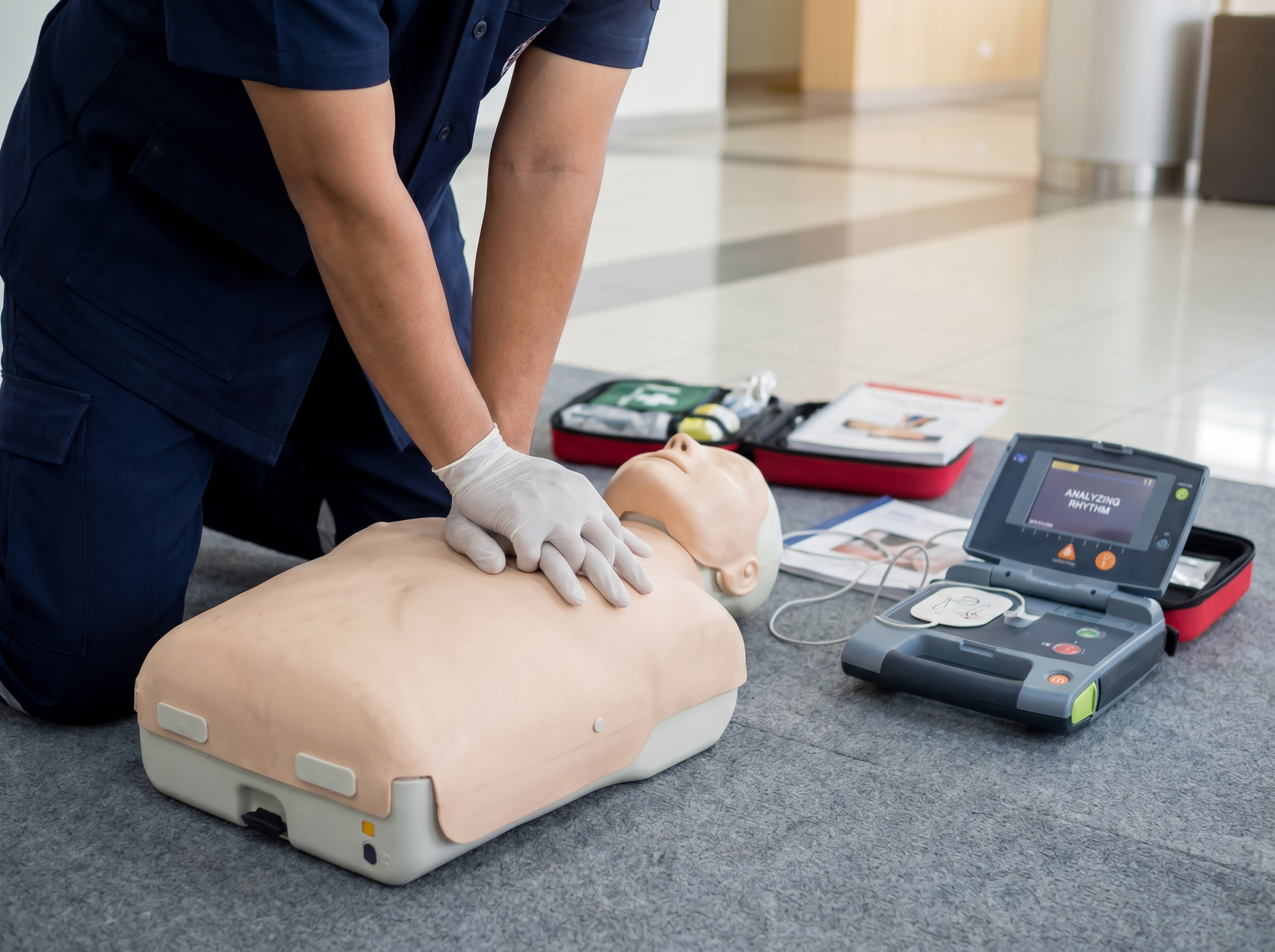
Proper hand placement and technique during chest compressions in a bystander CPR scenario with AED nearby


Step 4: Use the AED As Soon As It Arrives

When the AED arrives, power it on and follow the voice prompts. Modern AEDs are designed for use by minimally trained laypersons — you will find the device intuitive. Continue compressions while pads are being applied if possible, and pause only when the device directs you to during rhythm analysis. After a shock or no-shock advisory, resume compressions immediately without waiting to recheck the pulse.


Step 5: Hand Off to EMS

When EMS arrives, provide a concise, structured handoff: estimated time of collapse, time CPR was started, number of shocks delivered, and any observed changes in patient status. Then step back and allow EMS to take over. Your role is complete and your intervention may well have been the deciding factor in what happens next.


After the Event: Managing the Emotional Aftermath

Whether or not the patient survives, performing CPR in a public setting is emotionally demanding in ways that differ significantly from in-hospital resuscitation. The lack of team support, the uncontrolled setting, and the uncertainty of outcome can trigger strong emotional responses — including guilt, second-guessing, and symptoms consistent with vicarious trauma.


It is normal and appropriate to debrief after an off-duty emergency, even if only with a trusted colleague or through personal journaling. The resources on mental health strategies for ACLS providers address this directly and offer evidence-based approaches for processing difficult resuscitation experiences in a healthy way.


Importantly, the research is reassuring on this point: providers who intervene — regardless of outcome — consistently report lower rates of post-event psychological distress than those who witness a collapse and do not act. Taking action is psychologically protective. The sense of having done everything possible is a powerful buffer against trauma, while the memory of standing by is not.


Staying Ready: Keeping Your Skills Sharp Year-Round

Off-duty readiness is ultimately a product of maintained skills, current knowledge, and deliberate mental preparation. Your certifications are the foundation, but they need to be kept fresh and relevant.


At Affordable ACLS, our BLS certification course — available for just $49 with renewal pricing — is built by board-certified emergency medicine physicians and is 100% online and self-paced. It covers all the core competencies required for confident off-duty response: recognition of cardiac arrest, high-quality CPR mechanics, AED use, and the 2025 AHA guideline updates. You can complete it on your own schedule, from anywhere, with unlimited retakes and immediate digital certification upon passing.


Keeping your BLS current is not just a professional requirement — it is a commitment to being the person in the room who acts when it matters most. The gap between hesitation and action is smaller than you think. Training closes that gap, and the next time you face an off-duty emergency, your response will be automatic.


The Trained Provider's Obligation — and Opportunity

You did not spend years learning to respond to cardiac emergencies so those skills would stay inside the hospital walls. Every time you walk out into the world with clinical training and a current certification, you carry with you the potential to save a life in the most vulnerable, unprepared moment someone will ever face.


The freeze response is real. The hesitation is human. But it is not insurmountable. With mental rehearsal, a clear activation script, a firm understanding of your legal protections, and regularly refreshed skills, you can become someone who acts without hesitation when the moment arrives — not because you are immune to fear, but because you have decided in advance what you will do.


The person who collapses in the grocery store, at the gym, or on your flight home does not have the luxury of waiting for you to work through your hesitation. Every second of inaction is a second their brain is being deprived of oxygenated blood. Your training exists for exactly this moment. Use it.


Ready to renew your BLS or ACLS certification and sharpen the skills you need for confident off-duty response? Visit Affordable ACLS to access fully online, AHA/ILCOR-compliant courses starting at $49 — built by ER physicians, designed for busy healthcare professionals just like you. Reach us at 866-655-2157 or support@affordableacls.com with any questions.


ACLS Blogs

Off-Duty Bystander CPR: Why Healthcare Workers Hesitate in Public and How to Overcome the Freeze Response

You Know What to Do — So Why Did You Freeze?

You have the training. You have the certification. You have responded to codes in the hospital more times than you can count. But last Tuesday at the grocery store, when an older gentleman collapsed in the cereal aisle, something unexpected happened: you froze.


If you are a nurse, physician, paramedic, or other healthcare professional, this scenario may be more familiar than you would like to admit. The hesitation that grips trained providers in off-duty emergencies is real, well-documented, and deeply human — and it has nothing to do with incompetence. Understanding why it happens, and how to wire your brain to override it, is one of the most important things you can do with your clinical skills outside the hospital.


According to the American Heart Association, approximately 350,000 out-of-hospital cardiac arrests (OHCAs) occur in the United States each year, and survival without bystander CPR drops sharply with every passing minute. As a healthcare provider off the clock, you are one of the most valuable assets that bystander could have — if you act.

Off-duty healthcare professional performing bystander CPR on a collapsed person in a grocery store


The Science Behind the Freeze Response

The freeze response is not a character flaw. It is a deeply embedded neurological reaction to sudden, high-stakes, unexpected stress. In clinical environments, you operate within a structured system — a team, roles, equipment, protocols, and an implicit expectation that you will act. Remove all of that and put you in a parking lot or a restaurant, and your nervous system reacts very differently.


Psychologically, freezing is a survival mechanism that runs parallel to fight-or-flight. When faced with an unexpected life-threatening event, the amygdala can trigger a temporary paralysis of action as the brain rapidly assesses context and threat. Research published in the American Heart Association's Circulation journal on lay responder experiences confirms that emotional overwhelm, social uncertainty, and situational unfamiliarity are primary drivers of bystander inaction — even among trained individuals.


The hospital is your territory. The coffee shop is not. The cognitive and emotional scripts that fire automatically at work simply do not transfer seamlessly to novel environments. That is the core problem, and once you understand it, you can begin to solve it.


Why Healthcare Workers Face Unique Psychological Barriers

Trained providers actually face a distinct set of hesitation triggers that laypersons do not — some of which are paradoxically caused by their depth of knowledge.


The Perfectionism Trap

Healthcare professionals are trained to do things correctly — correct compression depth, correct rate, correct team communication. In a chaotic public setting without an ambu bag, a defibrillator at arm's reach, or a team to back you up, the gap between your ideal standard and the current reality can feel paralyzing. The inner voice that says "I can't do this properly" silences the voice that says "imperfect CPR is infinitely better than no CPR."


Fear of Liability and Second-Guessing

Concerns about legal liability are among the most commonly reported barriers for off-duty healthcare workers. Questions like "What if I break a rib? What if I do something wrong and get sued?" are understandable, but largely unfounded in practice. Every U.S. state has some form of Good Samaritan law that provides legal protection to individuals who render emergency care in good faith, voluntarily, and without compensation. Off-duty healthcare providers are explicitly covered in most jurisdictions, provided they act reasonably and without gross negligence.


The legal reality is clear: in the absence of a pre-existing duty to treat, acting voluntarily and in good faith in a public emergency is protected. Knowing this intellectually before you ever face the situation — not in the moment of crisis — is what allows you to act.


Role Identity Disruption

In a hospital, you wear a badge. You have a defined role. Other people defer to your expertise automatically. In public, you are just another bystander in jeans and a t-shirt. This loss of role identity is a surprisingly powerful psychological barrier. Without the environmental cues that trigger your clinical identity, the trained provider part of your brain may not activate as readily as it does at work.


The Audience Effect and Social Pressure

Paradoxically, performing CPR in front of a crowd of watching strangers can be more stressful than performing it in front of colleagues. Concerns about being watched, judged, or criticized — combined with uncertainty about how bystanders will respond — add a layer of social pressure that simply does not exist in clinical settings. Research on bystander behavior consistently shows that the presence of other onlookers increases personal distress and can amplify the freeze response through perceived diffusion of responsibility.


What Is Actually at Stake When You Hesitate

The data on bystander CPR outcomes should be burned into the memory of every trained provider.


According to the Sudden Cardiac Arrest Foundation, survival rates after out-of-hospital cardiac arrest remain below 12% overall — but bystander CPR can more than double the likelihood of survival. People who receive CPR within two minutes of cardiac arrest have an 81% greater chance of surviving to hospital discharge and a 95% higher chance of surviving without significant brain damage compared to those who receive no bystander CPR at all.


Equally important: AHA research published in 2024 found that CPR initiated more than 10 minutes after cardiac arrest provided no meaningful survival benefit over no CPR at all. Every minute of delay matters. The window in which you can make a life-or-death difference is narrow, and it closes fast.


Globally, bystander CPR is only initiated in 35 to 40 percent of witnessed cardiac arrests. That number is a reflection of hesitation, not incapability. As someone with clinical training, you are already in the top tier of potential rescuers — the gap between what you could do and what actually gets done is purely psychological.


Practical Strategies to Overcome the Freeze Response

The good news is that the freeze response is not fixed. It can be trained, anticipated, and effectively overridden with the right mental preparation strategies.


Mental Rehearsal: Script It Before It Happens

One of the most powerful tools used by military and emergency personnel is mental rehearsal — deliberately pre-scripting your response to emergencies before they occur. Spend five minutes imagining yourself in a public space when someone collapses. Walk through your actions step by step: you call out for help, you direct someone to call 911, you check responsiveness, you begin compressions. Do this repeatedly in different imagined settings. Research on performance psychology consistently shows that rehearsed mental scripts reduce decision latency in high-stress situations.


Building confidence as a responder outside the hospital setting is very similar to building confidence in your first clinical role. As covered in our resource on building confidence as a new code team member, mental preparation and repeated exposure — even simulated — are the most reliable paths to confident action under pressure.


Adopt the Decisive Action Mindset

One technique that works well for many providers is creating a personal activation phrase — a short internal statement you commit to triggering action regardless of circumstances. Something like: "I act first. I assess while acting." The goal is to interrupt the freeze-analyze-decide loop and replace it with a default behavior pattern. In any witnessed collapse, your first 10 seconds should involve movement, not deliberation.


Remind yourself that in 100% of witnessed cardiac arrest cases, doing nothing guarantees a dramatically worse outcome. Imperfect compressions maintain a survival window. Your job in those first minutes is not to run a perfect resuscitation — it is to buy time until EMS arrives and keep the brain perfused.


Take Command of the Scene Immediately

One of the most effective ways to bypass the social paralysis that public emergencies create is to immediately take verbal command of the situation. Loudly and directly announcing "I am a nurse — I am going to help" accomplishes several things at once: it activates your clinical role identity, it establishes a clear social structure for bystanders, and it assigns responsibility clearly. This simple action shifts you from anonymous bystander to designated responder in seconds.


Direct specific individuals to take specific actions. "You in the red shirt — call 911 now and tell me when they are on the line. You over there — go find an AED." Specificity overcomes the diffusion of responsibility that causes groups of bystanders to collectively do nothing. A crowd of 20 people watching is not the same as 20 people ready to help — until someone activates them.


Know Your AED Landscape

Part of pre-scripting your off-duty response is developing a habit of AED awareness in public spaces. When you walk into a gym, mall, airport, or grocery store, take five seconds to note where the AED is located. This dramatically reduces the cognitive load during an actual emergency. For a comprehensive refresher on AED use and deployment, our guide on AEDs and how they save lives is worth revisiting periodically.


Public-access defibrillation has been shown to dramatically improve OHCA survival rates, especially in the critical minutes before EMS arrival. Your awareness of AED locations is not a trivial habit — it can be the difference between a shockable rhythm being treated in time and irreversible neurological damage.


Remember: Compression-Only CPR Is Effective and Sufficient

One common source of hesitation — particularly around mouth-to-mouth ventilation — is eliminated entirely when you recall that compression-only (hands-only) CPR is fully endorsed by the AHA for adult bystander scenarios. There is no requirement to provide rescue breaths in a public setting. High-quality chest compressions at 100-120 per minute, 2 to 2.4 inches deep, with full chest recoil between each compression, is all that is required until EMS arrives. If you carry a pocket mask or face shield, excellent — but the absence of one is never a reason to delay or withhold CPR.


Good Samaritan Laws: Your Legal Shield as an Off-Duty Provider

Fear of legal consequences is one of the most persistently cited reasons healthcare workers hesitate in off-duty emergencies. Let's address it directly and thoroughly.


Good Samaritan laws exist in every U.S. state and are specifically designed to encourage bystander intervention in emergencies by limiting liability for those who act in good faith. For off-duty healthcare professionals, protection generally applies when the following conditions are met:


  • You are acting voluntarily, without expectation of compensation
  • There is no pre-existing duty to treat the individual
  • You are acting in good faith and with reasonable care
  • You are not committing gross negligence or willful misconduct


While statutes vary by state, the practical reality is that successful lawsuits against individuals who performed bystander CPR in good faith are extraordinarily rare. The far greater ethical and professional risk is doing nothing. Our article on navigating legal considerations for ACLS compliance explores this topic in more depth and is recommended reading for any provider concerned about off-duty liability.


It is also worth noting that the emotional and psychological cost of inaction is well-documented. Research published in a peer-reviewed study available through the National Institutes of Health found that bystanders who did not perform resuscitation showed significantly higher rates of pathological psychological distress in the weeks following a witnessed cardiac arrest compared to those who did intervene. Acting protects not only the patient — it protects you psychologically.


The Role of Regular Training in Building Off-Duty Readiness

One of the most consistent findings in CPR research is that training confidence decays over time — and that the decay accelerates when skills are rarely practiced in real scenarios. For providers who work in non-emergency settings, or whose daily roles do not regularly involve codes, the mental and physical readiness for off-duty intervention can erode significantly between certification cycles.


Simulation training is among the most effective tools available for building the kind of automatic, low-hesitation response that translates from the hospital to the parking lot. As explored in our resource on how simulation training enhances real-world resuscitation skills, deliberate practice in varied scenarios — including off-site and resource-limited environments — is what creates durable, transferable readiness.


This is one important reason why keeping your BLS and ACLS certifications current matters beyond mere credentialing compliance. Regular recertification is not just a box to check — it is a structured opportunity to refresh both the physical mechanics and the mental readiness required for action in any environment. For providers who want to maintain peak readiness without disrupting busy schedules, online recertification options provide a flexible and efficient solution that fits around your clinical schedule.


What to Actually Do: A Step-by-Step Off-Duty Response

Let's walk through the practical response to the scenario you will most likely face: a witnessed adult collapse in a public space. For a detailed walkthrough of this exact situation, see our guide on what to do if someone collapses while you are grocery shopping.


Step 1: Approach and Assess (0-10 seconds)

Move to the patient immediately. Announce loudly: "I am a healthcare professional — I am going to help." Tap the patient's shoulders firmly and shout "Are you okay?" Simultaneously scan for obvious breathing. If unresponsive and not breathing normally, proceed to the next steps without delay.


Step 2: Activate EMS and Locate AED (10-20 seconds)

Point directly at a specific bystander: "You — call 911 right now." Point at another: "You — find the AED and bring it here." Do not rely on general appeals to a crowd. Specific, directed commands bypass the diffusion of responsibility that causes groups to collectively hesitate.


Step 3: Begin Compressions (20 seconds onward)

Position yourself at the patient's side. Interlace your hands, place the heel of your bottom hand on the center of the chest, and begin compressions: hard, fast, and allowing full chest recoil after each push. Rate: 100-120 per minute. Depth: 2 to 2.4 inches. Do not stop to check for a pulse until EMS arrives or an AED is ready to analyze. Minimize interruptions to compressions at all costs — every pause reduces coronary perfusion pressure.

Proper hand placement and technique during chest compressions in a bystander CPR scenario with AED nearby


Step 4: Use the AED As Soon As It Arrives

When the AED arrives, power it on and follow the voice prompts. Modern AEDs are designed for use by minimally trained laypersons — you will find the device intuitive. Continue compressions while pads are being applied if possible, and pause only when the device directs you to during rhythm analysis. After a shock or no-shock advisory, resume compressions immediately without waiting to recheck the pulse.


Step 5: Hand Off to EMS

When EMS arrives, provide a concise, structured handoff: estimated time of collapse, time CPR was started, number of shocks delivered, and any observed changes in patient status. Then step back and allow EMS to take over. Your role is complete and your intervention may well have been the deciding factor in what happens next.


After the Event: Managing the Emotional Aftermath

Whether or not the patient survives, performing CPR in a public setting is emotionally demanding in ways that differ significantly from in-hospital resuscitation. The lack of team support, the uncontrolled setting, and the uncertainty of outcome can trigger strong emotional responses — including guilt, second-guessing, and symptoms consistent with vicarious trauma.


It is normal and appropriate to debrief after an off-duty emergency, even if only with a trusted colleague or through personal journaling. The resources on mental health strategies for ACLS providers address this directly and offer evidence-based approaches for processing difficult resuscitation experiences in a healthy way.


Importantly, the research is reassuring on this point: providers who intervene — regardless of outcome — consistently report lower rates of post-event psychological distress than those who witness a collapse and do not act. Taking action is psychologically protective. The sense of having done everything possible is a powerful buffer against trauma, while the memory of standing by is not.


Staying Ready: Keeping Your Skills Sharp Year-Round

Off-duty readiness is ultimately a product of maintained skills, current knowledge, and deliberate mental preparation. Your certifications are the foundation, but they need to be kept fresh and relevant.


At Affordable ACLS, our BLS certification course — available for just $49 with renewal pricing — is built by board-certified emergency medicine physicians and is 100% online and self-paced. It covers all the core competencies required for confident off-duty response: recognition of cardiac arrest, high-quality CPR mechanics, AED use, and the 2025 AHA guideline updates. You can complete it on your own schedule, from anywhere, with unlimited retakes and immediate digital certification upon passing.


Keeping your BLS current is not just a professional requirement — it is a commitment to being the person in the room who acts when it matters most. The gap between hesitation and action is smaller than you think. Training closes that gap, and the next time you face an off-duty emergency, your response will be automatic.


The Trained Provider's Obligation — and Opportunity

You did not spend years learning to respond to cardiac emergencies so those skills would stay inside the hospital walls. Every time you walk out into the world with clinical training and a current certification, you carry with you the potential to save a life in the most vulnerable, unprepared moment someone will ever face.


The freeze response is real. The hesitation is human. But it is not insurmountable. With mental rehearsal, a clear activation script, a firm understanding of your legal protections, and regularly refreshed skills, you can become someone who acts without hesitation when the moment arrives — not because you are immune to fear, but because you have decided in advance what you will do.


The person who collapses in the grocery store, at the gym, or on your flight home does not have the luxury of waiting for you to work through your hesitation. Every second of inaction is a second their brain is being deprived of oxygenated blood. Your training exists for exactly this moment. Use it.


Ready to renew your BLS or ACLS certification and sharpen the skills you need for confident off-duty response? Visit Affordable ACLS to access fully online, AHA/ILCOR-compliant courses starting at $49 — built by ER physicians, designed for busy healthcare professionals just like you. Reach us at 866-655-2157 or support@affordableacls.com with any questions.


blogs

More articles for you

all articles

Start Today!

Get certified at your own pace, on your schedule, from the comfort of your home.