Cardiac arrest on a general medical floor is rarely sudden. In the hours before a patient codes, there are almost always warning signs — rising respiratory rate, dropping oxygen saturation, altered mental status, subtle hemodynamic shifts. The tragedy is that those signs too often go unrecognized, under-escalated, or met with a response that arrives too late or without the right skills in the room.
This is precisely the problem a well-built Rapid Response Team (RRT) is designed to solve. By dispatching a skilled, ACLS-credentialed clinical team at the first signs of deterioration — before the patient arrests — hospitals can interrupt the trajectory toward code blue. Research published in PMC confirms that structured RRT programs have reduced inpatient cardiopulmonary arrest rates from 7.41 to as low as 1.77 per 1,000 discharges at some institutions, representing a reduction of more than 75%. Studies comparing code rates before and after RRT implementation show that the results, while variable across settings, are consistently meaningful when teams are built with intention.

Whether you are a nurse manager building your facility's first RRT, a medical director refining an existing program, or an administrator trying to align certification policy with operational need, this guide walks you through every layer — from the ACLS competencies that form the foundation to the debriefing culture that sustains excellence over time.
The rapid response system concept gained serious institutional momentum in 2004 when the Institute for Healthcare Improvement (IHI) launched its 100,000 Lives Campaign, calling on U.S. hospitals to deploy rapid response teams as one of six core interventions to prevent avoidable deaths. The campaign had a measurable ripple effect: hospitals nationwide began formalizing programs that previously existed as informal nurse-to-physician escalation chains.
The Joint Commission formalized the expectation in 2008 by incorporating rapid response systems into its National Patient Safety Goals. Today, Joint Commission resuscitation requirements make clear that hospitals seeking accreditation must demonstrate systematic approaches to recognizing and responding to clinical deterioration — and that ACLS-trained personnel play a central role in satisfying those standards. For facilities pursuing Magnet status, a functioning RRT with verifiable ACLS certification is essentially non-negotiable.
The data supporting this mandate is substantial. Research published in PMC examining RRT programs across multiple hospital settings found consistent reductions in cardiac arrests, adverse events, and in some cases overall hospital mortality. The key variable determining outcomes was not simply whether an RRT existed, but how rigorously it was built, trained, and sustained.
Before any discussion of team structure or escalation protocols, there is a skills baseline that every RRT member must meet. Advanced Cardiovascular Life Support (ACLS) certification is the clinical floor on which rapid response capability is built. An RRT responding to a patient with new-onset altered mental status, a deteriorating airway, or hemodynamic instability needs members who can perform each of the following without hesitation:
These are not skills that can be improvised under pressure. They must be trained, tested, and maintained. For nurses, this means current ACLS certification — not just BLS. For physicians and advanced practice providers on RRT rosters, ACLS competency should be verified before any floor-level response role is assigned.
From a practical standpoint, hospitals face the perennial challenge of keeping certification current for a rotating staff. Group certification solutions designed for healthcare facilities can dramatically reduce the administrative burden of tracking and renewing credentials across a multidisciplinary team. Online ACLS certification — 100% self-paced, AHA/ILCOR-compliant, and available at a fraction of the cost of in-person courses — is an efficient answer to the compliance problem, particularly when RRT membership draws from multiple departments and shift schedules.
There is no single universal RRT composition model, and that is by design. Team structure should reflect your facility's size, staffing patterns, specialty mix, and geographic layout. That said, effective RRTs across the literature share a consistent core membership profile:
In most community and mid-size hospitals, an experienced RN — typically drawn from the ICU or a designated float pool — serves as the primary RRT responder. This individual needs ACLS certification, critical care assessment skills, and the communication confidence to lead a scene until physician arrival. The RRT nurse does not wait for orders to begin the assessment. They own the room.
Depending on your hospital model, the responding provider may be a hospitalist, intensivist, senior resident, or NP/PA. What matters is that this person is reachable within a defined response window — typically two to five minutes — and arrives with decision-making authority. Larger academic centers often use an attending-led model; community hospitals frequently rely on a hospitalist or house officer on first call.
Adding a respiratory therapist to your RRT is one of the highest-yield structural decisions you can make. Respiratory deterioration — rising work of breathing, declining SpO2, impending failure — is among the most common reasons for RRT activation. Having a credentialed RT in the room who can immediately initiate NIV, optimize oxygen delivery, or prepare for intubation dramatically reduces time-to-intervention. ACLS training for RTs is increasingly standard, recognizing that airway management and cardiac resuscitation are inseparable.
Hospitals with embedded clinical pharmacists on rapid response activations report faster and more accurate medication management during complex deterioration events. For patients on polypharmacy regimens, or when the precipitating cause may be drug-related, having a pharmacist at the bedside reduces cognitive load on the responding physician and prevents medication errors under pressure.
A rapid response team is only as effective as the system that activates it. The most capable RRT in the world cannot save a patient whose deterioration was never escalated. This is where Modified Early Warning Score (MEWS) and its derivatives become essential operational tools.
MEWS aggregates five physiologic parameters — heart rate, systolic blood pressure, respiratory rate, temperature, and level of consciousness — into a composite score that triggers escalation thresholds. A score of 4 or above typically warrants increased monitoring frequency; a score of 5 or above typically triggers an RRT call. The simplicity of the scoring system is part of its strength: bedside nurses can calculate it with standard vital signs data, and the threshold gives them institutional authorization to escalate without waiting for physician acknowledgment.
Recent research examining early warning score integration with rapid response systems found that standardized EWS triggers improve the specificity of RRT activations — reducing unnecessary calls while catching the highest-risk patients earlier. For hospitals implementing or upgrading their RRT infrastructure, integrating MEWS or a National Early Warning Score (NEWS2) protocol into the EMR with automated nursing alerts is a high-priority workflow investment.
Beyond the score itself, effective escalation requires a cultural component: bedside nurses must feel empowered — and protected — when they call the RRT. Programs that reduce barriers to nurse-initiated activation consistently outperform those where floor nurses fear appearing alarmist. Structured communication frameworks for code and pre-code situations give nurses the language and confidence to escalate clearly and quickly.
Ambiguity is the enemy of rapid response. Every RRT program must publish — and train staff on — a specific list of activation criteria. These criteria should be posted at every nursing station, integrated into onboarding for new hires, and reviewed at unit-level staff meetings at least quarterly. Standard activation criteria should include:
That last criterion — the "staff concern" or "worry factor" activation — is one of the most powerful components in a mature RRT program. Experienced nurses frequently identify deteriorating patients on gestalt before vitals fully reflect the change. Giving staff permission to call the RRT on clinical instinct, without needing a threshold violation, substantially reduces the time from recognition to response.
A statewide collaborative study published through AHRQ PSNet examining RRT deployment across 31 hospitals found that facilities with clear, low-barrier activation criteria and strong nursing buy-in consistently outperformed those with more restrictive escalation thresholds. The message is straightforward: when in doubt, call it.
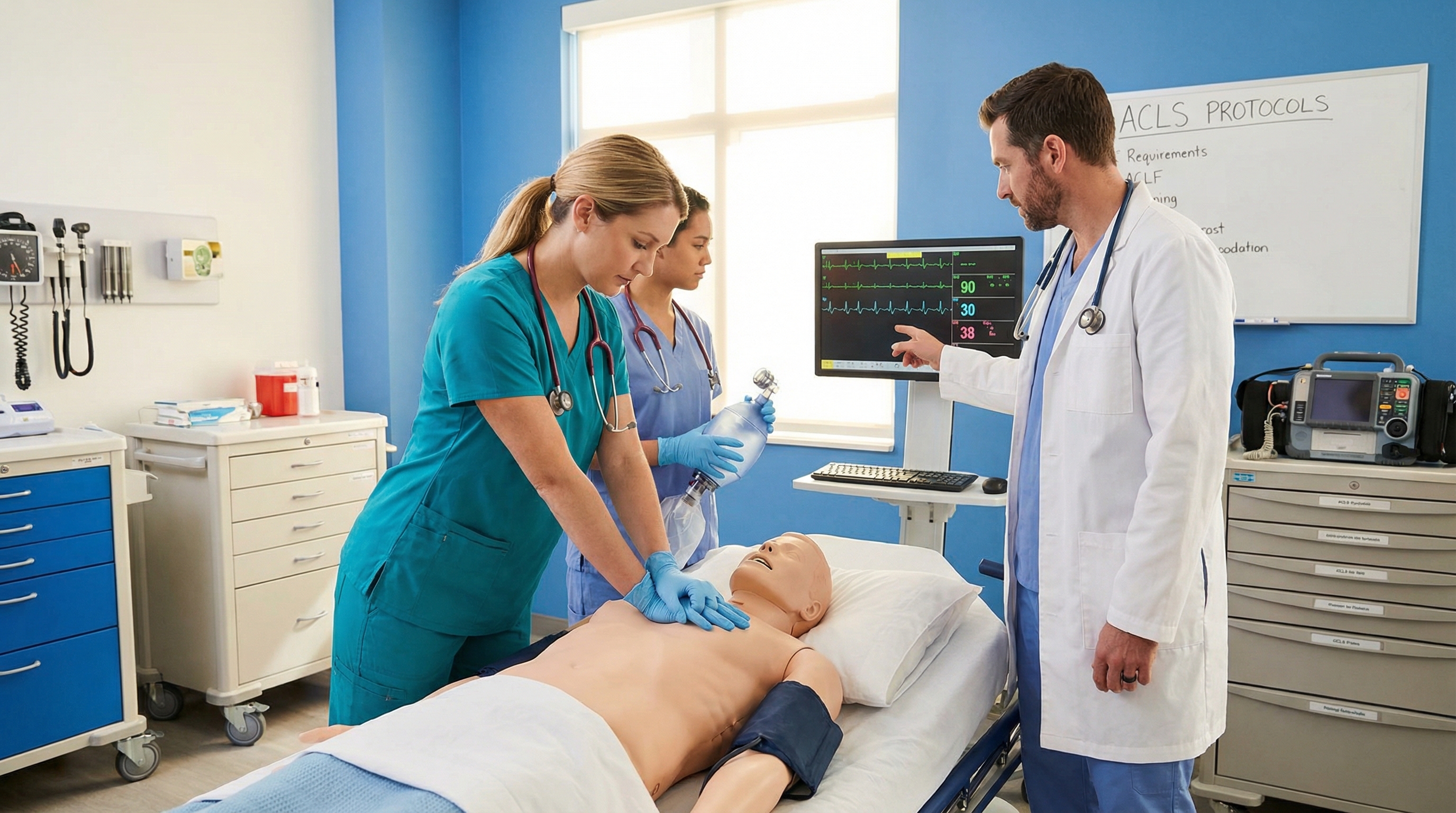
Certification keeps skills current on paper. Simulation is what converts individual competency into team performance. An ACLS-certified nurse who has never run a real RRT call with an unfamiliar physician, in an unfamiliar unit, with a crowd of floor nurses watching from the doorway, is not yet operationally ready. The gap between knowing the algorithm and executing it under pressure closes through repetition — and that repetition must be manufactured deliberately through mock code programs.
Effective mock drill programs run unannounced scenarios on actual patient care floors, using high-fidelity mannequins positioned in patient rooms. They test not just clinical execution but communication: Does the team leader assign roles explicitly? Does the nurse managing compressions rotate correctly? Does the pharmacist confirm medication doses before they are pushed? Does the team document the event in real time? Building an effective mock code program requires leadership commitment, scenario variety, and a structured debrief process that turns every drill into a learning event.

For RRT-specific simulation, scenarios should include the highest-frequency activations your team actually encounters: respiratory distress in a post-op patient, hemodynamic instability in a nephrology patient, new-onset altered mental status in an elderly patient overnight. Running scenarios that mirror real case patterns — rather than textbook-perfect presentations — produces the most durable team readiness.
Every RRT activation — whether it ends with stabilization on the floor, transfer to the ICU, or escalation to a full code — is a data point. The information captured in that activation can drive process improvement, but only if your program has a structured mechanism to extract it. This is where debriefing becomes a strategic tool rather than a box-checking exercise.
Debriefs following RRT calls should be brief, blame-free, and anchored to specific observable behaviors. The goal is not to evaluate individuals but to examine system performance: Was the activation criteria clear? Did the team assemble within the target window? Were the right medications available? Was handoff communication structured and complete? Hot debriefs conducted immediately after high-stakes events capture real-time impressions that cold debriefs — held days later — inevitably lose. Both have value, and a mature RRT program uses both.
On the individual provider side, post-event reflection supported by formal debriefing after ACLS events is associated with measurably better performance in subsequent resuscitations. Clinicians who review what went well and what they would do differently consolidate procedural memory more effectively than those who simply move on to the next patient. Building this reflection habit into RRT membership — not just at the program level but at the individual provider level — creates a continuous improvement loop that compounds over time.
Operational excellence in an RRT program requires measurement. Without data, leadership cannot distinguish between a team that is performing well and one that is quietly underperforming due to documentation gaps, training lapses, or escalation barriers. The following metrics should be tracked at minimum monthly and reviewed in a multidisciplinary quality committee:
The certification compliance metric deserves special attention. An RRT member whose ACLS has lapsed is a compliance liability, a patient safety risk, and a gap in institutional preparedness. Healthcare administrators managing ACLS compliance across multiple departments benefit substantially from centralized tracking dashboards that flag expirations 90 days in advance and make renewal frictionless through accessible, affordable online options.
A long-term cohort study examining mortality reduction following RRT implementation found that programs sustaining their outcomes over multi-year periods shared one consistent feature: administrative investment in ongoing training and competency maintenance. The benefit of an RRT is not permanent; it must be earned and re-earned through continuous investment in the people delivering it.
For RRT programs drawing from ICU nursing, hospitalist medicine, respiratory therapy, and pharmacy, coordinating certification renewals across departments and shift patterns is a genuine logistical challenge. The solution that works for most facilities combines three elements: a centralized certification tracker, a clear renewal policy with defined consequences for lapses, and a certification pathway that removes barriers to renewal.
Online ACLS certification addresses the barrier problem directly. Platforms like Affordable ACLS offer 100% online, self-paced ACLS certification developed and reviewed by Board Certified Emergency Medicine physicians — the same clinical standard as in-person training, at a fraction of the cost and without the scheduling friction of classroom-based programs. At $109 (or $99 for renewal), the cost per provider is low enough to make annual verification — not just biennial renewal — financially feasible for most RRT programs. Unlimited retakes and a money-back guarantee eliminate the risk of an unsuccessful first attempt creating a certification gap.
For facilities certifying multiple team members simultaneously, group solutions streamline both enrollment and compliance documentation. Rather than tracking individual providers through separate enrollment portals, a group certification approach consolidates records, enables bulk renewal, and gives nurse managers and medical directors a single compliance view. For RRT programs targeting 100% certification coverage at all times, this administrative simplification is not a convenience — it is a patient safety mechanism.
The most sophisticated early warning system and the most current ACLS certification cannot substitute for what ultimately makes rapid response teams effective: the people in them, and the culture that surrounds them. RRT programs succeed when the nurses on every floor trust the team and call without hesitation. They succeed when physicians respect the RN's clinical judgment and do not punish escalations that turn out to be precautionary. They succeed when administrators treat RRT membership as a high-value role, not an ancillary task.
Investing in that culture means visible leadership support — nursing directors attending mock drills, CMOs reviewing RRT metrics in quality meetings, and HR treating ACLS certification not as an arbitrary credentialing requirement but as a meaningful marker of clinical readiness. It means celebrating RRT activations that prevented codes, not just examining the ones that preceded them. And it means recognizing that the emotional demands of responding to deteriorating patients — the stress, the uncertainty, the occasional fatality despite everything going right — require intentional support structures for the clinicians on those teams.
Resilience at the team level is built through the same mechanism as clinical competency: deliberate practice, honest feedback, and a shared commitment to getting better. The debrief is not just a quality tool. It is a statement to every RRT member that their work is seen, their observations matter, and the program is serious about continuous improvement.
Building a hospital rapid response team that genuinely reduces code blue events and improves patient outcomes requires more than assembling a roster and posting an activation phone number. It requires an ACLS-competent clinical core, a systematic early warning infrastructure, defined and low-barrier escalation criteria, simulation-based team training, structured post-event debriefing, and the administrative discipline to keep certification current and metrics visible.
Each of these elements reinforces the others. ACLS skills make simulation more meaningful. Simulation makes real activations less chaotic. Debrief makes each activation a learning event. Metrics make the learning systematic. And a culture of safety and escalation makes the whole apparatus run. No single component is sufficient; all of them together create a program that reliably intercepts deterioration before it becomes catastrophe.
If your facility is building or rebuilding its RRT, start with the clinical foundation: ensure every team member carries current ACLS certification, and build your renewal infrastructure around a platform that makes compliance easy and affordable. From there, layer in the operational elements — early warning integration, activation criteria, simulation programs, and debrief culture — with the same deliberateness you bring to the clinical protocols themselves.
Affordable ACLS offers online ACLS certification starting at $99, developed by Board Certified Emergency Medicine physicians and fully AHA/ILCOR-compliant. Self-paced, immediately issued upon completion, and available for group enrollment — it is the practical answer to the certification challenge every RRT program faces. Contact us at 866-655-2157 or support@affordableacls.com to discuss group solutions for your team.
.jpg)