Reproductive endocrinology centers and IVF clinics occupy a unique and often underappreciated position in the landscape of procedural medicine. On any given morning, a team of nurses, embryologists, reproductive endocrinologists, and anesthesia providers may guide a patient through transvaginal oocyte retrieval — a minimally invasive procedure performed under moderate to deep sedation, often with propofol, fentanyl, or midazolam. The setting feels routine. The patients are typically young and healthy. And yet the sedation pharmacology, the physiologic demands of ovarian stimulation, and the relative distance from a full hospital crash team create a risk environment that demands rigorous Advanced Cardiovascular Life Support (ACLS) preparedness.
For physicians, nurses, and advanced practice providers working in IVF and reproductive endocrinology (REI) settings, ACLS certification is not simply a credentialing checkbox — it is a clinical imperative. Rare emergencies happen in well-run ambulatory settings. When they do, the minutes before EMS arrives define outcomes. This article walks through the specific emergency scenarios that REI providers must be prepared to manage, the ACLS skills that apply directly to this setting, and how to ensure your team stays certified and ready.

Egg retrieval, formally known as transvaginal oocyte retrieval (TVOR), is performed under ultrasound guidance and requires meaningful analgesia and anxiolysis. The most common sedation approach in freestanding IVF centers is intravenous (IV) moderate-to-deep sedation — sometimes called monitored anesthesia care (MAC) — using agents such as propofol, fentanyl, and/or midazolam. In some facilities, an anesthesiologist or certified registered nurse anesthetist (CRNA) manages all sedation. In others, reproductive endocrinologists or specially trained nurses administer and monitor moderate sedation directly.
This distinction matters for ACLS preparedness. When a dedicated anesthesia provider is not present, the burden of recognizing and responding to sedation-related emergencies falls on the procedure team. Even when an anesthesiologist is present, every member of the clinical team should be capable of performing high-quality CPR, managing a basic airway, and recognizing shockable versus non-shockable rhythms. As outlined in conscious sedation best practices for procedural settings, providers administering or monitoring sedation must understand dose-response relationships, reversal agents, and emergency escalation pathways.
Propofol is the most commonly used sedation agent in IVF egg retrieval in the United States. Its rapid onset (30 to 60 seconds) and short duration of action make it pharmacologically ideal for a procedure lasting 15 to 30 minutes. However, propofol's narrow therapeutic window carries real risks: respiratory depression, apnea, hypotension, and — particularly in hypovolemic or vasovagally prone patients — cardiovascular instability. The ACEP clinical practice guidelines for procedural sedation emphasize that any qualified provider managing propofol sedation must be prepared for airway rescue and hemodynamic support, including the skills taught through ACLS certification.
Emergencies in IVF clinics are uncommon — but they are not rare enough to ignore. Here are the six clinical scenarios that REI teams should drill and be certified to manage.
Propofol and opioid co-administration can cause rapid-onset apnea, particularly in patients who are anxious, have received pre-procedure anxiolytics, or who have unrecognized obstructive sleep apnea. The ACLS response begins with basic airway management: jaw thrust, head tilt-chin lift, supplemental oxygen, and bag-valve-mask (BVM) ventilation. ACLS-certified providers have practiced BVM technique and know when to escalate to advanced airway placement. For opioid-component apnea, IV naloxone (0.04 to 0.4 mg, titrated) should be immediately available at every sedation station. For benzodiazepine reversal, flumazenil (0.2 mg IV) is the reversal agent of choice, though its shorter half-life compared to benzodiazepines requires careful monitoring for re-sedation.
Vagal tone surges during transvaginal needle passes, particularly when follicle aspiration stimulates the pelvic peritoneum. The resulting vagal bradycardia can be dramatic — heart rates dropping to 30 to 40 bpm within seconds, accompanied by hypotension, pallor, and diaphoresis. In most cases, atropine 0.5 to 1 mg IV and Trendelenburg positioning resolve the event. However, if bradycardia persists below 40 bpm with hemodynamic compromise, the ACLS bradycardia algorithm applies: transcutaneous pacing and dopamine or epinephrine infusion may be required. An understanding of the ACLS adult bradycardia with a pulse algorithm is directly applicable to this scenario and should be part of every REI nurse's clinical toolkit.
Anaphylaxis can be triggered by propofol (in patients with egg or soy allergies), opioids, antibiotics administered peri-procedurally, or latex in gloves and equipment. The classic presentation — urticaria, bronchospasm, hypotension, and tachycardia — can rapidly progress to airway compromise and cardiovascular collapse. First-line treatment is IM epinephrine 0.3 to 0.5 mg (1:1000) in the anterolateral thigh, followed by IV fluid bolus, antihistamines, and corticosteroids. If cardiovascular collapse occurs, the ACLS cardiac arrest algorithm takes over. For a detailed overview, see this guide to managing anaphylaxis in clinical settings where ACLS meets allergic emergencies.
Full cardiac arrest in an IVF clinic is rare but has been reported, including cases associated with severe OHSS and its cardiovascular sequelae. When cardiac arrest occurs in an ambulatory procedural setting, the response framework is identical to any other clinical environment: high-quality CPR at 100 to 120 compressions per minute, AED or defibrillator attachment as rapidly as possible, rhythm analysis, and ACLS algorithm execution. The specific pharmacology — epinephrine 1 mg IV every 3 to 5 minutes, amiodarone 300 mg IV for refractory VF/VT — must be memorized and available. Crash cart location, AED accessibility, and regular team drills are as essential as individual provider certification. ACLS essentials for ambulatory surgery center staff addresses exactly this gap between hospital-based and outpatient emergency preparedness.
OHSS is a well-recognized complication of controlled ovarian stimulation. Mild to moderate OHSS is common and self-limiting. But critical OHSS — characterized by severe ascites, pleural effusion, hemoconcentration, oliguria, and thromboembolic events — is a systemic illness with real cardiovascular implications. According to case reports published in PMC documenting cardiac arrest with OHSS, cardiac arrest associated with OHSS has been documented, driven by extreme hemoconcentration, pericardial effusion, and hypercoagulability leading to coronary thrombosis.
From an ACLS standpoint, OHSS patients presenting acutely to a clinic with hypotension, tachycardia, and respiratory distress require rapid assessment using the systematic approach: airway, breathing, circulation, differential diagnosis. The reversible causes of cardiac arrest — the Hs and Ts framework — are directly relevant here: hypovolemia from third-spacing, hypoxia from pleural effusion, and thrombosis are all realistic etiologies in critical OHSS. Providers who have completed ACLS certification understand how to systematically address these reversible causes while maintaining resuscitative efforts. Research on critical OHSS management published in PMC confirms that cardiovascular monitoring and rapid escalation are cornerstones of severe OHSS care.
Some IVF centers supplement IV sedation with paracervical or intrafollicular local anesthetic blocks using lidocaine or bupivacaine. Inadvertent intravascular injection or rapid systemic absorption can cause local anesthetic systemic toxicity (LAST), presenting with perioral numbness, metallic taste, tinnitus, seizures, wide complex dysrhythmias, and cardiovascular collapse. LAST is managed with IV lipid emulsion therapy (20% intralipid, 1.5 mL/kg bolus), airway management, seizure suppression with benzodiazepines, and ACLS for any resulting cardiac arrest. Standard ACLS algorithms apply, with the important caveat that epinephrine doses should be reduced to 1 mcg/kg during lipid rescue to avoid compounding cardiovascular instability.
A well-prepared IVF clinic team should have ACLS certification across all clinical roles involved in procedural care. This includes reproductive endocrinologists and ob-gyn physicians, reproductive surgery nurses and procedure room nurses, nurse practitioners and physician assistants involved in patient care, and any CRNA or anesthesiologist providing sedation. In the absence of a dedicated anesthesia provider, it is strongly advisable that at minimum two ACLS-certified providers are present in the procedure room or immediately available during any sedation case.
BLS certification is the appropriate baseline for support staff — medical assistants, clinical coordinators, and patient service staff — who may be the first person to encounter a patient collapsing in a waiting room or recovery area. Everything nurses need to know about ACLS certification is a helpful starting resource for REI nurses who may be newer to advanced life support training requirements in their specialty.
ACLS certification is only as effective as the equipment available to support it. Every IVF clinic performing IV sedation should maintain, at a minimum, the following emergency equipment:
The American Society of Anesthesiologists (ASA) practice guidelines for non-anesthesiologist sedation providers recommend that all facilities providing moderate sedation maintain equivalent emergency support infrastructure regardless of patient acuity expectations. State-level accreditation bodies — including those that regulate office-based surgery and ambulatory surgical centers — often mandate specific emergency equipment lists and staff certification requirements that overlap substantially with ACLS competencies.
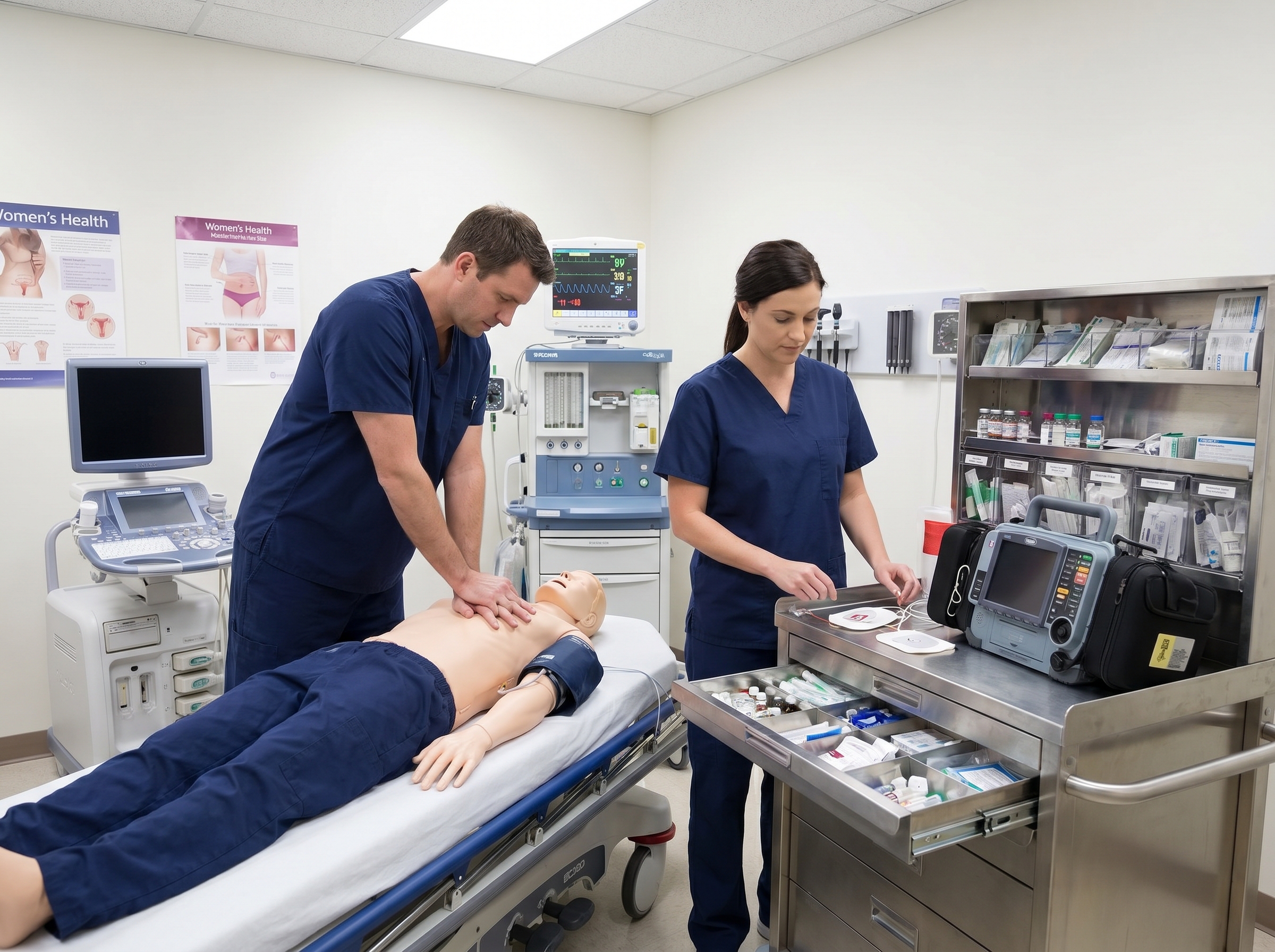
While most IVF patients are young and relatively healthy, certain patient populations present elevated procedural risk that amplifies the importance of ACLS readiness.
Advanced maternal age patients (40 and older) have higher rates of hypertension, subclinical cardiovascular disease, and reduced cardiovascular reserve. Propofol-induced hypotension may be more pronounced, and arrhythmias may be less well-tolerated.
High responders at risk for OHSS — particularly young, lean patients with polycystic ovary syndrome (PCOS) — may present with early-onset hemoconcentration even on the day of retrieval. Hemodynamic instability during or after the procedure in this population warrants heightened monitoring and a lower threshold for emergency response activation.
Patients with known cardiac history or arrhythmias — including those with prior SVT, Wolff-Parkinson-White syndrome, or long QT syndrome — require pre-procedure cardiology clearance and intraoperative ECG monitoring. Providers should be familiar with the ACLS tachycardia algorithm and the arrhythmia-specific interventions that may apply. According to a review published in BJA Education on anesthesia for assisted reproductive technologies, the cardiovascular demands of ovarian stimulation warrant individualized risk stratification, particularly for patients with pre-existing cardiac conditions.
Patients who are pregnant at the time of a procedure — whether undergoing a frozen embryo transfer or management of early pregnancy complications — represent an additional risk layer. Cardiac arrest protocols in pregnancy require specific modifications, including manual left uterine displacement during CPR. For teams caring for any pregnant or potentially pregnant patients, familiarity with modified resuscitation techniques for cardiac arrest in pregnant patients is essential.
Individual ACLS certification is necessary but not sufficient. The difference between a well-executed emergency response and a chaotic one is almost always team preparation. REI clinics should implement mock code drills at least twice per year, simulating the specific scenarios most relevant to their practice — vasovagal events, respiratory depression, and anaphylaxis being the most common. These drills should include role assignment (team leader, compressor, airway manager, medication nurse, documenter), communication protocols using closed-loop techniques, and post-drill debriefs to identify gaps.
Equipment checks should be standardized and documented. AED battery and pad expiration dates, crash cart medication expiration checks, and suction functionality should be verified on a defined schedule — monthly at minimum. Staff turnover in busy IVF practices means onboarding new team members into emergency protocols must be part of clinic orientation, not an afterthought.
The ACLS preparedness framework for plastic and cosmetic surgery centers provides a useful parallel model for IVF clinics, as both settings share the core characteristics of outpatient procedural sedation, elective patient populations, and limited on-site emergency resources compared to hospital-based care.
Accreditation standards for IVF clinics vary by state and accrediting body, but several common frameworks impose emergency preparedness requirements relevant to ACLS. The Joint Commission, AAAHC (Accreditation Association for Ambulatory Health Care), and JCAHO-accredited ambulatory surgical centers all require documented staff training in emergency response, which commonly includes BLS and, for providers administering sedation, ACLS certification.
The Society for Assisted Reproductive Technology (SART) and the American Society for Reproductive Medicine (ASRM) provide clinical guidelines that emphasize informed consent for anesthesia risks, the need for appropriately trained personnel during sedation, and the requirement that emergency equipment and trained staff be available whenever procedural sedation is administered. Research published in the American Journal of Emergency Medicine on emergency department utilization for OHSS demonstrates that clinics unprepared for OHSS-related cardiovascular complications contribute to preventable emergency department transfers and adverse outcomes.
From a liability and risk management standpoint, maintaining documented ACLS certification for all providers involved in sedation administration is a defensible standard of care. In the event of an adverse event, the presence of current ACLS credentials and documented emergency drills can be critical evidence of appropriate institutional preparation.
For providers refreshing their ACLS pharmacology knowledge, the key medications relevant to IVF clinic emergencies fall into several categories. Vasopressors and chronotropic agents — epinephrine, atropine, dopamine — address the hemodynamic instability seen in vasovagal events, anaphylaxis, and cardiac arrest. Antiarrhythmics — amiodarone, lidocaine, adenosine — apply to the rhythm disturbances that can accompany LAST, cardiac arrest, or underlying arrhythmia exacerbation under sedation stress.
Reversal agents — naloxone for opioids, flumazenil for benzodiazepines — are unique to the sedation environment and should be immediately available at every sedation station, not only in a centralized crash cart. This distinction matters when a patient is in a separate procedure room and a reversal event is time-critical. For a comprehensive medication reference, the ACLS medications cheat sheet covering dosages, routes, and indications is a practical bedside resource for REI teams.
Lipid emulsion therapy for LAST deserves special mention. The recommended protocol — intralipid 20% at 1.5 mL/kg IV bolus over 2 to 3 minutes, followed by an infusion of 0.25 mL/kg/min — is not part of standard ACLS algorithms but should be posted at every procedure room where local anesthetics are used. The Association of Anaesthetists recommends that lipid rescue kits be immediately available wherever local anesthetics are administered, and REI clinics using paracervical blocks should adhere to this guidance as a standard safety protocol.
Busy reproductive endocrinology practices face a genuine scheduling challenge when it comes to maintaining team certification. Traditional in-person ACLS courses require half-day or full-day commitments, coordinate around clinical schedules, and can be cost-prohibitive when certifying an entire team simultaneously. For high-volume IVF programs or multi-physician REI practices, the logistical burden of in-person recertification is real — and it often leads to lapses that leave clinics non-compliant and teams under-prepared.
Affordable ACLS was created by Board Certified Emergency Medicine physicians with over 20 years of combined experience, specifically to address this challenge. The platform offers 100% online, self-paced ACLS certification and recertification that providers can complete on their own schedule — before a shift, during a slow afternoon, or over a weekend. At $109 for initial certification and $99 for recertification, the cost is accessible for individual providers and manageable for clinics covering team certification. Unlimited retakes mean no provider faces the anxiety of a one-shot exam, and immediate digital certification upon completion ensures there is no waiting period before credentials are active and verifiable.
For REI clinic administrators managing certification compliance across a team, the ability to send each provider a course link and have them complete certification within days — rather than coordinating an off-site class for the entire staff — represents a meaningful operational advantage. The curriculum is AHA/ILCOR-compliant and covers all the core algorithms and pharmacology that directly apply to the sedation and emergency scenarios described in this article. Providers can review the material as many times as needed before testing, which is particularly valuable for RNs and PAs who may be newer to ACLS or returning after a lapse in certification. A money-back guarantee ensures there is no financial risk to getting started.
The IVF clinic is not a hospital. There is no rapid response team to call overhead, no adjacent ICU, and no in-house pharmacy down the hall. When a patient becomes apneic during propofol sedation, develops a vasovagal arrest during oocyte aspiration, or presents with critical OHSS-related cardiovascular collapse, the responsibility falls entirely on the team in that room. ACLS certification ensures that every provider has internalized the algorithms, pharmacology, and team communication frameworks to respond effectively in those first critical minutes before EMS arrives.
The clinical scenarios covered in this article — respiratory depression, vasovagal events, anaphylaxis, cardiac arrest, OHSS complications, and LAST — are not hypothetical. They appear in case reports, malpractice literature, and quality improvement databases across reproductive medicine. According to Medscape's clinical overview of OHSS, even the most experienced REI teams can encounter life-threatening cardiovascular events in patients who appeared stable moments before. The REI providers who handle these events well are the ones who trained before the emergency, not during it.
If you or your IVF clinic team are due for ACLS certification or recertification, Affordable ACLS provides a clinically rigorous, fully online pathway that fits the demanding schedules of reproductive medicine professionals. Complete your certification today and ensure your team is prepared for every contingency your procedure room might present.
.jpg)