If you have never taken a certification exam online before, the uncertainty can feel bigger than the exam itself. You know the content. You have reviewed the algorithms, the medications, the rhythms. What you have not done is sit down in front of your own laptop and click "start" on something that determines whether you are certified to practice. That gap between knowing the material and knowing the process is where most exam-day anxiety actually lives.
This walkthrough covers exactly what happens from the moment you sit down to the moment you have a certificate in hand: how to set up your space, what the login and exam screens look like, how questions are presented, what happens if you get one wrong, and what the retake and certification process actually involves. The goal is simple: by the time you finish reading, there should be no unknowns left about the format itself, so the only thing left to focus on is the clinical content you already spent time studying with your study plan.
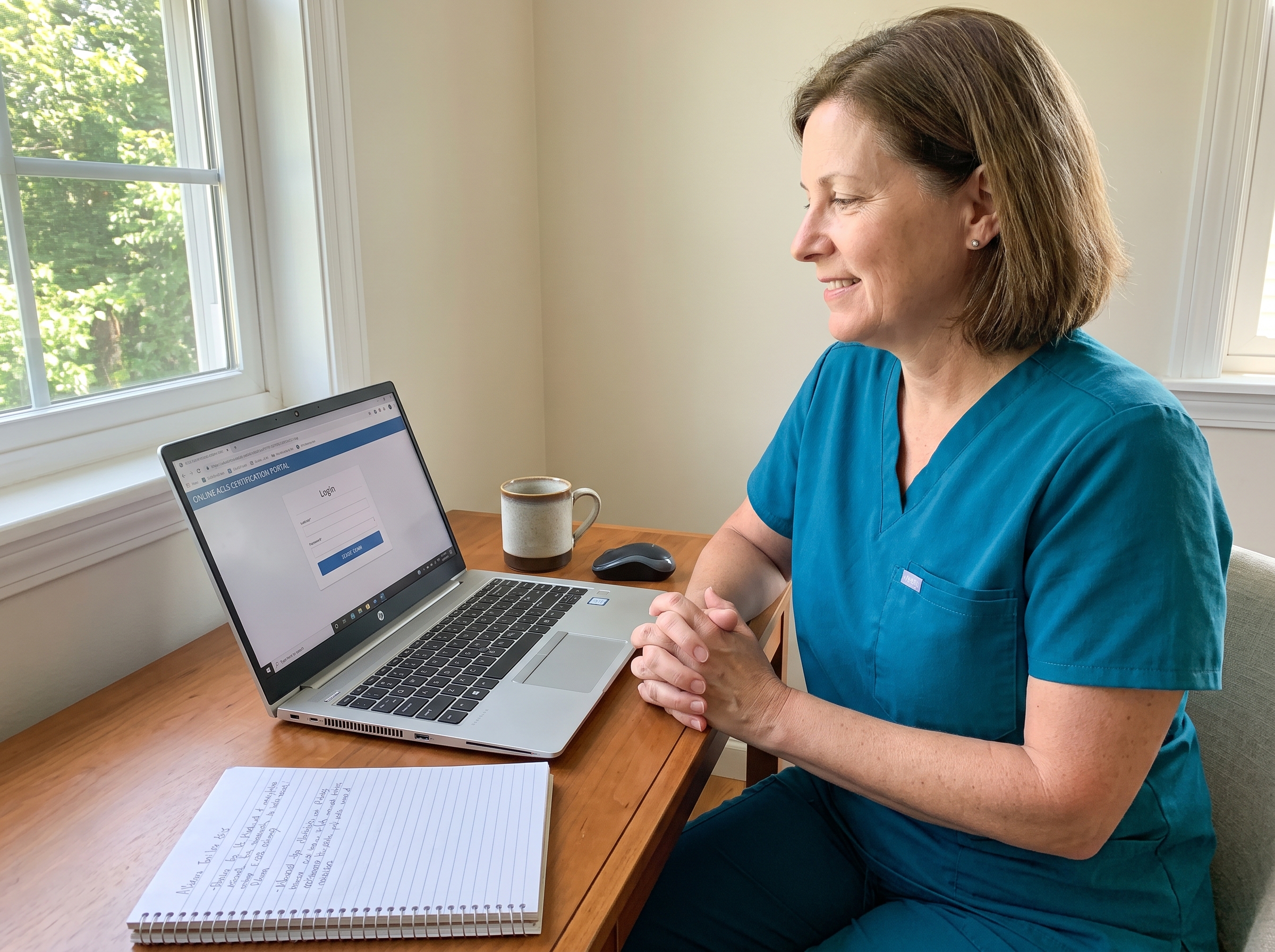
One of the biggest advantages of an online ACLS exam is that you control the environment. There is no testing center, no assigned seat, and no room full of other candidates. That flexibility only pays off if you use it deliberately, so treat your setup like part of the exam itself.
Start with your device. A laptop or desktop with a stable internet connection is the most reliable choice, though the course platform is built to work on a phone or tablet if that is what you have available. Whatever device you use, close out of other tabs and applications first. Update your browser to its current version before you log in, since an outdated browser is the most common cause of a page that will not load properly or a screen that renders oddly.
Next, deal with your physical space. You do not need silence, but you do need a stretch of uninterrupted time. Put your phone on do not disturb, let coworkers or family know you are not to be interrupted, and pick a spot with decent lighting if you plan to reference any printed notes. Because the course is self-paced with no time limit, you are not racing a clock, but you still want to avoid starting and stopping repeatedly, since it is easier to stay in a clinical mindset when you are not constantly re-orienting yourself. For a fuller sense of what the learning modules look like before you even reach the exam, this behind-the-scenes look at an online ACLS course walks through the full learner experience.
If you have not enrolled yet, this is also the point to do it. Enrolling in advance means your account, course materials, and exam access are all ready to go when you sit down, instead of adding an extra step on the day you actually intended to test. You can review course details and enroll directly through the ACLS certification course page.
Once you are set up, logging in is straightforward. You will sign in through your account portal, land on your course dashboard, and pick up exactly where you left off if you have already worked through the training modules. There is no separate scheduling step, no waiting for a proctor to admit you, and no check-in process. You log in when you are ready and the exam is right there.
Because your progress saves automatically, you are also free to step away and come back later if something comes up, without losing the work you have already done. That single feature removes a surprising amount of pressure. In a live classroom setting, stepping out mid-exam is not really an option. Online, it is built into how the course works.
Your account dashboard is also where you will find your course materials, your progress, and eventually your certificate, all in one place. There is no separate exam-booking system to navigate and no confirmation email to wait for before you can begin. If you ever need to log back in on a different device, whether that means finishing on a tablet what you started on a desktop, your account and progress travel with you rather than being tied to a single computer.
The exam itself is presented as a series of questions you answer directly on screen, drawn from the same clinical content covered in your course modules: rhythm recognition, medication dosing and indications, and algorithm-based decision points for scenarios like cardiac arrest, bradycardia, and tachycardia. Questions are multiple choice, so you are selecting the best answer from the options given rather than typing free text or narrating a full code response out loud.
There is no visible countdown timer creating pressure to rush, and there is no proctor watching you through a webcam or looking over your shoulder. You move through the exam at whatever pace lets you think clearly. If you want a preview of what the question style and difficulty actually feel like before your real attempt, working through a set of practice questions is the closest thing to a dress rehearsal. This ACLS pretest with answer rationales is built for exactly that purpose, and the site's free practice tests let you run through additional scenario-based questions before you sit down for the official exam.
A lot of exam anxiety is not actually about the content, it is about the format: being watched, being timed, and knowing that one bad five minutes can undo weeks of preparation. Online, untimed testing removes two of those three pressures entirely, and research on test anxiety in online assessment backs up why that matters. A recent study on test anxiety in online exams found that a candidate's sense of autonomy and self-efficacy, meaning how much control and confidence they feel over the testing situation, directly reduces the anxiety they experience during the exam itself. Being able to set your own pace, in your own space, is not just a convenience, it is a legitimate anxiety-reduction tool. Separate work on measuring test anxiety in online exams confirms this is not just an individual quirk of nerves. It is a well-documented and measurable response across many different candidates, which is exactly why the format of an exam, not just its content, is worth planning for.
That does not mean anxiety will not show up at all. Some nervousness before a certification exam is normal, and even useful, since it tends to sharpen focus rather than derail it entirely. What the self-paced, no-proctor format does is remove the artificial pressure layered on top of that normal nervousness. If you still have questions about how the process works before you commit to a course, the FAQ for first-time BLS, ACLS, and PALS students addresses many of the questions new candidates ask before they ever log in.
It also helps to remember that self-directed online learning is not a workaround or a lesser substitute for in-person training. Self-directed formats are an established and studied part of resuscitation education, and the American Heart Association's resuscitation education science guidelines address self-instruction and self-directed formats directly as part of how providers are trained and assessed. You are not taking a shortcut by testing online. You are using a format that has been studied and built into how modern resuscitation training actually works.
Missing a question on a low-stakes online exam is not the crisis it can feel like in the moment. There is no buzzer, no red mark flashed on screen, and no penalty structure designed to punish a single wrong answer out of proportion to what it actually means about your clinical knowledge. The exam is a checkpoint, not a single point of failure.
This design is consistent with what learning science says about testing in general. Research on retrieval practice, summarized by Washington University's Center for Teaching and Learning, shows that the act of attempting to recall information, even when you get it wrong, strengthens the memory pathway more than passively re-reading material would. In other words, missing a question and then seeing the correct answer is itself part of how you learn the content more durably, not just a test of what you already knew. If you want to see the specific errors that trip up a lot of first-time candidates, the top 10 mistakes healthcare professionals make during an ACLS exam breaks down the patterns worth watching for.
Here is the policy that changes how most people approach the whole experience once they actually understand it: retakes are unlimited and available at no extra charge until you pass. There is no cap on attempts, no cooling-off period, and no separate fee each time you want to try again. That single detail is worth sitting with for a moment, because it reframes what the exam actually is. It is not a one-shot event where a single rough afternoon determines your certification status. It is a checkpoint you can approach again as many times as it takes.
Knowing this in advance changes the exam experience itself. Candidates who understand that a missed attempt simply means reviewing the material and trying again tend to approach the exam with less white-knuckle tension than candidates who believe, incorrectly, that they get one chance. If you would rather build confidence before your official attempt than lean on the retake policy afterward, working through additional questions on the free practice tests ahead of time is the more proactive route.
Once you pass, certification is immediate. There is no waiting period, no card arriving by mail weeks later, and no separate approval step. You download and print your certificate right from your account as soon as you complete the exam, which means you can hand it to a supervisor, upload it to a credentialing system, or attach it to a job application the same day you tested.

If you are wondering whether an employer will actually accept a certificate generated this way, that is a fair question and a common one for first-time online candidates. Verification and employer acceptance are covered in detail in this look at how online ACLS certification is verified by employers, but the short version is that a digital certificate tied to your account is not a lesser form of proof, it is simply a faster one.
Use this list the morning of, or the night before, your exam to make sure the format is one less thing to think about.
None of these steps take more than a few minutes, but together they remove almost every logistical surprise that could otherwise interrupt your focus once you actually begin answering questions.
Strip away the unknowns and the online ACLS exam is a lot less intimidating than it looks from the outside: you log in on your own schedule, answer questions at your own pace with no proctor watching, get the chance to try again at no extra cost if you need to, and walk away with a certificate the moment you pass. None of that changes how important the clinical content is, but it does mean the format itself should not be the thing keeping you up the night before.
If you still have not started your course, or you are ready to schedule your exam attempt, you can review options and enroll on the ACLS certification page. And if pediatric or basic life support recertification is also on your radar, working from a clear day-by-day study plan can make the whole process feel a lot more manageable, no matter which certification you are working toward next.
.jpg)