If you search "do paramedics need ACLS," you will find confident answers on both sides, and both sides are half right. The truth is that no single answer covers every paramedic, because paramedic licensure and Advanced Cardiovascular Life Support certification are two different things governed by two different systems. One is a credential issued by your state after you pass the National Registry of Emergency Medical Technicians (NREMT) exam. The other is a course completion card documenting that you have demonstrated the resuscitation algorithms, pharmacology, and team leadership skills built around current American Heart Association guidelines. A paramedic can hold a valid state license and never be required to show an ACLS card. Another paramedic, working two exits down the highway for a different agency, might lose their job without one.
This guide walks through the four recognized EMS certification levels, where ACLS actually sits relative to NREMT certification and state licensure, and who realistically ends up requiring it: your EMS agency's policy, your medical director's protocols, hospital-based employers, and interfacility or critical care transport services. We will also cover flight and critical care transport, where ACLS moves from "sometimes required" to close to universal.
The National EMS Scope of Practice Model recognizes four levels of EMS licensure in the United States: Emergency Medical Responder (EMR), Emergency Medical Technician (EMT), Advanced EMT (AEMT), and Paramedic. Each level has its own scope of practice, training-hour range, and skill set, and each is licensed at the state level after the candidate passes the corresponding NREMT cognitive and psychomotor exams. Understanding where you sit in that ladder is the first step to understanding whether ACLS applies to you.
EMRs are typically the first trained responders on scene, often in roles like fire first response, campus safety, or industrial medical teams. The EMR scope is intentionally narrow: scene safety, initial patient assessment, bleeding control, oxygen administration, and high-quality CPR with AED use until an ambulance crew arrives. EMR training runs roughly 40 to 60 hours. ACLS is not part of the EMR conversation at all. At this level, the relevant life-support credential is BLS, not ACLS, because EMRs do not carry cardiac medications, do not interpret rhythms, and do not lead a resuscitation team.
EMTs make up the largest share of the EMS workforce. Training generally runs 150 to 190 hours and covers patient assessment, splinting, oxygen therapy, and a short list of assisted or protocol-driven medications such as aspirin, oral glucose, epinephrine auto-injectors, and albuterol. BLS certification is foundational at this level and is usually a condition of the EMT license itself, not an optional add-on. If you want the full breakdown of which roles require BLS versus ACLS across healthcare, our job-by-job BLS requirements guide is a useful companion to this one. EMTs generally do not need ACLS, since the EMT scope does not include cardiac drug administration, IV therapy, or rhythm-based algorithm decisions.
AEMT is the bridge level between basic and advanced life support. Depending on the state, training runs anywhere from roughly 150 to 400 hours on top of EMT certification. AEMTs can start IV and IO lines, use supraglottic airway devices, and administer a limited formulary of medications beyond what an EMT can give. Some AEMT protocols brush up against ACLS-adjacent content, like certain cardiac arrest medications, but the AEMT scope of practice generally stops short of full rhythm interpretation, synchronized cardioversion, or independent code leadership. Whether an individual AEMT needs ACLS comes down almost entirely to local protocol and medical director sign-off rather than a blanket national rule.
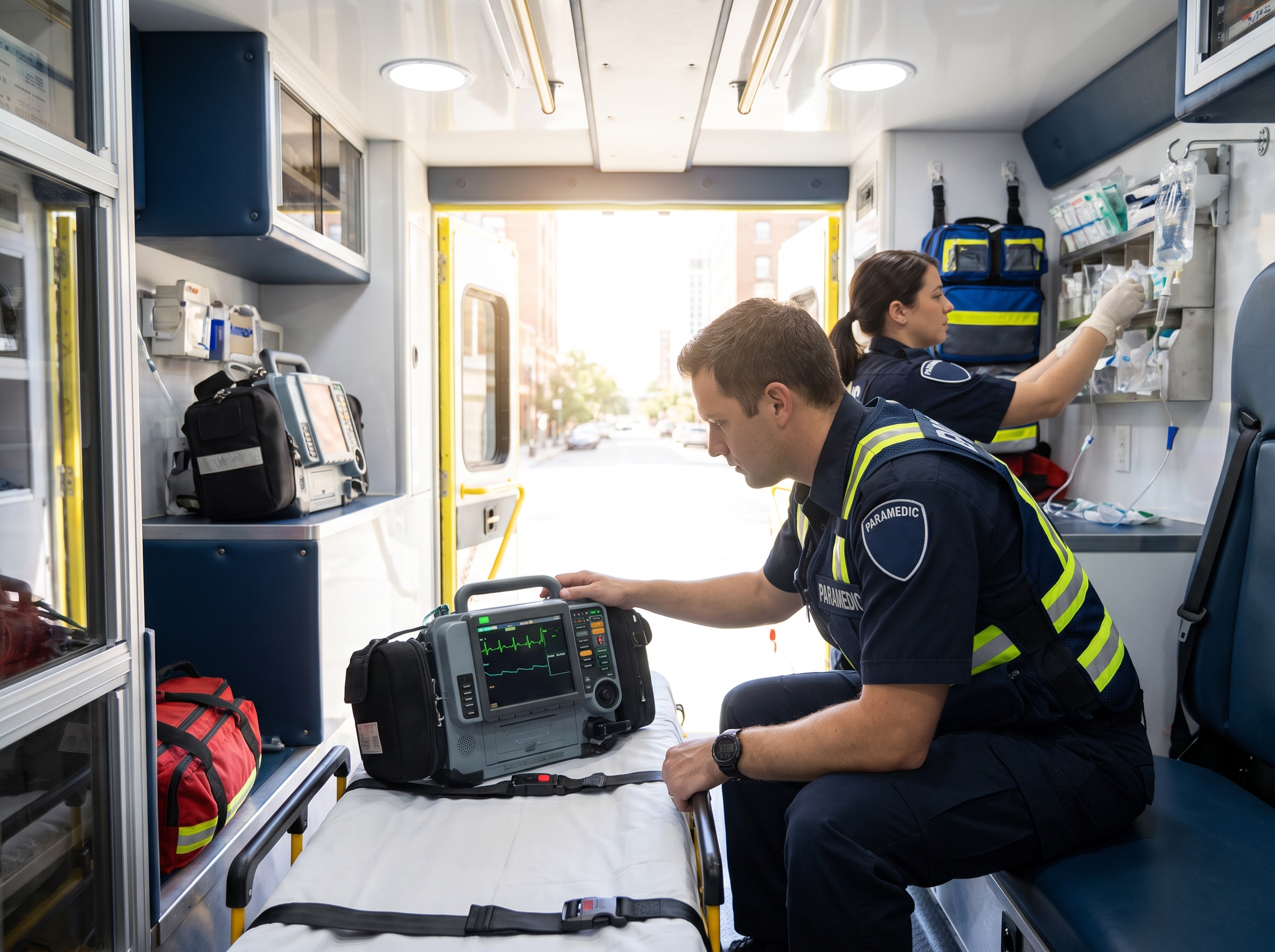
Paramedic is the top EMS licensure level, with 1,000 to 1,800 or more hours of training depending on the program. Paramedic scope includes cardiac monitoring, 12-lead ECG acquisition and interpretation, advanced airway management including intubation, a full medication formulary, defibrillation, synchronized cardioversion, and in many systems the authority to lead a resuscitation independently until a physician assumes care. This is exactly why the "do paramedics need ACLS" question keeps coming up: paramedic education already teaches most of the content an ACLS course covers, algorithm by algorithm. But teaching the content and issuing the credential are not the same thing. If you are mapping out the jump from EMT to paramedic and want to understand how ACLS-style training fits into that transition, see our guide on how ACLS certification bridges the gap from EMT to paramedic.
Your paramedic license is what gives you legal authority to practice, and it comes from your state EMS office after NREMT certification and any state-specific requirements are met. ACLS is a course completion card from an AHA-aligned training provider showing you have current knowledge of specific cardiac arrest, bradycardia, tachycardia, and post-arrest care algorithms, along with team dynamics and pharmacology. According to the StatPearls overview of EMS scope of practice, credentialing for specific skills and protocols happens at the individual agency level under the authority of the system medical director, which is a separate process entirely from earning or renewing a life-support course card.
In practice, this means the NREMT Paramedic exam tests your ability to manage cardiac arrest, unstable rhythms, and advanced airways as part of your scope of practice, but passing it does not automatically hand you an ACLS card, and most state EMS licensing boards do not list ACLS as a licensure prerequisite. The National EMS Scope of Practice Model defines what each level of EMS licensure is permitted to do; it does not mandate that paramedics carry a specific commercial or association-issued course card to exercise that scope. That distinction is exactly where the confusion around this topic usually starts.
The most honest answer to "does my agency require ACLS" is: read your agency's policy, because it varies enormously. A rural, BLS-transport-focused service running mostly non-emergency transfers may never ask for it. A busy urban or suburban 911 ALS service, on the other hand, frequently lists current ACLS as a condition of employment for every paramedic on the roster, even though the paramedic curriculum already overlaps with ACLS content, because the card gives HR and quality assurance teams a standardized, auditable proof point.
Medical directors carry real weight here. Local protocols are typically written to align with, or directly reference, current AHA algorithms for cardiac arrest, bradycardia, and tachycardia management. A medical director can require ACLS as part of the credentialing packet that authorizes a paramedic to function under their standing orders, separate from whatever the state license alone allows. This is also where recredentialing cycles matter: a lapsed ACLS card can suspend a paramedic's authorization to perform certain interventions even though their state paramedic license is still active.
Hospital-based paramedics, including those working as ED techs, cath lab team members, or on hospital-employed critical care teams, are usually folded into the hospital's broader code-team credentialing policy. That policy typically applies the same ACLS requirement to every code-team-eligible staff member regardless of underlying license type, whether they are a paramedic, RN, or respiratory therapist. Since BLS is the one certification almost every clinical role shares, it is worth checking our job-by-job BLS requirements guide alongside your hospital's ACLS policy to see the full picture of what your role actually mandates.
Interfacility and critical care transport employers are among the most consistent requirers of ACLS for paramedics. When a paramedic crew is moving a patient between facilities, especially an ICU-level or ALS-level transfer, the receiving hospital and the transport company's own quality standards generally expect current ACLS, and often PALS, on file before that paramedic is scheduled on transport shifts. Unlike a 911 response where backup and online medical control are minutes away, an interfacility crew may be the only clinical team available to the patient for the length of a long transport.
Flight and critical care transport is the corner of EMS where ACLS stops being situational and starts being close to a baseline expectation. Paramedics pursuing Flight Paramedic (FP-C) or Critical Care Paramedic (CCP-C) credentials through the International Board of Specialty Certification are expected to maintain current, working knowledge of ACLS, PALS, and neonatal resuscitation content as part of the exam's clinical judgment domain. Programs that staff helicopters and fixed-wing aircraft routinely require ACLS, PALS, and sometimes NRP as conditions of hire, not just recommendations. For a deeper look at how these considerations play out in the air specifically, see our guide to ACLS considerations for air medical transport crews.

Ground-based critical care transport (CCT) programs follow a similar pattern. These are hospital-based or contracted interfacility programs moving ventilated, drip-dependent, or otherwise unstable patients, and the paramedic or paramedic-nurse team functions as the code team for the entire transport with no ability to call in additional hands mid-transfer. It makes sense, then, that CCT programs commonly list current ACLS, along with PALS or pediatric-specific training, as a prerequisite for the role rather than something to pick up later. If flight or critical care transport is where you are headed, treating ACLS as a career prerequisite rather than an optional extra will save you from being screened out of an application before you even get to the interview.
Every EMS provider, from EMR through paramedic, is expected to hold current BLS, since it is the foundation for high-quality chest compressions, AED use, airway basics, and team-based CPR that underlies everything else in resuscitation. If you have ever wondered exactly how BLS and ACLS differ in scope and audience, our article on the difference between BLS and ACLS breaks down the distinction skill by skill.
ACLS builds directly on top of that BLS foundation. Where BLS is about compressions, airway, and defibrillation as a team member, ACLS adds rhythm-specific decision trees for cardiac arrest, symptomatic bradycardia, and unstable tachycardia, along with the pharmacology and team leadership skills needed to run a code rather than simply support one. For a paramedic already functioning at full ALS scope in the field, ACLS is less about learning brand-new clinical content and more about formalizing that competency into a credential that agencies, medical directors, and hospitals can verify at a glance.
Even paramedics whose current agency does not require ACLS often end up getting certified anyway, because it shows up as a checkbox somewhere down the career path. Nursing programs frequently expect it before clinical rotations that involve acute or critical care units. Physician assistant programs and hospital-based residency-adjacent roles often list it as a preferred or required credential. If you are considering the jump from field paramedicine into a PA program, our guide to moving from paramedic to PA covers how certifications like ACLS fit into that transition. Getting ACLS early, even before your current employer technically requires it, keeps your resume ready for the next opportunity instead of scrambling to certify under a deadline.
Once you know your agency, medical director, or target employer expects ACLS, the certification process itself is straightforward. Current American Heart Association guidance describes ACLS as built for personnel who direct or participate in managing cardiac arrest, stroke, and other cardiopulmonary emergencies, which squarely includes paramedics working at the ALS level, according to the American Heart Association's CPR and ECC guidelines. Many paramedics prefer a self-paced, online format precisely because shift schedules make it hard to commit to a fixed classroom date. Affordable ACLS's ACLS certification course was built by practicing emergency medicine physicians and lets you work through the material between shifts, at your own pace, without losing progress if you have to log off mid-module. If this is your first ACLS card rather than a renewal, the ACLS certification course option is the one built specifically for first-time certification.
No. NREMT certification and state paramedic licensure do not require you to separately hold an ACLS card, even though paramedic school curriculum covers much of the same clinical ground. ACLS is a course credential layered on top of your license, not a prerequisite for earning it.
No. Paramedic education teaches the assessment and treatment skills behind cardiac arrest and arrhythmia management as part of your scope of practice, but it does not issue an ACLS course completion card. Those are two separate credentials tracked separately by employers and medical directors.
No, and this is the most common source of confusion. Requirements vary by agency policy, medical director protocols, and employer type. It is most consistently required in hospital-based EMS roles, interfacility and critical care transport, and flight programs, and least consistently required in smaller BLS-focused or rural transport-only services.
Whether a paramedic needs ACLS is not a national rule; it is a local answer shaped by your agency, your medical director, and the kind of transport or hospital-based work you do. EMR and EMT roles rarely require it. AEMT sits in a gray zone decided by local protocol. Paramedics working hospital-based roles, interfacility transport, or flight and critical care programs should expect it as close to a baseline requirement. If you have checked your agency policy and confirmed you need current ACLS, moving forward with a self-paced, physician-built course is the fastest way to close that gap without pulling you off a shift schedule that was never designed around a classroom seat.
.jpg)