ACLS Blogs

In-House ACLS Training vs. Online Certification: A True Cost Comparison for Department Managers

The Question Every Department Manager Eventually Faces

You have a team of nurses, physicians, and clinical staff due for ACLS recertification. The question is not whether to certify them — that is non-negotiable for compliance and patient safety. The real question is how to do it in a way that does not blow your training budget, pull staff off the floor for an entire day, or create scheduling chaos in an already stretched department.


For years, in-house instructor-led ACLS training was the default. You booked a classroom, arranged an AHA-certified instructor, ordered course materials, and blocked a full day on the schedule. It felt like the right way to do things. But as healthcare operations have grown leaner and the demands on department managers have intensified, that model deserves a hard look — specifically at what it actually costs versus what you get from it.


This article breaks down the true, all-in cost of in-house ACLS training versus online certification, so you can make the most informed decision for your team. Because the number on the invoice is only part of the story.
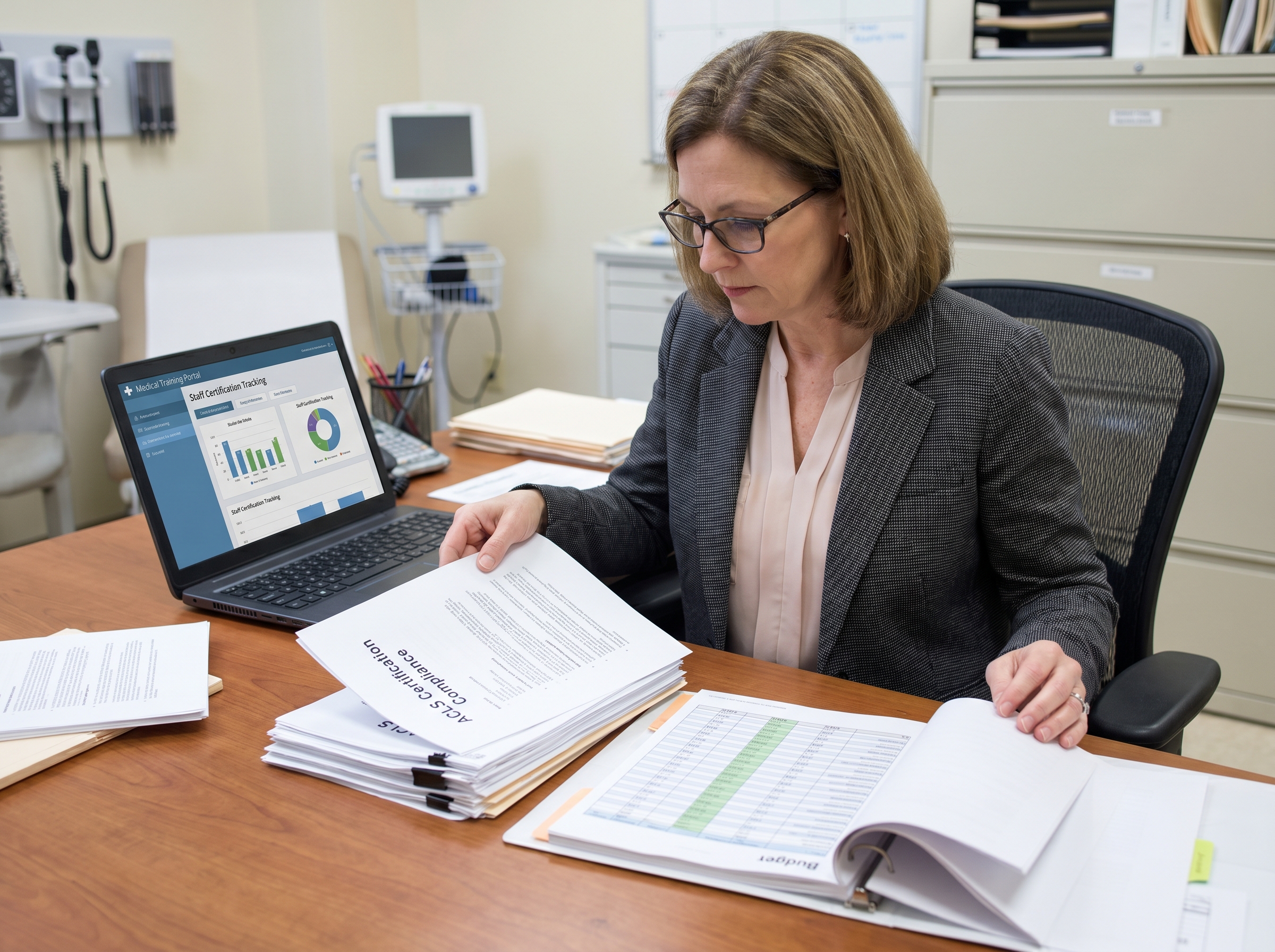
Healthcare department manager reviewing ACLS certification budget and compliance records at desk


The Real Cost of In-House ACLS Training

On the surface, in-house training looks straightforward: pay an instructor, provide space, and get your staff certified. But when you account for every input required to run a single in-house ACLS session, the total often surprises even experienced department managers.


Direct Costs

The most visible expenses are the direct costs associated with the course itself. These typically include:


  • Instructor fees: A certified ACLS instructor typically charges $500 to $1,500 per session, depending on location and demand. If you are contracting through a training center, facility fees may be added on top.
  • Course materials: AHA provider manuals, pocket reference cards, and supplementary materials can run $30 to $60 per student.
  • Equipment and consumables: Manikins, defibrillators, medication simulation supplies, and AED training devices must be maintained and replenished. If your facility owns this equipment, you still face depreciation and upkeep costs. If you rent, add $200 to $500 per session.
  • Space and setup: Using a hospital conference room or classroom carries an opportunity cost. That space could be used for other operational purposes.

For a group of ten staff members, direct out-of-pocket costs for a single in-house ACLS session often range from $1,500 to $3,000 before you account for a single hour of staff time.


The Hidden Costs Department Managers Rarely Track

The numbers above are just the starting point. The costs that rarely appear in a training budget line item are often the most significant — and they compound with every certification cycle.


  • Staff overtime or shift coverage: A full-day in-house ACLS course requires pulling clinicians off their regular assignments. In a department running tight on staffing, that often means overtime pay for coverage or paying agency staff to fill gaps. At $45 to $75 per hour for a floor nurse, a 6 to 8 hour training day per staff member is a substantial labor expense.
  • Lost productivity: Every hour a nurse, physician, or respiratory therapist sits in a classroom is an hour they are not generating revenue or providing direct patient care. For a department billing by procedures or patient encounters, this has a measurable financial impact.
  • Scheduling and coordination burden: Someone — usually a charge nurse, education coordinator, or the department manager themselves — spends significant administrative hours organizing dates, communicating with instructors, managing last-minute cancellations, and tracking completions. That time has a real dollar value.
  • Failed attempts and retakes: When a staff member fails an in-house ACLS exam, the facility typically bears the cost of a remediation session or rescheduled course. These costs are rarely budgeted in advance.
  • Last-minute expirations: When certifications slip through the cracks and expire, departments scramble to find emergency training solutions, often at premium rates. As explored in our piece on the hidden costs of delaying ACLS renewal, the downstream financial and compliance consequences of lapsed certifications are frequently underestimated.

What In-House Training Actually Costs Per Person

When you add up direct costs, shift coverage, and administrative overhead, the true all-in cost per certified staff member for in-house ACLS training typically falls between $200 and $500 per person — sometimes higher in urban markets with elevated labor costs. For a department certifying 20 staff members twice every two years, that translates to $8,000 to $20,000 in certification expenditures per cycle.


What Online ACLS Certification Actually Costs

Online ACLS certification operates on a fundamentally different cost structure. Platforms like Affordable ACLS charge a flat per-person fee with no hidden add-ons — and that fee is a fraction of in-house training costs.


Transparent, Flat-Rate Pricing

At Affordable ACLS, current pricing is straightforward:


  • ACLS Certification: $99 per person
  • ACLS Recertification: $89 per person
  • BLS Certification: $59 per person
  • BLS Recertification: $49 per person
  • ACLS + BLS Bundle: $123 per person
  • ACLS + BLS + PALS Bundle: $227 per person

These prices include the full course, unlimited retakes at no additional charge, and an immediately downloadable digital certificate upon passing. There are no instructor fees, no equipment rentals, no materials costs, and no facility expenses layered on top.


No Overtime. No Shift Coverage. No Scheduling Headaches.

Because Affordable ACLS courses are fully self-paced and accessible on any device, staff can complete certification during low-census periods, between shifts, during breaks, or from home on their own time. Most courses are completed in 1 to 2 hours. This eliminates the largest hidden cost in the in-house model: pulling staff off patient care and paying for coverage.


For departments managing multiple certifications simultaneously, group certification solutions allow managers to coordinate multiple enrollments with centralized tracking — making it easy to monitor who is certified, who is due for renewal, and who has completed their course without requiring manual spreadsheets or administrative follow-up.


Side-by-Side Cost Comparison: A 20-Person Department

Let us put real numbers on the table for a mid-sized department certifying 20 clinical staff members for ACLS recertification:


In-House Training Scenario

  • Instructor fee (1 session, 20 participants): $800
  • Course materials ($35/person x 20): $700
  • Equipment rental/manikins: $400
  • Shift coverage for 20 staff (avg. 6 hours at $55/hr): $6,600
  • Administrative coordination (10 hrs at $30/hr): $300
  • Miscellaneous (refreshments, printing, etc.): $150

Total In-House Cost: approximately $8,950 — or roughly $447 per staff member.


Online Certification Scenario (Affordable ACLS)

  • ACLS Recertification ($89/person x 20): $1,780
  • Course materials: $0 (included)
  • Equipment: $0 (no equipment needed)
  • Shift coverage: $0 (self-paced, completed off-shift or during downtime)
  • Administrative coordination: Minimal (centralized tracking dashboard)

Total Online Cost: $1,780 — or $89 per staff member.


That is a potential savings of over $7,000 per certification cycle for a single department — without compromising the quality or clinical validity of the certification. Multiplied across multiple departments or annual recertification cycles, the budgetary impact becomes substantial.
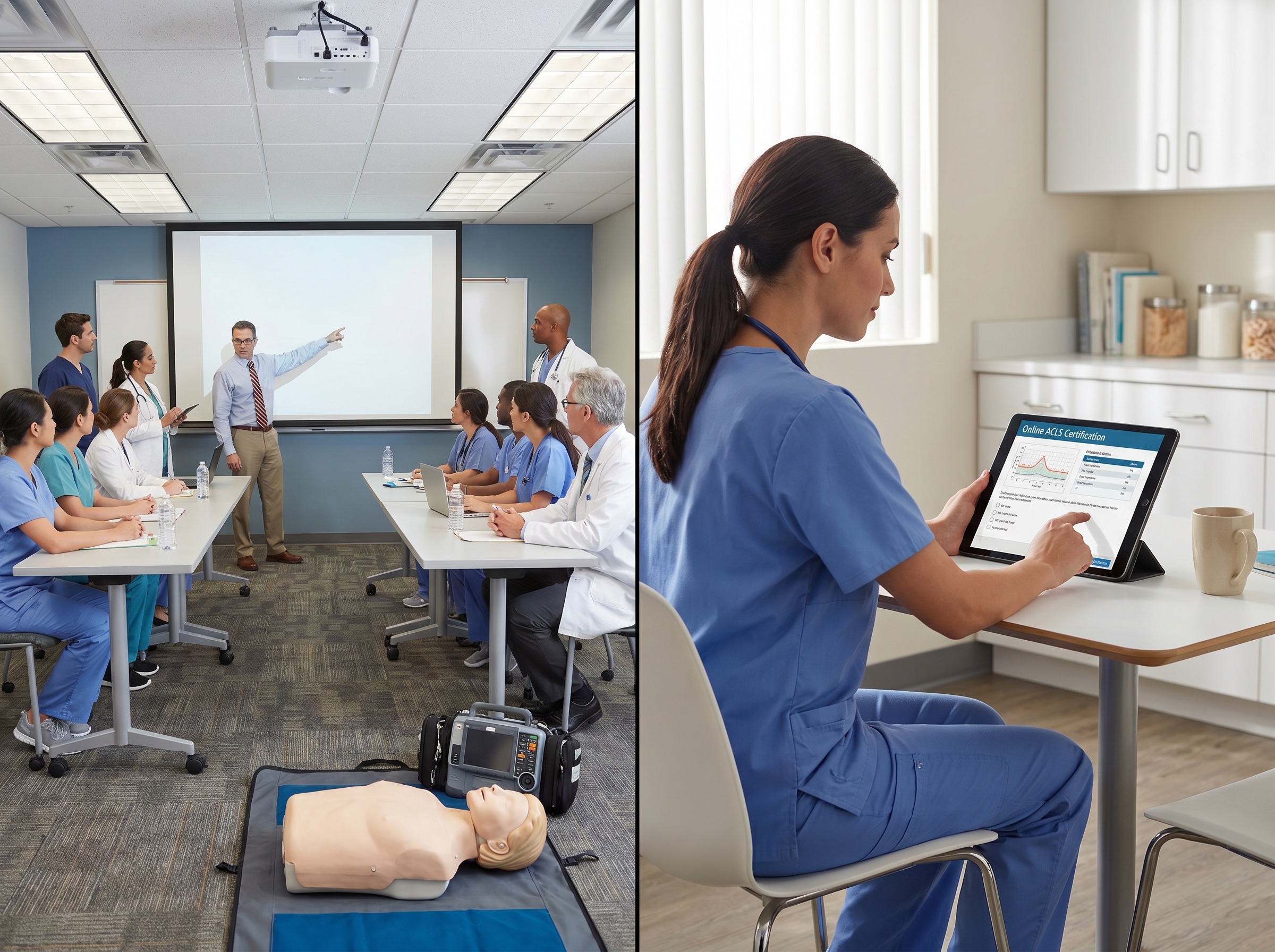
Comparison of in-house classroom ACLS training versus self-paced online certification on tablet device


Does Online ACLS Match In-House Quality?

This is the question department managers reasonably ask, and it deserves a direct answer. The concern is understandable: if you are responsible for a code team's performance during a real cardiac arrest, you want to know the certification carries weight.


Affordable ACLS courses are developed by actively practicing, Board Certified Emergency Medicine physicians with more than 20 years of combined clinical and academic experience. The curriculum is built on current American Heart Association (AHA) and ILCOR guidelines — the same evidence base used in any accredited ACLS program. The content covers the full scope of ACLS algorithms, pharmacology, rhythm recognition, and team dynamics that clinicians need to function effectively in a resuscitation.


From an employer acceptance standpoint, online ACLS certification is widely accepted across healthcare settings. According to ACLS Online's comparative analysis of online vs. in-person formats, online ACLS training and certification is accepted in all 50 states by most healthcare employers and facilities. The determining factor is not delivery format — it is whether the content aligns with recognized guidelines and whether your specific institution's credentialing policy accepts the certificate.


Affordable ACLS offers a money-back guarantee if an employer does not accept the certification — a meaningful assurance for department managers recommending this option to their teams. For a deeper look at how employer acceptance works in practice, see the guide on employer reimbursement for ACLS certification courses.


The Administrative Advantage for Department Managers

Beyond cost, there is an operational dimension that department managers often find equally compelling: the reduction in administrative burden when teams certify online.


With in-house training, the logistics fall squarely on the department. You coordinate with instructors, confirm attendance, handle rescheduling when staff call in sick on training day, track completion paperwork, and store physical certificates. If you manage a department of 30 or more clinical staff with staggered certification expiration dates, this becomes an ongoing administrative project rather than a periodic task.


Online certification platforms centralize all of this. Staff receive recertification reminders, complete courses on their own schedule, and generate their own digital certificates immediately upon passing. Department managers gain visibility into completion status without chasing down individuals. The healthcare administrator's guide to ACLS compliance and budgeting covers exactly how to build this kind of systematic tracking into your department's workflow.


Scheduling Flexibility: The Underrated Benefit

Healthcare staffing is under sustained pressure. Nurse-to-patient ratios are tight, overtime is costly, and any unplanned absence from patient care creates downstream operational stress. In this environment, scheduling a full-day in-house training event requires significant logistical effort — and it creates real disruption even when it goes according to plan.


Online certification eliminates scheduling as a constraint. Staff can complete their course at any time, on any device, at any pace. A physician can finish a section before rounds and complete the exam on a lunch break. A night-shift nurse can certify from home on a day off. This flexibility is not just convenient — it is operationally significant for departments that cannot afford to pull multiple staff members simultaneously.


As discussed in the detailed breakdown of online vs. in-person ACLS certification options, scheduling flexibility is one of the most consistently cited advantages among healthcare professionals who have made the transition to online certification. It is especially valuable for departments with high shift variability, travel clinicians, or staff working across multiple locations.


Compliance Tracking: Staying Ahead of Expiration Dates

One of the most common and preventable compliance failures in healthcare departments is allowing certifications to expire due to poor tracking. Research from StaffReady's analysis of training program ROI found that effective training management systems directly correlate with fewer compliance citations — and that manually tracked systems are far more prone to lapses.


In-house training events create a one-time snapshot of compliance. Everyone who attended is certified. Everyone who missed training is not — and unless someone actively tracks re-scheduling, those individuals can remain out of compliance for weeks while the department waits for the next available instructor date.


Online platforms provide a continuous compliance model. Recertification reminders go out automatically. Staff can re-certify as soon as they receive a reminder without waiting for a group event to be scheduled. The result is a department that maintains near-100% certification compliance throughout the calendar year rather than cycling between peaks of full compliance and valleys of expiring credentials.


According to NetSuite's healthcare budgeting analysis, compliance training costs are among the most controllable budget line items in healthcare operations — and organizations that implement proactive recertification systems consistently reduce their per-person compliance training costs compared to reactive, event-based training models.


When In-House Training Still Makes Sense

This is not an argument that in-house training is without merit. There are specific scenarios where instructor-led, in-person ACLS training offers advantages that online certification does not fully replicate:


  • Hands-on skills integration: For newly hired staff with limited clinical experience, supervised mannequin practice and real-time instructor feedback can reinforce procedural skills that experience alone cannot replicate. If your department is onboarding large cohorts of new graduates, a blended approach — online didactics combined with in-house skills stations — may be optimal.
  • Team-based simulation: ACLS team dynamics — closed-loop communication, role clarity during a code — benefit from group practice. An in-house simulation session focused specifically on teamwork, run as a supplement to rather than a replacement for online certification, can address this dimension effectively.
  • State or facility-specific requirements: A small number of states and institutions have specific requirements around skills assessments that must be documented at an authorized training center. Department managers in California, for example, should confirm their facility's policy, as some institutions require documented in-person skills sessions alongside the didactic component.

For most departments certifying experienced clinicians who are maintaining existing skills rather than building them from scratch, online certification delivers full value at a fraction of the cost.


Calculating Your Department's ROI on Online Certification

The ROI of switching from in-house to online ACLS certification is not abstract — it is calculable. Here is a simple framework department managers can apply:


  • Count your staff requiring certification: Include all RNs, physicians, PAs, NPs, and other clinical staff who require ACLS as a condition of employment in your department.
  • Estimate your current all-in cost per certification: Add instructor fees, materials, equipment, shift coverage, and administrative overhead. Divide by the number of staff certified per event.
  • Compare to online pricing: At $89 per recertification through Affordable ACLS, calculate your total outlay for the same number of staff.
  • Multiply by certification frequency: ACLS requires recertification every two years. Calculate your cumulative savings over a 4-year planning horizon.

For a 30-person department where in-house training costs $400 per person and online recertification costs $89 per person, the savings over a four-year period (two recertification cycles) amount to approximately $18,660. That is a meaningful budget recovery that can be redirected to equipment, staffing, or clinical education initiatives that provide direct patient care value.


Research from Education Management Solutions on maximizing healthcare training ROI consistently demonstrates that combining cost-effective certification with systematic competency tracking produces the highest overall return — both financially and in terms of clinical outcome improvements.


Getting Staff to Pursue Online Certification Independently

One practical advantage of online certification that compounds department-level savings: many facilities offer tuition reimbursement or continuing education stipends that cover online certification costs. When staff certify independently using employer reimbursement, the cost to the department budget may be zero — and the administrative burden shifts entirely to the individual.


At $89 to $99 per course, online ACLS certification from Affordable ACLS falls well within the range of most CE reimbursement budgets. Staff who understand how to leverage employer reimbursement for certification courses can often cover their own certification costs with minimal out-of-pocket expense, while the department maintains complete compliance records. This approach effectively converts a department budget line item into a distributed individual benefit — a win on both sides of the ledger.


Real-World Application: The Small Clinic Model

The economics are not limited to large hospital departments. Consider how this plays out for smaller clinical settings — a primary care practice, a dialysis center, an urgent care clinic. These facilities often lack the volume to make in-house training cost-effective and may struggle to find instructors willing to schedule sessions for small groups.


A case study on small clinic certification efficiency with Affordable ACLS illustrates how a facility with fewer than 15 clinical staff used online certification to achieve 100% compliance across the team in less than two weeks — without scheduling a single group event or incurring any instructor or equipment costs. The clinical director estimated total savings of over $3,000 compared to their previous in-house model.


According to a cost breakdown published by Respond and Rescue's ACLS certification cost analysis, in-person group ACLS training at a training center ranges from $150 to $300+ per person even before facility overhead costs are applied — making the online model's flat-rate pricing especially compelling for facilities operating on tight margins.


Making the Decision: A Practical Framework for Department Managers

If you are evaluating whether to transition your department from in-house to online ACLS certification, consider the following criteria:


  • Experienced staff: If the majority of your clinical team already holds active ACLS certification and is recertifying rather than certifying for the first time, online is almost always the more efficient and cost-effective choice.
  • Scheduling constraints: If pulling multiple staff members off the floor simultaneously creates operational or patient care challenges, online certification solves this problem completely.
  • Budget pressure: If your department is under pressure to reduce non-clinical expenditures without compromising quality or compliance, online certification delivers immediate, measurable savings.
  • Employer acceptance: Verify your facility's credentialing policy accepts online certification. Most do, and Affordable ACLS's money-back guarantee provides a safety net for those who have not yet confirmed acceptance.
  • New graduates or skills gaps: If you are onboarding staff who have never performed ACLS in a clinical setting, supplement online certification with structured skills station practice before deploying them to the code team.

The Bottom Line for Department Managers

The true cost of in-house ACLS training is substantially higher than the invoice from your training center suggests. When you account for shift coverage, lost productivity, administrative overhead, and the compliance gaps created by event-based scheduling, the real per-person cost is often four to five times the sticker price of an online certification course.


Online ACLS certification through Affordable ACLS delivers guideline-compliant, physician-developed, employer-accepted certification at a price point that makes department-wide compliance genuinely affordable. At $89 per recertification with unlimited retakes, no equipment costs, no shift disruption, and immediate digital certificates, the financial case is straightforward.


The question is not whether online certification is good enough. Developed by Board Certified Emergency Medicine physicians and grounded in current AHA and ILCOR guidelines, it meets the same clinical and educational standards as any accredited ACLS program. The question is whether your department's training budget is being used in the most effective way possible — and for most managers, the answer increasingly points toward online.


Ready to explore how online group certification can work for your department? Visit Affordable ACLS group certification solutions or contact the team directly at 866-655-2157 to discuss options for your facility. Every member of your team can be certified, compliant, and confident — without breaking the department budget.


ACLS Blogs

In-House ACLS Training vs. Online Certification: A True Cost Comparison for Department Managers

The Question Every Department Manager Eventually Faces

You have a team of nurses, physicians, and clinical staff due for ACLS recertification. The question is not whether to certify them — that is non-negotiable for compliance and patient safety. The real question is how to do it in a way that does not blow your training budget, pull staff off the floor for an entire day, or create scheduling chaos in an already stretched department.


For years, in-house instructor-led ACLS training was the default. You booked a classroom, arranged an AHA-certified instructor, ordered course materials, and blocked a full day on the schedule. It felt like the right way to do things. But as healthcare operations have grown leaner and the demands on department managers have intensified, that model deserves a hard look — specifically at what it actually costs versus what you get from it.


This article breaks down the true, all-in cost of in-house ACLS training versus online certification, so you can make the most informed decision for your team. Because the number on the invoice is only part of the story.

Healthcare department manager reviewing ACLS certification budget and compliance records at desk


The Real Cost of In-House ACLS Training

On the surface, in-house training looks straightforward: pay an instructor, provide space, and get your staff certified. But when you account for every input required to run a single in-house ACLS session, the total often surprises even experienced department managers.


Direct Costs

The most visible expenses are the direct costs associated with the course itself. These typically include:


  • Instructor fees: A certified ACLS instructor typically charges $500 to $1,500 per session, depending on location and demand. If you are contracting through a training center, facility fees may be added on top.
  • Course materials: AHA provider manuals, pocket reference cards, and supplementary materials can run $30 to $60 per student.
  • Equipment and consumables: Manikins, defibrillators, medication simulation supplies, and AED training devices must be maintained and replenished. If your facility owns this equipment, you still face depreciation and upkeep costs. If you rent, add $200 to $500 per session.
  • Space and setup: Using a hospital conference room or classroom carries an opportunity cost. That space could be used for other operational purposes.

For a group of ten staff members, direct out-of-pocket costs for a single in-house ACLS session often range from $1,500 to $3,000 before you account for a single hour of staff time.


The Hidden Costs Department Managers Rarely Track

The numbers above are just the starting point. The costs that rarely appear in a training budget line item are often the most significant — and they compound with every certification cycle.


  • Staff overtime or shift coverage: A full-day in-house ACLS course requires pulling clinicians off their regular assignments. In a department running tight on staffing, that often means overtime pay for coverage or paying agency staff to fill gaps. At $45 to $75 per hour for a floor nurse, a 6 to 8 hour training day per staff member is a substantial labor expense.
  • Lost productivity: Every hour a nurse, physician, or respiratory therapist sits in a classroom is an hour they are not generating revenue or providing direct patient care. For a department billing by procedures or patient encounters, this has a measurable financial impact.
  • Scheduling and coordination burden: Someone — usually a charge nurse, education coordinator, or the department manager themselves — spends significant administrative hours organizing dates, communicating with instructors, managing last-minute cancellations, and tracking completions. That time has a real dollar value.
  • Failed attempts and retakes: When a staff member fails an in-house ACLS exam, the facility typically bears the cost of a remediation session or rescheduled course. These costs are rarely budgeted in advance.
  • Last-minute expirations: When certifications slip through the cracks and expire, departments scramble to find emergency training solutions, often at premium rates. As explored in our piece on the hidden costs of delaying ACLS renewal, the downstream financial and compliance consequences of lapsed certifications are frequently underestimated.

What In-House Training Actually Costs Per Person

When you add up direct costs, shift coverage, and administrative overhead, the true all-in cost per certified staff member for in-house ACLS training typically falls between $200 and $500 per person — sometimes higher in urban markets with elevated labor costs. For a department certifying 20 staff members twice every two years, that translates to $8,000 to $20,000 in certification expenditures per cycle.


What Online ACLS Certification Actually Costs

Online ACLS certification operates on a fundamentally different cost structure. Platforms like Affordable ACLS charge a flat per-person fee with no hidden add-ons — and that fee is a fraction of in-house training costs.


Transparent, Flat-Rate Pricing

At Affordable ACLS, current pricing is straightforward:


  • ACLS Certification: $99 per person
  • ACLS Recertification: $89 per person
  • BLS Certification: $59 per person
  • BLS Recertification: $49 per person
  • ACLS + BLS Bundle: $123 per person
  • ACLS + BLS + PALS Bundle: $227 per person

These prices include the full course, unlimited retakes at no additional charge, and an immediately downloadable digital certificate upon passing. There are no instructor fees, no equipment rentals, no materials costs, and no facility expenses layered on top.


No Overtime. No Shift Coverage. No Scheduling Headaches.

Because Affordable ACLS courses are fully self-paced and accessible on any device, staff can complete certification during low-census periods, between shifts, during breaks, or from home on their own time. Most courses are completed in 1 to 2 hours. This eliminates the largest hidden cost in the in-house model: pulling staff off patient care and paying for coverage.


For departments managing multiple certifications simultaneously, group certification solutions allow managers to coordinate multiple enrollments with centralized tracking — making it easy to monitor who is certified, who is due for renewal, and who has completed their course without requiring manual spreadsheets or administrative follow-up.


Side-by-Side Cost Comparison: A 20-Person Department

Let us put real numbers on the table for a mid-sized department certifying 20 clinical staff members for ACLS recertification:


In-House Training Scenario

  • Instructor fee (1 session, 20 participants): $800
  • Course materials ($35/person x 20): $700
  • Equipment rental/manikins: $400
  • Shift coverage for 20 staff (avg. 6 hours at $55/hr): $6,600
  • Administrative coordination (10 hrs at $30/hr): $300
  • Miscellaneous (refreshments, printing, etc.): $150

Total In-House Cost: approximately $8,950 — or roughly $447 per staff member.


Online Certification Scenario (Affordable ACLS)

  • ACLS Recertification ($89/person x 20): $1,780
  • Course materials: $0 (included)
  • Equipment: $0 (no equipment needed)
  • Shift coverage: $0 (self-paced, completed off-shift or during downtime)
  • Administrative coordination: Minimal (centralized tracking dashboard)

Total Online Cost: $1,780 — or $89 per staff member.


That is a potential savings of over $7,000 per certification cycle for a single department — without compromising the quality or clinical validity of the certification. Multiplied across multiple departments or annual recertification cycles, the budgetary impact becomes substantial.

Comparison of in-house classroom ACLS training versus self-paced online certification on tablet device


Does Online ACLS Match In-House Quality?

This is the question department managers reasonably ask, and it deserves a direct answer. The concern is understandable: if you are responsible for a code team's performance during a real cardiac arrest, you want to know the certification carries weight.


Affordable ACLS courses are developed by actively practicing, Board Certified Emergency Medicine physicians with more than 20 years of combined clinical and academic experience. The curriculum is built on current American Heart Association (AHA) and ILCOR guidelines — the same evidence base used in any accredited ACLS program. The content covers the full scope of ACLS algorithms, pharmacology, rhythm recognition, and team dynamics that clinicians need to function effectively in a resuscitation.


From an employer acceptance standpoint, online ACLS certification is widely accepted across healthcare settings. According to ACLS Online's comparative analysis of online vs. in-person formats, online ACLS training and certification is accepted in all 50 states by most healthcare employers and facilities. The determining factor is not delivery format — it is whether the content aligns with recognized guidelines and whether your specific institution's credentialing policy accepts the certificate.


Affordable ACLS offers a money-back guarantee if an employer does not accept the certification — a meaningful assurance for department managers recommending this option to their teams. For a deeper look at how employer acceptance works in practice, see the guide on employer reimbursement for ACLS certification courses.


The Administrative Advantage for Department Managers

Beyond cost, there is an operational dimension that department managers often find equally compelling: the reduction in administrative burden when teams certify online.


With in-house training, the logistics fall squarely on the department. You coordinate with instructors, confirm attendance, handle rescheduling when staff call in sick on training day, track completion paperwork, and store physical certificates. If you manage a department of 30 or more clinical staff with staggered certification expiration dates, this becomes an ongoing administrative project rather than a periodic task.


Online certification platforms centralize all of this. Staff receive recertification reminders, complete courses on their own schedule, and generate their own digital certificates immediately upon passing. Department managers gain visibility into completion status without chasing down individuals. The healthcare administrator's guide to ACLS compliance and budgeting covers exactly how to build this kind of systematic tracking into your department's workflow.


Scheduling Flexibility: The Underrated Benefit

Healthcare staffing is under sustained pressure. Nurse-to-patient ratios are tight, overtime is costly, and any unplanned absence from patient care creates downstream operational stress. In this environment, scheduling a full-day in-house training event requires significant logistical effort — and it creates real disruption even when it goes according to plan.


Online certification eliminates scheduling as a constraint. Staff can complete their course at any time, on any device, at any pace. A physician can finish a section before rounds and complete the exam on a lunch break. A night-shift nurse can certify from home on a day off. This flexibility is not just convenient — it is operationally significant for departments that cannot afford to pull multiple staff members simultaneously.


As discussed in the detailed breakdown of online vs. in-person ACLS certification options, scheduling flexibility is one of the most consistently cited advantages among healthcare professionals who have made the transition to online certification. It is especially valuable for departments with high shift variability, travel clinicians, or staff working across multiple locations.


Compliance Tracking: Staying Ahead of Expiration Dates

One of the most common and preventable compliance failures in healthcare departments is allowing certifications to expire due to poor tracking. Research from StaffReady's analysis of training program ROI found that effective training management systems directly correlate with fewer compliance citations — and that manually tracked systems are far more prone to lapses.


In-house training events create a one-time snapshot of compliance. Everyone who attended is certified. Everyone who missed training is not — and unless someone actively tracks re-scheduling, those individuals can remain out of compliance for weeks while the department waits for the next available instructor date.


Online platforms provide a continuous compliance model. Recertification reminders go out automatically. Staff can re-certify as soon as they receive a reminder without waiting for a group event to be scheduled. The result is a department that maintains near-100% certification compliance throughout the calendar year rather than cycling between peaks of full compliance and valleys of expiring credentials.


According to NetSuite's healthcare budgeting analysis, compliance training costs are among the most controllable budget line items in healthcare operations — and organizations that implement proactive recertification systems consistently reduce their per-person compliance training costs compared to reactive, event-based training models.


When In-House Training Still Makes Sense

This is not an argument that in-house training is without merit. There are specific scenarios where instructor-led, in-person ACLS training offers advantages that online certification does not fully replicate:


  • Hands-on skills integration: For newly hired staff with limited clinical experience, supervised mannequin practice and real-time instructor feedback can reinforce procedural skills that experience alone cannot replicate. If your department is onboarding large cohorts of new graduates, a blended approach — online didactics combined with in-house skills stations — may be optimal.
  • Team-based simulation: ACLS team dynamics — closed-loop communication, role clarity during a code — benefit from group practice. An in-house simulation session focused specifically on teamwork, run as a supplement to rather than a replacement for online certification, can address this dimension effectively.
  • State or facility-specific requirements: A small number of states and institutions have specific requirements around skills assessments that must be documented at an authorized training center. Department managers in California, for example, should confirm their facility's policy, as some institutions require documented in-person skills sessions alongside the didactic component.

For most departments certifying experienced clinicians who are maintaining existing skills rather than building them from scratch, online certification delivers full value at a fraction of the cost.


Calculating Your Department's ROI on Online Certification

The ROI of switching from in-house to online ACLS certification is not abstract — it is calculable. Here is a simple framework department managers can apply:


  • Count your staff requiring certification: Include all RNs, physicians, PAs, NPs, and other clinical staff who require ACLS as a condition of employment in your department.
  • Estimate your current all-in cost per certification: Add instructor fees, materials, equipment, shift coverage, and administrative overhead. Divide by the number of staff certified per event.
  • Compare to online pricing: At $89 per recertification through Affordable ACLS, calculate your total outlay for the same number of staff.
  • Multiply by certification frequency: ACLS requires recertification every two years. Calculate your cumulative savings over a 4-year planning horizon.

For a 30-person department where in-house training costs $400 per person and online recertification costs $89 per person, the savings over a four-year period (two recertification cycles) amount to approximately $18,660. That is a meaningful budget recovery that can be redirected to equipment, staffing, or clinical education initiatives that provide direct patient care value.


Research from Education Management Solutions on maximizing healthcare training ROI consistently demonstrates that combining cost-effective certification with systematic competency tracking produces the highest overall return — both financially and in terms of clinical outcome improvements.


Getting Staff to Pursue Online Certification Independently

One practical advantage of online certification that compounds department-level savings: many facilities offer tuition reimbursement or continuing education stipends that cover online certification costs. When staff certify independently using employer reimbursement, the cost to the department budget may be zero — and the administrative burden shifts entirely to the individual.


At $89 to $99 per course, online ACLS certification from Affordable ACLS falls well within the range of most CE reimbursement budgets. Staff who understand how to leverage employer reimbursement for certification courses can often cover their own certification costs with minimal out-of-pocket expense, while the department maintains complete compliance records. This approach effectively converts a department budget line item into a distributed individual benefit — a win on both sides of the ledger.


Real-World Application: The Small Clinic Model

The economics are not limited to large hospital departments. Consider how this plays out for smaller clinical settings — a primary care practice, a dialysis center, an urgent care clinic. These facilities often lack the volume to make in-house training cost-effective and may struggle to find instructors willing to schedule sessions for small groups.


A case study on small clinic certification efficiency with Affordable ACLS illustrates how a facility with fewer than 15 clinical staff used online certification to achieve 100% compliance across the team in less than two weeks — without scheduling a single group event or incurring any instructor or equipment costs. The clinical director estimated total savings of over $3,000 compared to their previous in-house model.


According to a cost breakdown published by Respond and Rescue's ACLS certification cost analysis, in-person group ACLS training at a training center ranges from $150 to $300+ per person even before facility overhead costs are applied — making the online model's flat-rate pricing especially compelling for facilities operating on tight margins.


Making the Decision: A Practical Framework for Department Managers

If you are evaluating whether to transition your department from in-house to online ACLS certification, consider the following criteria:


  • Experienced staff: If the majority of your clinical team already holds active ACLS certification and is recertifying rather than certifying for the first time, online is almost always the more efficient and cost-effective choice.
  • Scheduling constraints: If pulling multiple staff members off the floor simultaneously creates operational or patient care challenges, online certification solves this problem completely.
  • Budget pressure: If your department is under pressure to reduce non-clinical expenditures without compromising quality or compliance, online certification delivers immediate, measurable savings.
  • Employer acceptance: Verify your facility's credentialing policy accepts online certification. Most do, and Affordable ACLS's money-back guarantee provides a safety net for those who have not yet confirmed acceptance.
  • New graduates or skills gaps: If you are onboarding staff who have never performed ACLS in a clinical setting, supplement online certification with structured skills station practice before deploying them to the code team.

The Bottom Line for Department Managers

The true cost of in-house ACLS training is substantially higher than the invoice from your training center suggests. When you account for shift coverage, lost productivity, administrative overhead, and the compliance gaps created by event-based scheduling, the real per-person cost is often four to five times the sticker price of an online certification course.


Online ACLS certification through Affordable ACLS delivers guideline-compliant, physician-developed, employer-accepted certification at a price point that makes department-wide compliance genuinely affordable. At $89 per recertification with unlimited retakes, no equipment costs, no shift disruption, and immediate digital certificates, the financial case is straightforward.


The question is not whether online certification is good enough. Developed by Board Certified Emergency Medicine physicians and grounded in current AHA and ILCOR guidelines, it meets the same clinical and educational standards as any accredited ACLS program. The question is whether your department's training budget is being used in the most effective way possible — and for most managers, the answer increasingly points toward online.


Ready to explore how online group certification can work for your department? Visit Affordable ACLS group certification solutions or contact the team directly at 866-655-2157 to discuss options for your facility. Every member of your team can be certified, compliant, and confident — without breaking the department budget.


blogs

More articles for you

all articles

Start Today!

Get certified at your own pace, on your schedule, from the comfort of your home.